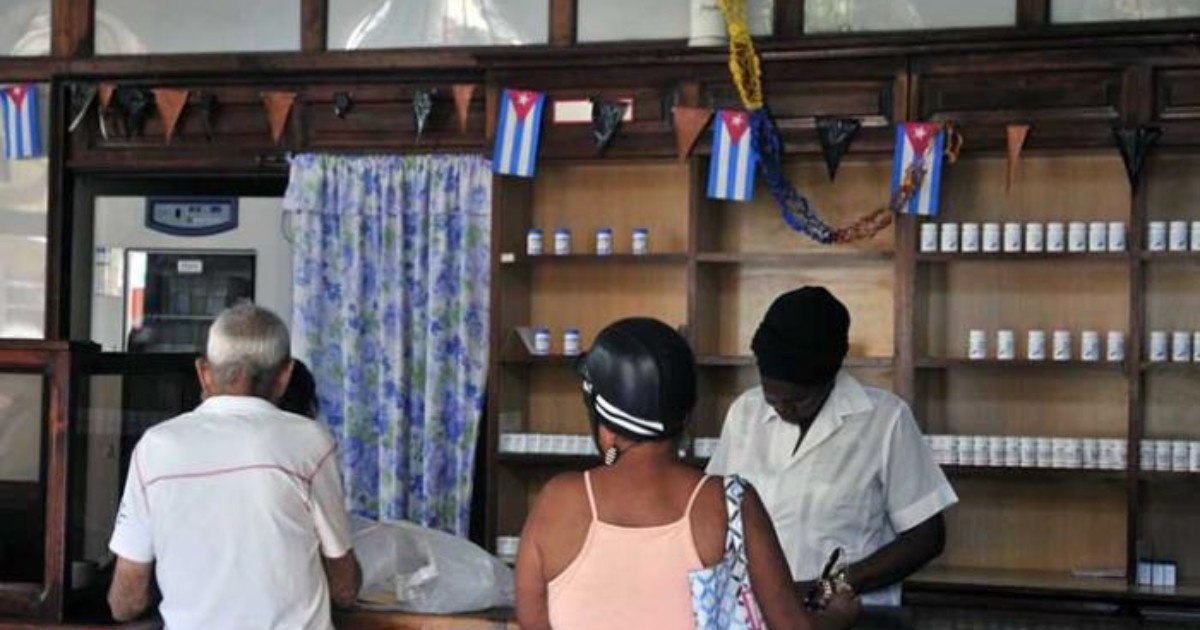
The Cuban government reported that 14 projects for the non-state management of community pharmacies have already received approval to continue their procedures, while three other proposals are in the process of establishment.
According to Granma, Cristina Lara Bastanzuri, national director of Medications and Medical Technologies at the Ministry of Public Health (Minsap), explained at a press conference that authorities are evaluating a total of 36 projects for the management of community pharmacies through non-state management models.
However, Lara clarified that no pharmacy under this new model has yet begun to provide services to the public.
The measure will allow non-state management systems to operate community pharmacies, provide pharmaceutical services, and market medications and other health-related products.
Establishments must meet specific requirements for the storage and dispensing of medications, in addition to having qualified personnel in charge and responsible for the technical activity.
The authorities also clarified that the locations currently operating as state community pharmacies will not be leased for this purpose.
Those facilities will continue to be managed by the state and will provide the services that correspond to them, as specified in the official report.
Imports will continue to go through state-owned companies
Although the pharmaceutical activity is opened up to private businesses and other non-state actors, the importation of medications will continue to be channeled through entities authorized by the State.
"All imports must go through the two importers we have, which are Medicuba, from the Ministry of Public Health, and Farmacuba, from the Cuban pharmaceutical industry," Lara explained.
According to the official, both companies have prepared services to assist new managers at various stages of the process, including supplier identification and the procedures associated with importation.
They will also be able to use the services of Emcomed, a commercial entity belonging to the pharmaceutical industry, which has a health license, warehouses, transportation, and personnel.
Authorities insisted that these businesses will be subject to health requirements and controls due to the direct impact that the marketing of medications has on the health of the population.
What medications will they be able to sell?
Pharmacies managed by non-state entities will be able to create their own portfolio of medications and health products, but they must comply with the regulations established for this activity.
They will not be able to sell hospital-use medications, products classified as drugs, or others listed in national lists subject to restrictions.
In addition, any medication that is sold must be registered with the Cuban regulatory authority.
The new regulations allow for the initial use of a temporary health registration valid for two years, during which the product's performance can be evaluated and it will later be determined whether to apply for its permanent registration.
The Minsap also prepared a guideline list that includes medications in demand by the population, some of which have inconsistent availability, as well as medical supplies and other health products.
An activity that was prohibited until a few weeks ago
The process is also supported by regulatory backing in Decree 160/2026, which opened pharmaceutical services to private companies, private small and medium-sized enterprises, and non-agricultural cooperatives, an activity that was previously prohibited for the private sector.
The regulation, published on July 28 and in force since August 4, classifies pharmaceutical, optical, care, and rehabilitation services as authorized or conditional activities, subject to state permits and regulations.
The flexibilization is part of a broader package of economic transformations.
In June, the government presented 176 measures to attempt to reactivate the deteriorating Cuban economy, including the expansion of powers for the private sector and the reduction of prohibited activities.
The opening of this market takes place amid a serious shortage of medications affecting the state network.
In August, Miguel Díaz-Canel himself acknowledged that only about 30% of the essential medicines were available in the country.
In that context, numerous Cubans have had to turn to other avenues to obtain medications that they cannot regularly find in state pharmacies.
In August, a place advertised as a private pharmacy in Regla, Havana, displayed medications, vitamins, and natural products priced in the thousands of pesos.
One of the workers then explained that an expansion of the establishment was being prepared and that the project was being "analyzed and authorized" by the authorities.
Related videos:
Filed under: