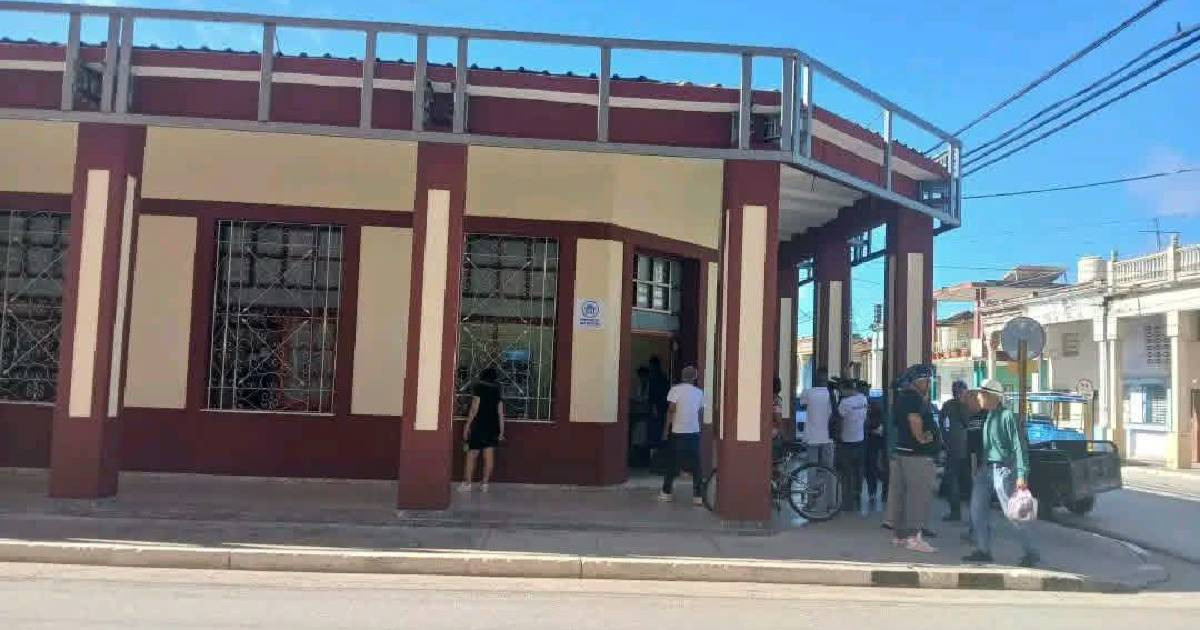
The opening of the El Jupuro establishment, heralded as the first neighborhood market in Ciego de Ávila, was overshadowed by complaints from customers who questioned the limitations on digital payment options and the lack of benefits in pricing.
The establishment, located at the intersection of Carretera Central and Honorato del Castillo Street, reopened as part of the transformations driven by the Cuban government in trade, gastronomy, and services, within axis 19 of the 176 economic measures approved in June.
The provincial station Radio Surco announced on Wednesday the opening as an initiative supported by Resolution 16/2026 of the Ministry of Domestic Trade, which establishes prices that are 15% to 30% lower than those of other businesses and includes the use of Transfermóvil and EnZona for making payments.
However, several buyers expressed their dissatisfaction in the comments of a Facebook post by the official newspaper Invasor. According to their testimonies, payment through electronic platforms was limited to three products, a restriction that calls into question the real scope of one of the conveniences announced for the establishment.
"I went today, and an employee stood at the entrance and said that only three products can be purchased with mobile payments. I assume we’ll be back to the same situation soon," wrote a user.
Another commentator directly questioned the promotion of that payment method. "The payment through electronic platforms is a fraud. A mockery. They limit it to just three products. It's a crude and fraudulent way of making it seem like they accept this method," he stated.
The user Alfonso López Brito also described limitations for purchasing through transfers and questioned how the practice deviated from the concept announced for these markets.
According to a post on Facebook, the information board only displayed one of the scheduled products, while inside the establishment, there was rice, oil, and other essential items.
However, he stated that electronic payment only allowed the purchase of three units, so anyone buying, for example, three packs of rice would have to pay for the rest of the products in cash.
"Why do we conceive, make decisions, and in practice do so in a distorted way?" questioned López, who criticized the launch of an initiative without being prepared to fulfill what had been announced. In his view, El Jupuro ended up being "just another store that pops up every day."
Complaints also highlighted the lack of journalistic verification of the actual service conditions. A customer asked Invasor to visit the establishment to check how digital payments were operating and expressed feeling deceived after visiting the location.
Prices were another reason for discontent. Several users stated that products were sold at prices similar to those at other retail locations, which, in their view, diminishes the advantage of going to the new market.
"The same street prices, 2,500 for the oil and everything else as well, so what’s the benefit?" commented one user. Another noted that, although the establishment accepted transfers, the prices were the same as those on any corner.
Critics question two of the advantages attributed to the neighborhood market model: offering lower prices than other establishments and facilitating transactions through electronic platforms.
However, the comments published by customers do not allow for a determination of whether the reported restrictions were applied permanently or only during the initial days of operation.
The reopening also rekindled questions about the history of the property. A commentator stated that the venue had been closed for nearly 10 years and that the civil works had been completed about five years ago, prompting a request for information regarding the cost of the renovations and the ownership of the establishment.
Other users expressed doubts about the continuity of digital payments due to difficulties in withdrawing cash. For now, the criticism gathered on social media reflects the dissatisfaction of some buyers, while it remains to be seen if the authorities will clarify the mentioned restrictions and how the announced conditions for the market will be applied in practice.
In Cárdenas, Cubans described the initiative as "the same dog with a different collar," while in Cienfuegos, 900 ml of oil was sold for 2,500 pesos, equivalent to 78% of the monthly minimum wage.
In Granma, a user calculated that acquiring one unit of each of the 22 products on the board would cost 12,740 pesos, nearly four times the minimum wage of 3,210 pesos that has been in effect since July.
The economist Javier Pérez Capdevila estimates that a person needs approximately 96,000 pesos per month to cover their basic needs, which is almost thirty times the minimum wage.
By October 8, the national network of neighborhood markets had reached 47 establishments across the country, since the pilot program began on July 23 in Plaza de la Revolución, Havana.
Related videos:
Filed under: