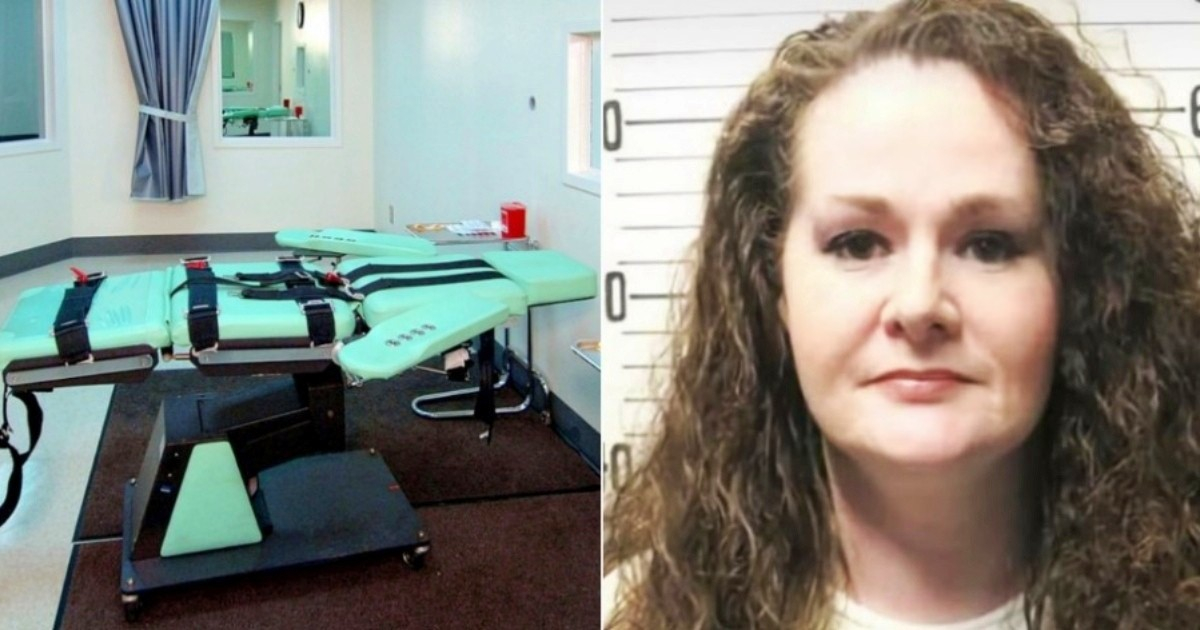
Christa Pike, the 50-year-old woman who survived a lethal injection in Tennessee after receiving two doses of pentobarbital, was discharged from the hospital this Saturday and returned to prison.
Her recovery, after being unconscious for several days and suffering serious injuries, opens an unprecedented legal battle over whether the United States can attempt to execute her again.
Her lawyers, Luke Ihnen, Randy Spivey, Stephen Ferrell, and Kelly Gleason, confirmed that Pike returned to the Debra K. Johnson Rehabilitation Center, the prison where she has been incarcerated for over three decades.
“She is grateful to the emergency services and her medical team for the care provided in these extraordinary circumstances,” the lawyers stated in a statement released on Saturday.
The woman continues to receive medical attention within the correctional facility, while her legal representatives monitor her recovery and any potential physical and psychological aftereffects of the procedure.
The case has sparked enormous controversy in the United States, not only due to the circumstances of the botched execution, but also because, according to the Death Penalty Information Center, Pike would be the first known person to survive an attempt at lethal injection after the drugs were administered to him.
An execution that lasted for more than an hour
On September 30, 2026, Christa Pike was taken to the execution chamber in Tennessee to carry out the death sentence imposed for the murder of Colleen Slemmer, a 19-year-old woman.
According to the case background, Pike was strapped to a gurney at 7:27 PM. Before the procedure began, she spoke a few words that seemed to express resignation to her fate.
"I am going to leave this world in the same way I spent most of my life: with love. I am at peace, I am ready to be free. This is a happy day," she declared.
However, what should have been an execution by a lethal dose of pentobarbital turned into a prolonged and painful procedure.
Prison officials had difficulty establishing intravenous access. According to attorney Randy Spivey, who witnessed the events, there were at least seven attempts to insert needles.
Shortly after receiving the first dose, Pike began to complain of intense burning in his arm and asked if that sensation was normal.
"Please, try it higher up, on my shoulder," she requested.
The witnesses observed that he was lifting his head, groaning, and moving his legs. The journalist Catherine Sweeney from the WPLN broadcaster later described the scene with a powerful phrase: "None of that was normal."
Due to the lack of the expected result, those responsible for the procedure administered a second dose of pentobarbital. Pike lost consciousness but continued to breathe.
"It lasted a very long time," Spivey recounted, describing her client as a survivor.
Finally, the authorities interrupted the procedure and requested emergency medical assistance. The woman was taken to a hospital in Nashville, where she began an unexpected fight for her life.
He was unconscious for several days and awoke when the worst was feared
Pike's health condition during the first few days was extremely serious.
Her lawyers reported that she remained unconscious, intubated, and connected to a ventilator. She also suffered severe injuries to both arms, related to attempts to establish intravenous access and the administration of medications.
Initially, there were fears that he had suffered irreversible brain damage.
However, on October 7, an unexpected change occurred: Pike woke up and began to speak.
“To everyone’s surprise —including mine, her legal team, and the medical team— Christa woke up and started talking,” Spivey stated.
His first questions were: “Where am I?” and “Who are you?”.
In the following days, the condemned began to eat again and to walk with assistance.
His lawyers also reported a gradual recovery of mobility in his arms, although the injuries remained concerning.
The woman had experienced complications such as pneumonia, a blood clot, severe inflammation of the extremities, and episodes of mental confusion.
Stephen Ferrell, another of her lawyers, explained to the BBC that Pike could move around her room, but she still had cognitive difficulties.
"It's quite good, but also somewhat confusing. She can easily lose her train of thought and forget where she was going," he stated.
Although he was finally discharged from the hospital, his defense warns that it is still too early to determine if he will experience permanent consequences.
Why was Christa Pike sentenced to death?
The story of Pike dates back to January 1995, when he was 18 years old and participated in the brutal murder of 19-year-old Colleen Slemmer, a fellow participant in the Job Corps training program in Knoxville, Tennessee.
According to judicial records, Pike, her then-boyfriend Tadaryl Shipp, and a third student took Slemmer to a wooded area near the agricultural campus of the University of Tennessee.
There, the young woman was subjected to a prolonged assault. They beat her, injured her with a cutter, and etched a pentagram on her chest. Finally, Pike threw a piece of asphalt at her head.
Jealousy was identified as the motive for the crime.
Pike was sentenced to death in 1996, while Shipp, who was 17 years old at the time of the murder, received a life sentence without the possibility of parole.
Had the execution in September been carried out, Pike would have been the first woman executed in Tennessee in over 200 years.
His lawyers had warned about the risks of lethal injection
Before the execution, the defense had warned that Pike's medical conditions could complicate the procedure.
The woman suffers from thrombocytosis, a blood disorder that, according to her lawyers, could hinder venous access and increase the risk of suffering during the administration of medications.
In August 2026, their representatives requested alternative methods of execution, including hanging and a firing squad composed exclusively of women.
They argued that the presence of male staff could reactivate traumas related to sexual abuse experienced during their childhood.
The applications were rejected.
The hypothesis proposed regarding the failure of the injection is that some of the pentobarbital may have accumulated in the tissues instead of properly entering the bloodstream. However, this explanation does not constitute a definitive conclusion of the investigation.
The Tennessee Department of Corrections stated that its officials followed the established protocol.
Can Tennessee attempt to execute Christa Pike a second time?
This is now the main judicial uncertainty.
The Republican governor of Tennessee, Bill Lee, ordered an independent investigation into what happened and postponed the pending executions for the remainder of 2026.
However, that decision does not mean that Pike's death sentence has been overturned.
“The state has made no promise that Mrs. Pike will not be executed in the future,” warned attorney Luke Ihnen during a court hearing in Nashville.
The defense argues that a second attempt could violate constitutional protections against cruel and unusual punishments and raise issues related to the prohibition of double jeopardy.
Robert Dunham, an expert in death penalty policy, highlighted a key difference to CNN regarding other cases of botched executions.
"Christa Pike is the only case in which the chemical substances for the lethal injection were injected," she explained.
In other interrupted procedures, the officials did not properly establish the intravenous lines before administering the medications.
One of the most well-known precedents is that of Willie Francis, a teenager who survived an execution in the electric chair in Louisiana in 1946. The U.S. Supreme Court allowed a second attempt, which resulted in his death.
Nevertheless, Pike's lawyers could argue that his situation is different because the state introduced the substances intended to cause his death.
Judge I'Ashea Myles of the Davidson County Court of Equity ordered the preservation of evidence related to the failed procedure, including medical materials, communications, and records.
The victim's family continues to demand justice
While Pike's lawyers are trying to prevent a new execution, Colleen Slemmer's family continues to demand that the sentence be carried out.
May Martínez, mother of the victim, traveled from Florida to Nashville to witness the execution on September 30.
After learning about the failure of the procedure, he expressed his frustration with the authorities in Tennessee.
“All I wanted was justice”, he declared.
The controversy has also reached state politics.
Republican Senator Marsha Blackburn, a gubernatorial candidate, defended the reinstatement of the electric chair as an alternative for carrying out capital sentences.
"The answer is simple: the electric chair should be reinstated and justice should be served quickly for these victims," he wrote on X.
On the contrary, Democratic candidate Jerri Green expressed her intention to impose a moratorium on executions.
Experts believe that the case could set an important precedent for the future of the death penalty in the United States.
What will happen now with Christa Pike?
Currently, Pike remains incarcerated and under medical care. Her hospital discharge marks a significant improvement, but it does not mean that she has fully recovered from the injuries sustained during the failed execution.
His legal team remains concerned about potential neurological damage, memory difficulties, and the psychological trauma of having undergone a procedure intended to end his life.
The next steps will depend on both the results of the investigation ordered by the governor and the decisions of the courts, as well as a possible executive intervention to commute his sentence to life imprisonment.
The defense insists that Pike has already endured extraordinary suffering and that subjecting her to another execution would be constitutionally questionable.
Meanwhile, the state of Tennessee is facing questions about the operation of its lethal injection protocol and the accountability of the officials involved in the procedure.
Related videos:
Filed under: