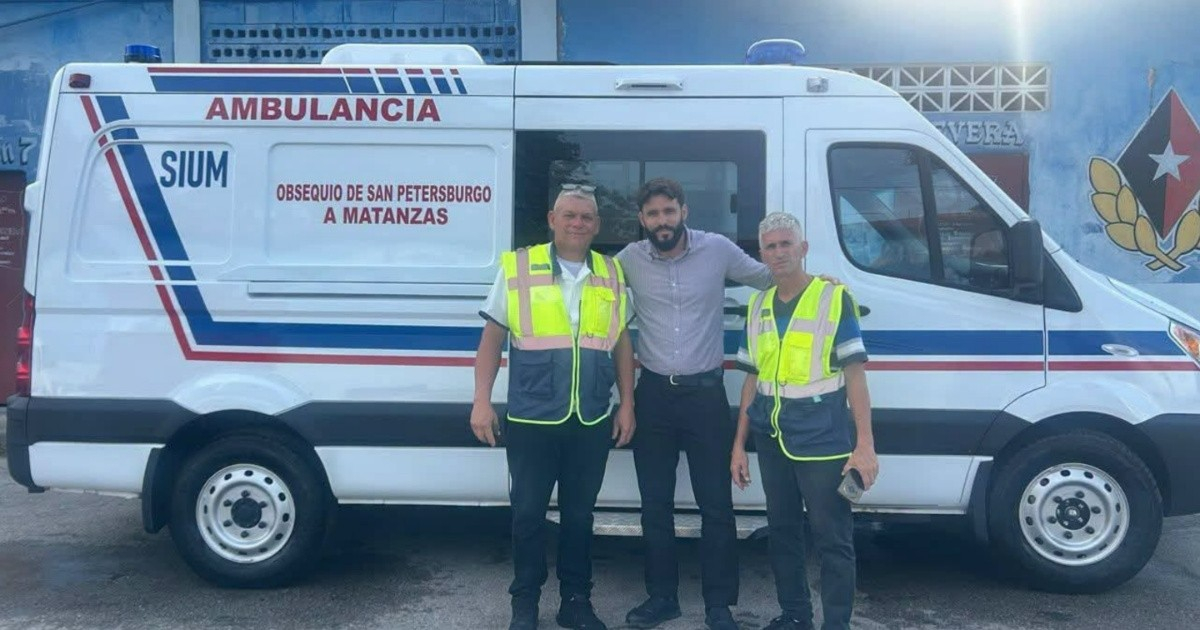
The province of Matanzas received a new high-tech ambulance, delivered by the Russian Embassy in Cuba as a donation from the governor and the people of Saint Petersburg, as part of the sister city relationship between both cities, as reported by the newspaper Girón.
The vehicle, bearing the inscription "Gift from Saint Petersburg to Matanzas," will be integrated into the Provincial Integrated Emergency Medical System (SIUM) and will primarily be allocated to the Maternal and Child Health Care Program, prioritizing newborns, critically ill pregnant women, and children.
The donation was finalized as a result of the agreements reached during the official visit of the governor of St. Petersburg, Aleksandr Beglov, to Cuba in November 2025, when he committed to send three ambulances for Havana, Matanzas, and Santiago de Cuba. The vehicles physically arrived on the Island in August 2026 through the port of Mariel, and the official delivery took place on October 4 in Havana.
The governor of Matanzas, Marieta Poey Zamora, announced the news via her social media and expressed that "the people of Matanzas are grateful for such a valuable gesture in benefit of the residents of Matanzas."
Doctor David Lima González, head of Emergencies and Urgencies for the province, described the vehicle's equipment as typical of the "first world" and detailed its purpose: "The aim of this ambulance will be to support the Maternal and Child Care Program, with a focus on critically ill children, neonates, and pregnant women. Additionally, it will facilitate the transfers from the provincial maternity hospital to the Faustino Pérez hospital, where critically ill mothers receive intensive care."
The head of the regional ambulance base, Yusbier González Morales, emphasized the technical capabilities of the vehicle: "It has excellent features and high-tech equipment, such as ventilation systems and cardiac monitoring. Additionally, it is equipped with a camera system that allows specialists located in other centers to reassess the patient in real time, evaluate what is being done, or determine what procedures are necessary."
The unit also includes refrigerated support for blood and neonatal fluids, three specialized cases—for air transport, cardiopulmonary resuscitation, and care for newborns and mothers—, a spinal board, cervical collars, and a sink for invasive procedures.
The arrival of this ambulance contrasts with the severe crisis facing the emergency system in Matanzas. Lima González revealed that out of an initial fleet of 54 ambulances, the province only has 20 vehicles, of which only 14 are operational: "That represents 29.6% of what we can provide to the population," the specialist admitted, noting that six units remain out of service due to engine failures.
This reality is framed within a national deficit acknowledged by the regime itself: the Ministry of Public Health admitted in 2023 that Cuba covered only 39.6% of the necessary ambulances, a situation worsened by fuel shortages and prolonged blackouts. In January 2026, the SIUM of Santiago de Cuba reported that there were no ambulances available, and in April, a man died after waiting more than four hours for a unit in that same province.
This delivery is part of a sustained pattern of healthcare cooperation between St. Petersburg and Matanzas. In December 2025, the José Ramón López Tabrane Maternity Hospital received medications and food for newborns; in May 2026, a new donation of medications arrived at the same facility; and St. Petersburg also provided telemedicine equipment for the Gastroenterology service at the Faustino Pérez Hospital. According to data collected by the Girón Newspaper, the regional ambulance base in Matanzas conducts an average of 700 transfers per month, of which more than 80% are for emergencies, including between 10 and 15 transfers of critical maternity cases and between eight and 10 transfers of critical newborns each month.
Russia also donated three ambulances and a Lada car to a health center in Havana on October 4, at a ceremony presided over by the Russian ambassador Víctor Koronelli.
Related videos:
Filed under: