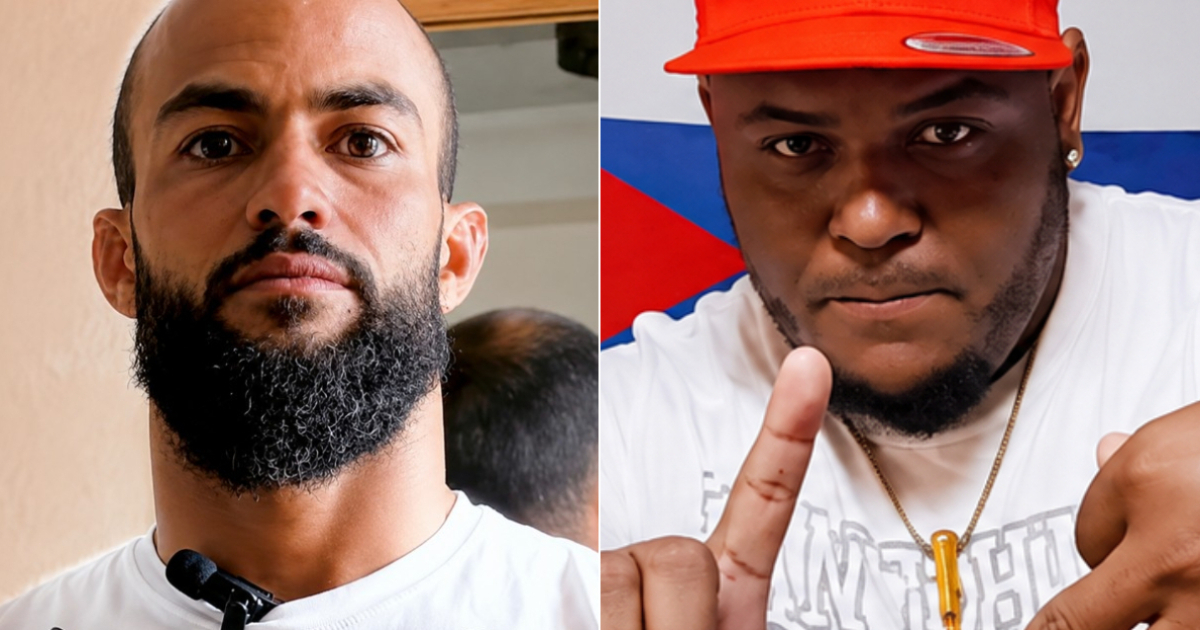
The Cuban regime has accumulated criminal charges against Javier Ernesto Martín Gutiérrez, the athlete known as the Cuban "Spiderman," while keeping him in provisional custody without a trial date since April.
According to his partner's report to Martí Noticias, the authorities added two new charges —contempt and propaganda against the constitutional order— to the original charge of public disorder.
What worsens the situation is that the charge of contempt had been dropped at the beginning of the process due to a lack of evidence to support it. "It was proven that he had not committed any contempt, and it turns out that they are imposing it on him again," denounced Lisandra Cuza, the athlete's partner.
The defense became aware of the new charges in mid-September through a court document that rejected a request for judicial review. "They obviously denied the judicial review, but we were alarmed because two more charges had been brought against him," Cuza explained.
The defense attorney has also been unable to access the file. When he went to Villa Marista—home of State Security—to consult it, he was told that "it had not yet been sent, that it was still at the court."
Martín Gutiérrez, 34 years old and a mixed martial arts champion, was arrested on April 24 after peacefully protesting from the balcony of his home in the Marianao municipality of Havana, where he criticized the prolonged power outages and the social crisis.
During the arrest, he reported that about ten State Security officers beat him before subsequently transferring him through the sixth police unit of Marianao, Villa Marista, and finally to Combinado del Este, a maximum-security prison where he is currently held.
In August, according to research by Diario de Cuba, the athlete sent a letter to the prosecutor reporting that the toxicological tests, mental health evaluations, and investigations into alleged foreign financing came back negative during the 22 days of inquiry; nonetheless, he was sent to provisional prison.
In July, he had warned that he would go on a hunger strike if a date for his trial was not set within six months.
MC K-Libre: sick, imprisoned, and with no trial in sight
In parallel, the rapper Andrés Matos Alcántara, known as MC K-Libre, remains in the 1580 penal facility in Havana with no trial date and serious health problems: he suffers from chronic obstructive pulmonary disease (COPD) and type 1 diabetes, and in September, there were reports of episodes of hypertension during his imprisonment.
The authorities denied a new request for a change of precautionary measure — the second rejection, following another in July — and notified the family of the decision on Tuesday.
The musician Raudel Collazo, known as Escuadrón Patriota, publicly denounced: "They are being particularly cruel with his case for being very critical of the dictatorship from Cuba; that is his main offense, as the regime has nothing else against him."
Matos was arrested on June 25 when he attended a police summons at the Siboney unit in the Playa municipality, where he was handcuffed and taken away without being shown an arrest warrant. The authorities link him to the noise protests and demonstrations in the Barbosa neighborhood, sparked by blackouts lasting over 30 hours. His wife, Ariacna Garcés Gómez, denied that he had organized or incited those protests.
Both cases are part of a documented escalation of repression throughout 2026.
The Cuban regime maintains a historic record of 1,372 political prisoners, including 40 minors and 158 women, according to Prisoners Defenders.
Among the most recent cases are Anna Bensi and her mother, sentenced to two years of restricted freedom for recording a MININT agent, and the founders of El4tico, against whom the Prosecutor's Office requested up to 10 years in prison for propaganda against the constitutional order.
Anonymous sources from the Cuban penal system consulted by Diario de Cuba revealed that in cases classified by the regime as "sensitive"—when the defendant has publicly questioned the government or participated in protests—"pretrial detention far exceeds the precautionary role assigned by law, becoming a mechanism for neutralization, process control, and preemptive punishment".
Related videos:
Filed under: