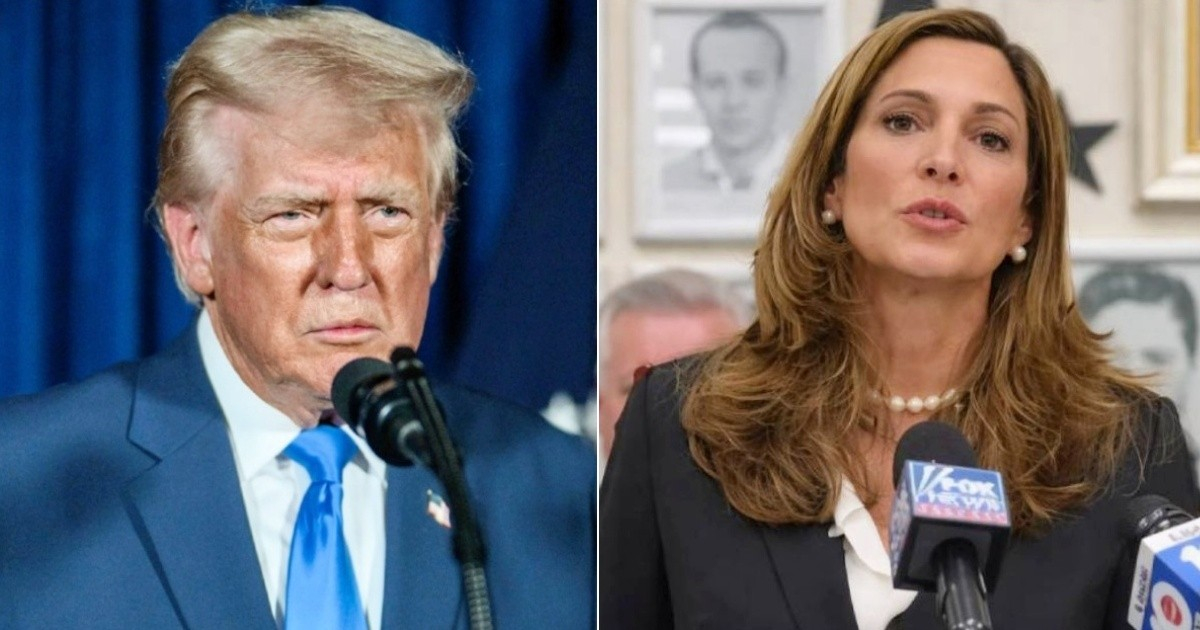
The Republican congresswoman María Elvira Salazar stated this Thursday that President Donald Trump will sign a law to regularize certain immigrants before the end of his term, and that Cuba will be "without the Castros" when the president leaves the White House.
Salazar made these statements in response to questions from the agency EFE during an event of Miami's Community News at Casa Cuba, amid her campaign for reelection in Florida's 27th District, one of the most competitive races in the upcoming November 3 elections.
"It's easy, the president understands it, but I know that this is being discussed and that in the next two years, before the president leaves the White House, there will be an immigration reform that will resolve a 40-year problem. If anyone can do it, it's Trump, you all know him," stated the legislator of Cuban descent.
The proposal that Salazar advocates is the Dignity Act, a bipartisan project that he reintroduced in July 2025 alongside the Democrat Veronica Escobar, aimed at regularizing immigrants without criminal records who work in construction, agriculture, health, hospitality, and food.
"There is legislation, which is the Dignity Law, that I am presenting, which is a compromise; it doesn't grant citizenship, but at the same time, it allows them to remain with a 'Dignity' visa," explained the congresswoman.
Salazar also argued that 20% of the U.S. GDP depends on five industries that, in turn, require labor-intensive work, much of which is undocumented.
As of now, the Dignity Act has 40 co-sponsors in Congress—20 Republicans and 20 Democrats—and more than 100 endorsements from organizations, but it remains stalled in committee without having been put to a full vote. The newspaper Miami Herald noted in September that the bill has little chance of becoming law.
The statements made this Thursday mark a notable shift in Salazar's tone compared to previous weeks. In September, the congresswoman recorded a video in front of the White House in which she accused Trump of going "too far" with mass deportations and warned that Hispanic voters "feel betrayed."
Trump then responded by maintaining his formal support for the congresswoman, but not hiding his displeasure: "Maria won only thanks to me", the president stated, adding that she "has become a bit softer on the border." The Department of Homeland Security also responded sharply, reaffirming that "there will be no amnesty."
Now, less than three weeks before the elections, Salazar steps away from confrontation and presents Trump as the only one capable of driving a historic immigration reform, in an attempt to reconcile his moderate stance with the presidential support he needs to retain his seat.
Her Democratic rival, Eliott Rodríguez, a former host of CBS Miami and the son of Cuban parents, is currently tied with her at 45%, according to an internal poll, although the Decision Desk HQ model estimated on Wednesday a 76% probability that Salazar will retain the district.
District 27, where 73.5% of the residents are Hispanic and more than half were born outside the United States, places immigration policy at the core of a campaign that will be decided on November 3rd.
La posible regularización de inmigrantes y otros cambios migratorios en EE.UU. siguen en constante evolución. Mantente al tanto de todo lo que ocurre en nuestra sección de
Related videos:
Filed under: