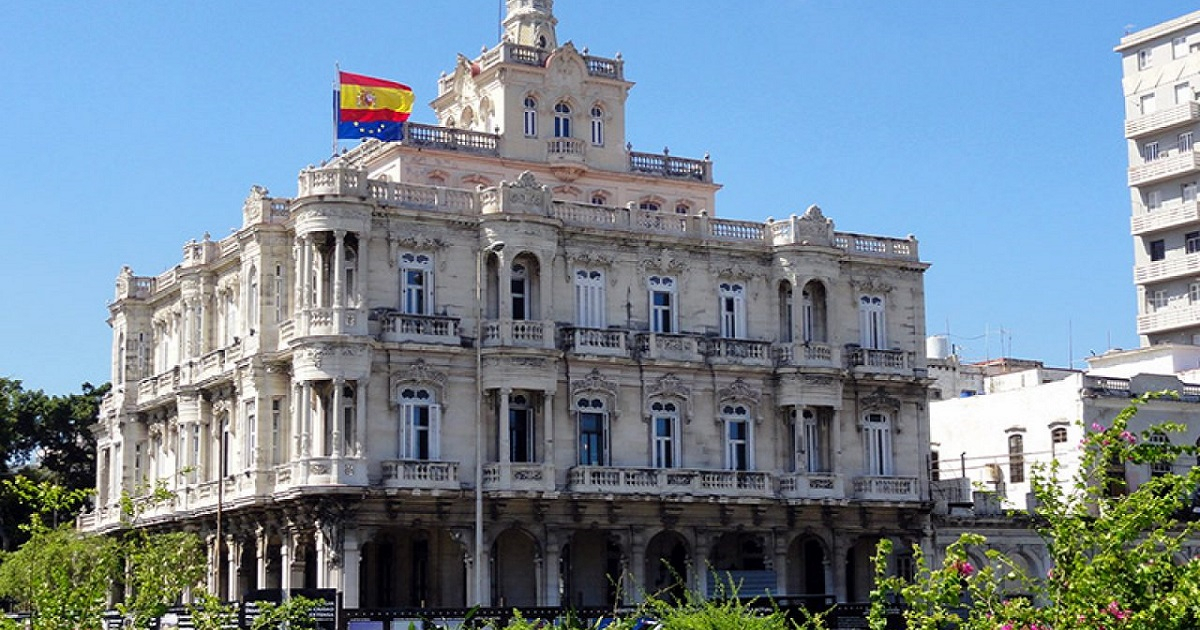
The Spanish union Manos Limpias reported nine consuls of Spain stationed in Cuba, Mexico, Argentina, and Venezuela for alleged irregularities in the granting of nationalities under the Democratic Memory Law, known as the Grandchildren's Law, and requested that the Anti-Corruption Prosecutor's Office investigate potential crimes of document forgery and administrative malfeasance.
In an official statement, the organization, led by Miguel Bernad Remón, explained that the document points to the consular officials in Havana, Cuba; Buenos Aires, Bahía Blanca, Córdoba, and Rosario, in Argentina; Mexico City, Monterrey, and Guadalajara, in Mexico; and Caracas, in Venezuela.
The complaint states that numerous Spanish nationality files may have been approved using only photocopies, without the necessary verifications to confirm the authenticity of the documents and compliance with legal requirements.
It also questions the acceptance of documentation related to emigrations prior to July 18, 1936, the date from which an administrative instruction from 2022 establishes a presumption of exile for certain applicants.
According to Manos Limpias, these actions could constitute offenses outlined in articles 390, 391, and 404 of the Spanish Penal Code.
The union requests that the nine consulates submit all approved nationality files related to the law of grandchildren and the questioned administrative instruction to the Prosecutor's Office.
The organization intends to determine which documents were submitted, how they were verified, and which officials authorized the concessions.
They question a directive that expanded access to Spanish nationality
One of the main arguments of the complaint is directed against the instruction approved on October 25, 2022, by Sofía Puente Santiago, who was then the Director General of Legal Security and Public Faith.
The provision developed the application of the Law of Democratic Memory and established, among other aspects, that the status of exiles would be presumed for Spaniards who left their country between July 18, 1936, and December 31, 1955. However, this presumption does not eliminate the obligation to provide documentary evidence of leaving Spain during that period, as stipulated by the directive itself.
Manos Limpias believes that this interpretation allowed for broader access to nationality beyond what is stipulated in the law and questions whether consular officials granted citizenship without adequately verifying the requirements.
However, the instruction itself published in the Official State Gazette outlines various cases for obtaining Spanish nationality by descent. Therefore, the existence of family documents prior to 1936 does not, by itself, demonstrate that a grant was irregular.
The Spanish newspaper The Objective, which revealed the details of the complaint on Tuesday, noted that the union also questions the mass processing of applications in consular offices that may have been overwhelmed by the number of requests.
The complaint does not, by itself, confirm the commission of crimes, and so far, there has been no public confirmation of the initiation of criminal proceedings against the officials mentioned.
What could happen to Cubans who requested Spanish nationality?
The inclusion of the Spanish Consulate General in Havana directly impacts the process for thousands of descendants of Spaniards in Cuba who have turned to the Law of Democratic Memory to obtain citizenship.
However, the complaint does not entail the automatic annulment of the nationalities already granted nor does it establish a general suspension of pending cases.
It has also not been announced that Cubans who were naturalized under this legislation must repeat their procedures or resubmit their documents as a consequence of the complaint.
According to the current instructions from the Consulate of Spain in Havana, the deadline to request appointments under the Democratic Memory Law ended on October 22, 2025.
However, those who requested an appointment within the timeline and received a valid justification will be able to obtain their credentials to choose a date and submit the documentation in person, according to the established procedure.
The complaint coincides with the restrictions on voting for Spanish nationals by naturalization
The complaint comes after the Spanish Supreme Court upheld a precautionary measure that affects the voting rights of 163,020 citizens who were nationalized under the grandchildren's law and are registered in the electoral roll of residents abroad.
The resolution, related to the general elections on November 29, includes exceptions for those who can provide documentation proving that they meet the legal requirements.
This Wednesday, October 14, the Spanish Ministry of Foreign Affairs warned that the implementation of precautionary measures could lead to "paradoxical" situations, such as Spanish citizens who voted in previous elections now likely being unable to do so.
According to information from the EFE agency, the department led by José Manuel Albares stated that it complies with the court decision with the "utmost diligence," although it acknowledged the difficulties it poses for many consular offices.
The electoral restriction is a judicial measure that is distinct from the complaint filed by Manos Limpias, and it does not, in itself, imply the loss of Spanish nationality for the affected citizens.
Related videos:
Filed under: