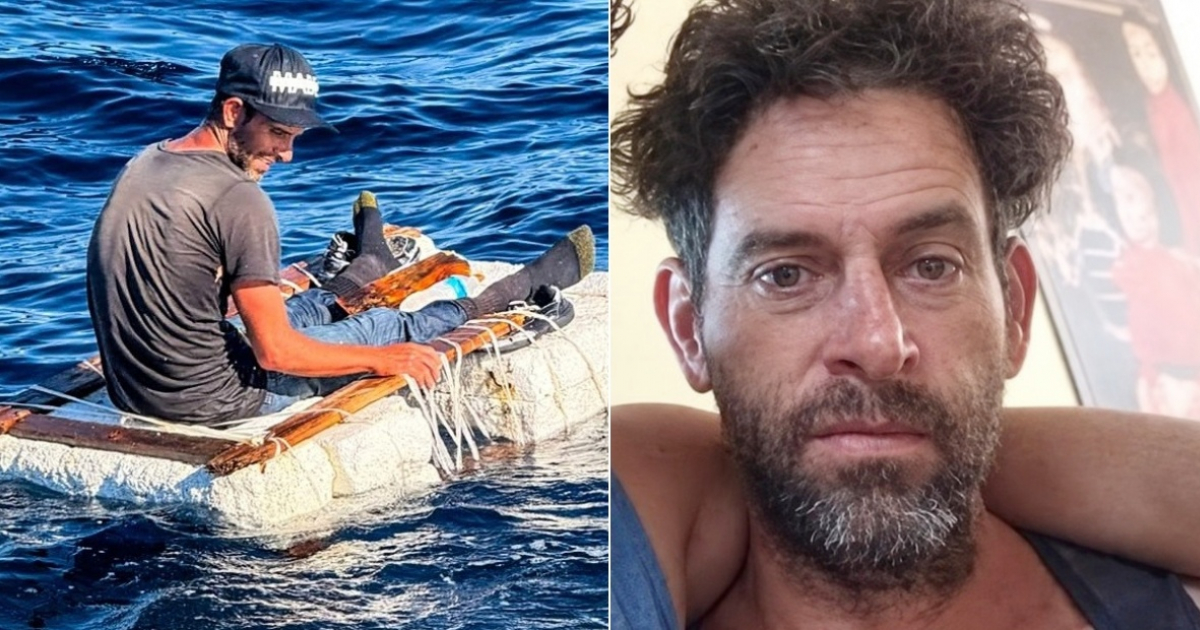
The Cuban Enrique René Reyes Martínez, 38 years old, recounted how he managed to survive several days adrift in the Florida strait, clinging to a small improvised raft, without water or food, surrounded by sharks and facing waves of up to three meters.
He assures that his greatest motivation to not give up was the hope of seeing his daughter and family again.
In a telephone interview granted from Havana to journalist Univision 23, Javier Díaz, after being rescued off Key Biscayne and repatriated to Cuba, the survivor described the extreme conditions he faced and the moments when he feared for his life.
“I survived because I wanted to see my family again, my daughter... Those were the things that kept me alive, and I always thought that no, I was not going to die in the sea,” he confessed.
Reyes Martínez clarified that he never intended to leave Cuba and ended up at sea after going fishing from Cojímar, in Havana, on Thursday, October 8.
“I never intended to leave the country. This was just something that happened to me. It was quite difficult and complicated. I am alive thanks to God because who survives on a little piece of cork like that?”, he expressed.
"I fought day and night against three-meter waves."
The fisherman described the difficulties he faced during the days he spent in the Florida Straits, clinging to an improvised boat that capsized several times.
"I fought day and night against three-meter waves. That little boat of mine turned over, the piece of 'cork' turned over several times. It rained for three days, and I spent three nights under heavy rain and never gave up," he recounted.
Without drinking water or food, he had to endure physical exhaustion, sunburns, and the constant danger of falling into the sea.
The nights were particularly distressing. The darkness made it difficult for him to discern what was happening around him, and the solitude heightened his fear.
“It was dreadful when night fell because it was a wolf's mouth. You couldn't see anything there. You were all alone, hearing voices, as if you were losing your mind,” he recalled.
Despite the conditions, he assured that he never abandoned hope of survival.
He also explained that he did not use oars to move during the journey and that it was the ocean currents that carried him close to Florida.
"My journey was not shaped by rowing; it was driven by the current of the sea, which has always been on my side," he affirmed.
Sharks up to three meters below their small raft
One of the most dangerous moments was when he saw sharks swimming beneath the precarious boat.
"I had them beneath me, two-meter and three-meter sharks right below me," he said, referring to the size of the sharks he claimed to have seen.
However, he explained that he never let desperation take over, despite the thirst, hunger, and the presence of sharks.
“I never despaired. I never lost confidence in myself. I never went crazy or threw myself into the sea… neither out of thirst nor hunger nor anything else. I never thought of any of that,” he stated.
His goal was to stay on the small support that kept him afloat, even when the waves threatened to tip him over and he had to struggle not to be at the mercy of the sea.
"I thought about seeing my family again, my daughter."
When Javier Díaz asked him what he had thought about during the moments when his life was in danger, Reyes Martínez explained that the hope of being able to hug his daughter again was his main motivation.
“I thought about living. I always thought that I would never stay there, nor that I would die there. I thought about seeing my family again, my daughter, and I always fought for that”, she declared.
The fisherman also credited his survival to his faith and the prayers he offered during the days he spent at sea.
“The Virgin of Charity of Copper was with me because I prayed to her a lot. I also prayed a lot to God to accompany me, to not leave me alone”, he expressed, referring to the Virgin of Charity of Copper, the patroness of Cuba.
"I had no strength to walk" when they rescued him
On Monday, October 12, a couple returning from the Bahamas to Miami spotted the fisherman in the distance and alerted the authorities via the emergency marine channel VHF 16.
Units from CBP Air and Marine Operations and the U.S. Coast Guard participated in the rescue off Key Biscayne, approximately 16 nautical miles east of the coast.
By then, Reyes Martínez was completely exhausted, dehydrated, and sunburned.
"Dehydrated and burned by the sun, and without strength because when they pulled me out of that piece of cork, I didn't have the energy to walk," he explained.
The fisherman was transferred to the coast guard USCGC Melvin Bell, without setting foot on U.S. territory.
During his conversation with Javier Díaz, he expressed gratitude for the attention received from the U.S. authorities following the rescue.
Two days later, on Wednesday, October 14, he was repatriated to Cuba, where his grandmother and aunt were waiting for him.
The first photographs released after his return to Havana showed him thin and with sunburns.
"My daughter almost lost her father."
After surviving the experience, Reyes Martínez stated that he doesn't plan to go fishing again.
“No, I’m not going to go fishing anymore after this. This was a very bad experience, and my daughter almost lost her father,” he confessed.
Although he insisted that his departure was not an attempt to emigrate, he also responded to a question about the risks of leaving Cuba on makeshift boats.
"I don't recommend anyone to do that madness. It's a very difficult and complicated path, where you are putting your life in danger," he warned.
Family versions of his departure from Cuba
Reyes Martínez resides in Havana, although he is originally from the Los Cangrejitos neighborhood in Santiago de Cuba. According to the information initially provided by his family, he had gone fishing from Cojímar to get food for his young daughter.
In the days following his disappearance, various accounts emerged regarding the circumstances of his departure.
His aunt, Yelsa Reyes Fabelo, stated that “he was desperate to leave Cuba, but that was not intentional.” A cousin, on the other hand, maintained that the trip was indeed planned and that Enrique had kept his intentions hidden from the family.
The fisherman himself rejected that interpretation in his interview with Univision 23, insisting that he never intended to leave the country.
The same week of their rescue, the U.S. Coast Guard repatriated another six Cubans after two separate operations in the Florida Straits.
Related videos:
Filed under: