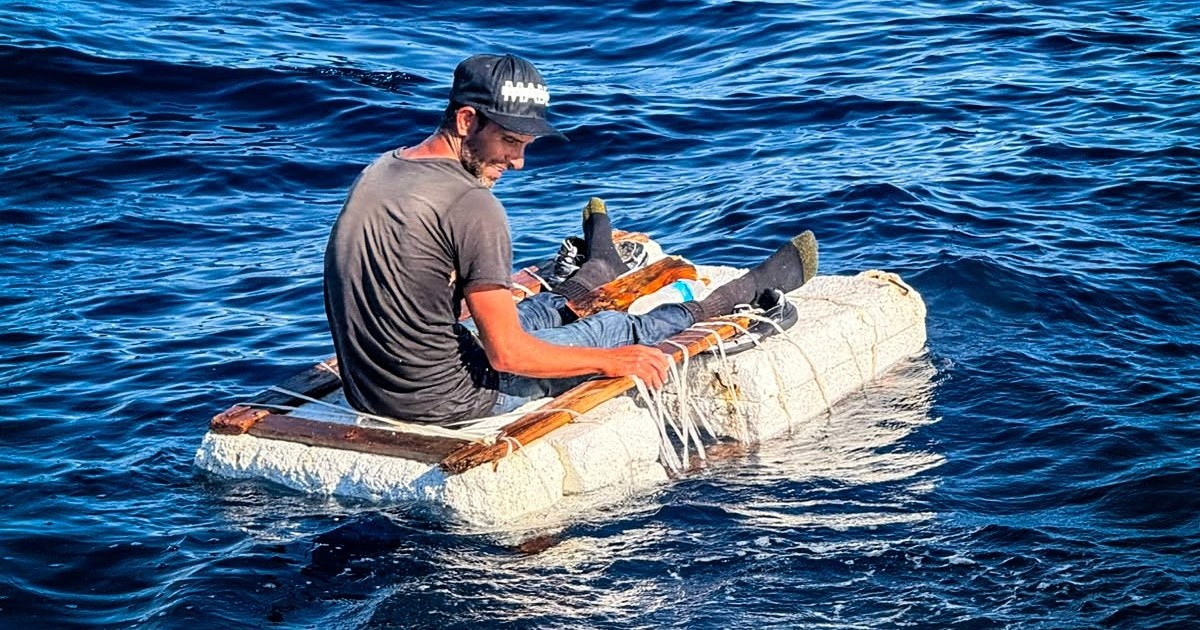
Enrique René Reyes Martínez, the 38-year-old Cuban rescued on Monday about 16 nautical miles east of Key Biscayne, was deported to Cuba this Wednesday, as confirmed by journalist Javier Díaz through his social media, citing the man's own family.
Díaz specified that Reyes Martínez "was always attended to on a Coast Guard vessel and was not taken to a hospital," which means that he never set foot on U.S. soil after being rescued adrift on a makeshift raft made of polystyrene blocks, wooden planks, and ropes.
Originally from Santiago de Cuba and residing in Havana, Reyes Martínez had set off from Cojímar beach on Thursday, October 8, and had been missing at sea for four days when a couple returning from the Bahamas to Miami spotted him adrift and alerted the authorities via the maritime emergency channel VHF 16.
Este caso forma parte de un panorama migratorio en constante cambio. Sigue todas las novedades sobre deportaciones, rescates y políticas fronterizas en nuestra sección de
The rescue involved units from CBP Air and Marine Operations and the Coast Guard, which transported the man to the coast guard vessel USCGC Melvin Bell for his immigration processing.
The relatives of Reyes Martínez provided conflicting accounts regarding the circumstances of the trip when interviewed by Univision.
Her aunt, Yelsa Reyes Fabelo, stated: "He was eager to leave Cuba, but that was not intentional," attributing the journey to an accident during a fishing trip exacerbated by bad weather.
However, a cousin maintained that the trip was indeed intentional and that Reyes Martínez hid his plans from the family to avoid worrying them.
The man is the father of a little girl who remains in Cuba.
Immigration attorney José Guerrero had warned Univision, before the deportation became known, that Reyes Martínez would be subjected to an expedited removal process: "He will be transferred to a detention center and placed in an expedited deportation process because he is a foreign national arriving in the United States, in this case by sea."
Guerrero recalled that the "wet foot, dry foot" policy was eliminated in January 2017, although he clarified that not all migrants intercepted under these circumstances end up being deported.
The incident occurs during a week of intense migratory activity in the Florida Strait: the Coast Guard repatriated six Cubans on Tuesday after two separate operations, and on October 8, the cutter USCGC Raymond Evans rescued three Cuban men southwest of Cay Sal, in the Bahamas, one of whom required specialized medical evacuation.
The gradual closure of legal emigration routes partially explains the increase in dangerous crossings: the Cuban Family Reunification Program closed to new applications in December 2025, and on January 1, 2026, a presidential proclamation took effect, suspending the issuance of immigrant visas for Cubans outside the United States.
Just eleven days before the rescue, the U.S. Embassy in Havana issued a discouragement message with the slogan "Don’t risk your life, it’s not worth it," which generated an avalanche of critical responses from Cubans who pointed out the impossibility of emigrating through legal channels.
Between 2021 and 2026, more than 1.79 million Cubans have left the island in the largest exodus in its history.
Related videos:
Filed under: