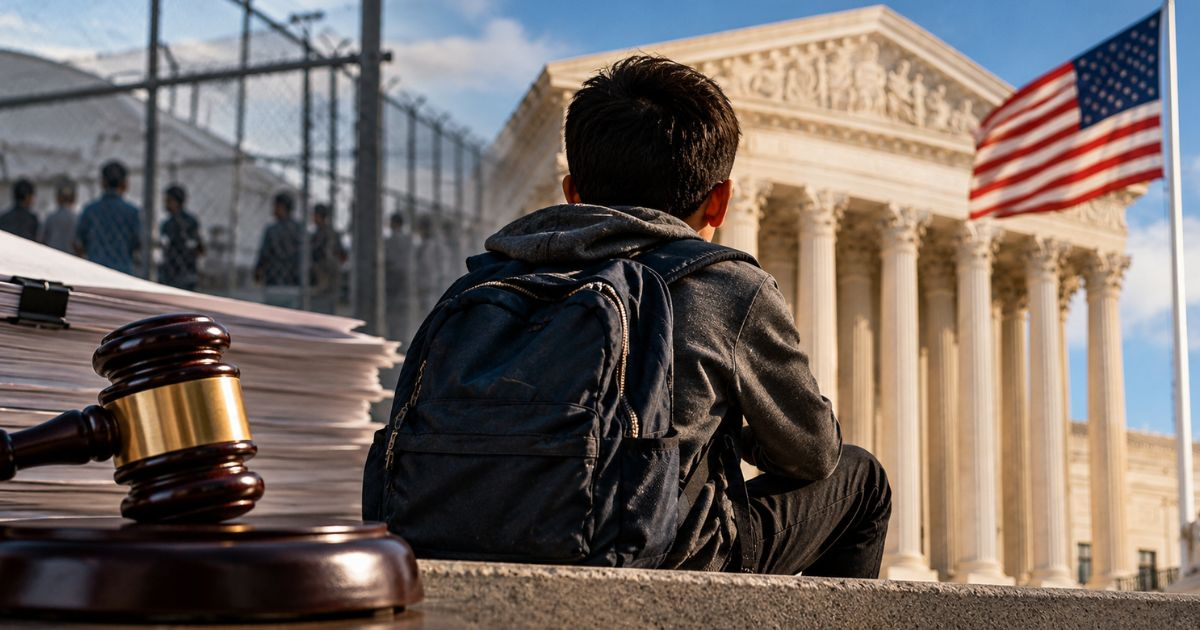
Six organizations providing legal assistance to migrant minors have filed a federal lawsuit against the Donald Trump administration to halt the expedited asylum and deportation processes for children who arrived alone in the United States, as they believe the new government practices hinder them from adequately preparing their protection applications.
The legal action, identified as The Door v. Edlow, was filed on Thursday, October 15, in the Federal Court for the District of Maryland, Southern Division, as confirmed by the National Center for Youth Law.
The lawsuit, registered under case number 8:26-cv-04326-DLB, challenges a series of measures that, according to the plaintiff entities, are undermining the procedural guarantees of foreign minors seeking asylum in U.S. territory.
According to the case summary published by the National Immigration Law Center (NILC), organizations argue that various federal agencies are altering child protection procedures in a way that hinders minors' access to asylum and a fair assessment of their cases.
The filing of the complaint does not mean that a court has declared those practices illegal, nor that the expedited procedures have been suspended. The case is listed as active, and its outcome will depend on the judicial decisions made throughout the process.
What measures does the lawsuit question?
The requesting organizations claim that federal authorities are imposing preparation times and appearance conditions that they consider incompatible with the needs of children and adolescents facing immigration proceedings without the presence of their parents or guardians.
In a statement published on October 15, NILC outlined several of the contested practices:
- To require some minors to submit their asylum applications just a few weeks after arriving in the United States.
- Notify asylum interviews with very little advance notice, in some cases less than 24 hours, according to organizations.
- Change the location or format of the interviews with little notice.
- Require frequent appearances before immigration courts.
- Impose accelerated completion goals for minors' cases under immigration custody.
The plaintiffs believe that these conditions may hinder minors from gathering documents, providing evidence, consulting with their lawyers, and adequately explaining the circumstances that led to their departure from their countries.
They also claim that the government has weakened mechanisms for representation and legal assistance for minors who remain in federal custody.
Six organizations are taking the case to court
The lawsuit was filed by six organizations that work in the defense and representation of immigrants, particularly minors:
- Amica Center for Immigrant Rights, an organization advocating for immigrant rights.
- The Door, an organization that provides legal services and support to youth.
- Florence Immigrant and Refugee Rights Project (FIRRP), dedicated to providing legal assistance to immigrants and refugees.
- Galveston-Houston Immigrant Representation Project (GHIRP), an organization providing legal representation for immigrants.
- Immigrant Defenders Law Center (ImmDef), a specialized entity in immigration defense.
- Jewish Family and Community Services Pittsburgh (JFCS Pittsburgh), an organization that provides community services and assistance to immigrants.
The entities are represented by the National Immigration Law Center, the Center for Gender and Refugee Studies, the National Center for Youth Law, and the Trial Impact Project.
The lawsuit challenges the actions of various federal agencies related to immigration and justice, including the U.S. Citizenship and Immigration Services (USCIS) and the Department of Justice.
Joseph Edlow, director of USCIS, is among the officials being sued and is named in the case.
Why do unaccompanied minors have special protections?
U.S. legislation includes specific safeguards for foreign minors who arrive in the country without a parent or legal guardian available to take care of them.
These protections aim to acknowledge that a child does not confront a migration process under the same conditions as an adult, especially when they must explain circumstances of violence, persecution, threats, or other risks that could justify an asylum application.
The organizations that filed the lawsuit argue that the new federal practices contradict guarantees established by Congress and violate the right to due process.
Among the provisions they invoke are the Trafficking Victims Protection Reauthorization Act, the Immigration and Nationality Act, the Administrative Procedure Act, and the Fifth Amendment to the U.S. Constitution.
The court must determine whether the challenged measures comply with those standards and what judicial remedies, if any, are applicable.
What can change with this lawsuit?
The goal of the organizations is to achieve a court intervention that prevents practices which they claim deprive minors of sufficient time and opportunities to prepare their protection requests.
If the court grants the requested measures, certain administrative actions could be limited or modified. However, that outcome is not guaranteed, and the mere filing of the lawsuit does not automatically alter individual asylum files.
The demand does not equate to a general approval of protection requests, nor does it eliminate the possibility of deportation for minors whose cases are being processed by immigration authorities.
The specific scope of any decision will depend on its content and on the groups or procedures that the court determines to include.
What does it mean for Cuban families in the United States?
The case is of interest to Cuban families who are following changes in U.S. immigration procedures, particularly those with minors who arrived in the country without their parents or guardians and are seeking humanitarian protection.
However, it has not been established that there are Cuban minors among the plaintiffs or that the lawsuit grants automatic protection to children of that nationality.
The importance of the process lies in its challenge to federal practices concerning unaccompanied minors, regardless of whether their countries of origin are Cuba or other nations.
For any individual case, the consequences will depend on the minor's immigration status, the stage of their proceedings, and the decisions made by the competent authorities.
Other recent changes in the care of migrant minors
The judicial controversy arises in the context of changes in the way the U.S. government handles issues related to foreign minors.
At the beginning of the month, it was revealed that the Trump administration would assign federal lawyers to work on cases related to migrant children, through a new structure within the Department of Health and Human Services (HHS).
That measure pertains to the organization of the government's legal services and is different from the lawsuit filed now in Maryland, which challenges the speeding up of asylum and deportation proceedings.
On the other hand, a recent report on the arrests of minors by Immigration and Customs Enforcement (ICE) once again brought public attention to the situation of children affected by the enforcement of immigration policies in the United States.
This report addresses statistics on arrests and does not constitute a resolution or a procedural precedent of The Door v. Edlow.
For now, the news is the opening of a federal lawsuit that seeks to subject the speed at which certain cases of unaccompanied minors are processed to judicial review.
The demanding organizations assert that the pursuit of faster procedures should not deprive children of a real opportunity to seek protection.
The litigation registry of the National Center for Youth Law lists the case as active, without implying that a favorable judgment has been issued for the plaintiffs.
Los casos de asilo y deportación de menores migrantes no acompañados son parte de un panorama migratorio en constante cambio. Sigue toda la actualidad en nuestra sección de
Related videos:
Filed under: