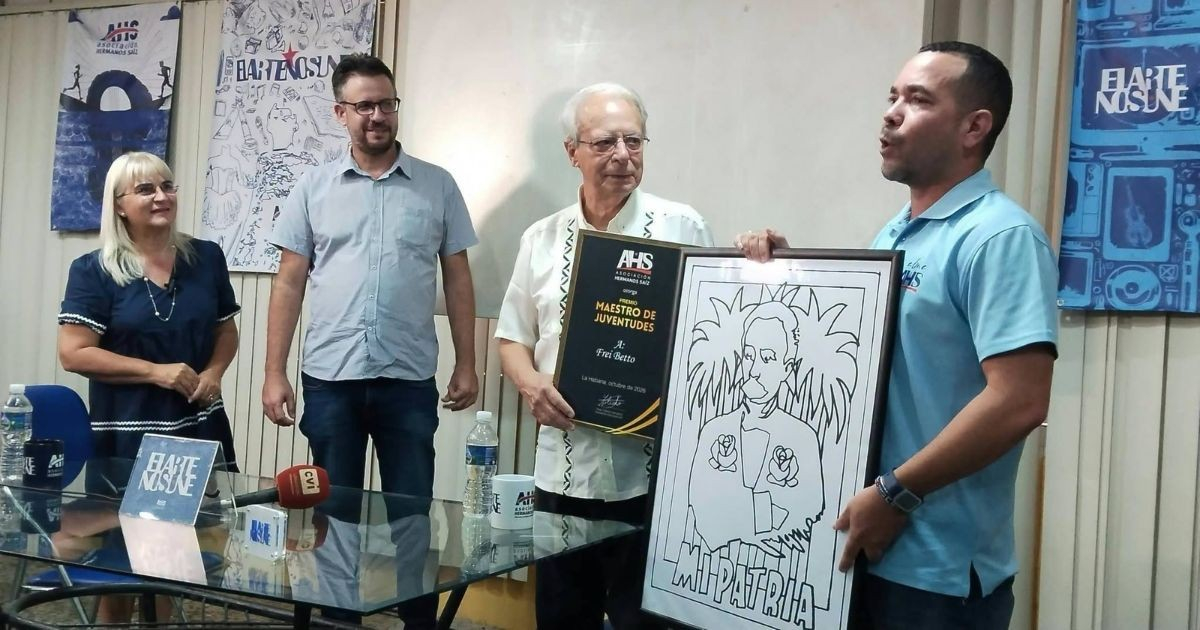
The Hermanos Saíz Association (AHS) awarded its highest honor, the Master of Youth Award, to the theologian and writer Frei Betto, during a ceremony held in Havana that reminds us of the Brazilian intellectual's numerous "controversial" statements about Cuba and its people.
The event is part of the celebrations for the 40th anniversary of the AHS, founded on October 18, 1986. Frei Betto was the only foreigner among the 17 awardees of 2026; the other 16 are figures from Cuban culture, including writer Marilyn Bobes, filmmaker José Ramón Artigas Vázquez, director Orlando Cruzata, writer Jorge Fornet, and actor Dagoberto Gaínza Pérez, according to reported by Prensa Latina. The central anniversary event, which will include the presentation of the other awards, is scheduled for this Saturday at the José Martí Memorial in Plaza de la Revolución.
Yasel Toledo Garnache, president of the AHS, announced the distinction on his social media and described the Dominican friar as "a dear friend of Cuba and a benchmark for the scope of his research and intellectual work, ethics, defense of just causes, and deep humanism." The organization justified the recognition due to Betto's support of the Cuban revolutionary process and his defense of the island in international forums.
However, the name of Frei Betto —the religious name of Carlos Alberto Libânio Christo— carries a long history of statements that have outraged Cubans. In March 2022, during an appearance on Mesa Redonda, he recommended frying potato peels as a snack: "The potato peel, for example, is excellent for snacking when having a drink. Fried, it is outstanding."
In that same intervention, he proposed using melon peels to make sweets, not discarding carrot leaves because "they have great nutritional value," and opening bakeries that sell bread made from cassava, sweet potatoes, or corn.
Months earlier, in December 2021, it was published in the official newspaper Granma that in Cuba "there is no hunger", although Cubans "have a strong appetite," and attributed the food issues to the "bad habits" of the population and the U.S. embargo, not to the regime's management. In that same text, it was noted that "Cubans have eating habits that can easily be changed, such as the preference for wheat bread, an imported cereal."
In June 2024, Betto returned to the Mesa Redonda to invite Cubans to plant “even in the windows of their homes” and mobilize the Committees for the Defense of the Revolution (CDR) to cultivate any available space, in a direct evocation of the practices from the Special Period.
And in February of this year, at a meeting at the CDR Museum in Havana, he urged Cubans to look to Fidel's example of resistance and described Donald Trump as "the great threat to the world."
Frei Betto also serves as an advisor to the Cuban regime for the Food Sovereignty and Nutritional Education Program (SAN), approved in 2020, and has regularly published in Granma. In 2019, he wrote in that newspaper that those who emigrate from Cuba are individuals “contaminated by the propaganda of capitalist consumerism” and that on the island “there has never been a popular manifestation” opposing the Government.
The awarding of the prize contrasts sharply with the reality faced by millions of Cubans: prolonged blackouts, chronic food shortages, inadequate salaries, and a massive exodus considered the largest in the country's recent history. On social media, over the past few years, hundreds of users have questioned the disconnect between the Brazilian intellectual's discourse and the daily experiences of the population.
His advice about potato peels is an almost caricatured symbol of that gap.
Related videos:
Filed under: