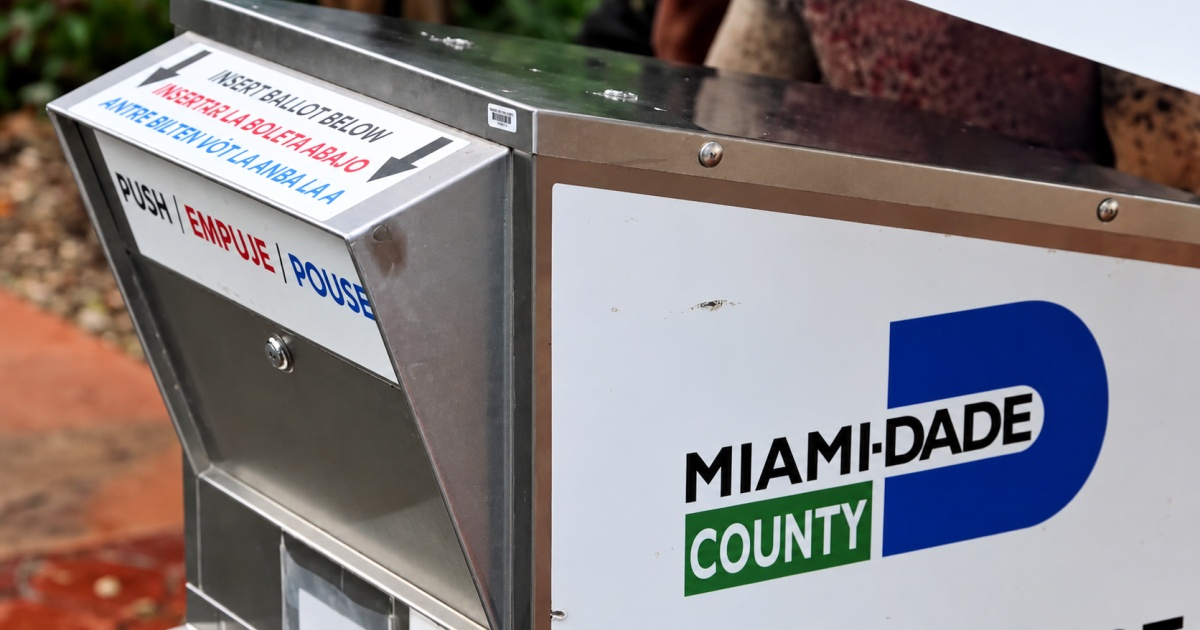
The early voting in Miami-Dade for the general elections on November 3, 2026 begins this upcoming Monday, October 19, and runs until Sunday, November 1, with 28 designated centers throughout the county, open daily from 7:00 a.m. to 7:00 p.m., according to the official statement from the Supervisor of Elections.
For the Cuban-American community in Hialeah, Doral, Westchester, Kendall, and Little Havana, this guide encompasses the essentials for voting smoothly.
When and where to vote early?
During the early voting period, any registered voter in Miami-Dade can go to any of the 28 county centers, regardless of their assigned precinct.
That flexibility disappears on election day: on Tuesday, November 3, each voter must appear exclusively at the polling place indicated on their voter information card.
Some locations have been temporarily relocated, so it is advisable to check the updated address at votemiamidade.gov before leaving home.
Among the available locations are the John F. Kennedy Library (190 W 49th Street, Hialeah), the International Mall Library (10315 NW 12th Street, Doral), the West Kendall Regional Library (10201 Hammocks Boulevard), the Westchester Regional Library (9445 SW 24th Street), and the main Election office (2700 NW 87th Avenue, Doral).
Critical date: October 22 at 5:00 p.m.
Those who prefer to vote by mail have until Thursday, October 22 at 5:00 p.m. to request their ballot; the deadline has no exceptions: the postmark of that date is not enough, the request must arrive at the office before that time.
Mail-in ballots that have already been received can be returned at any early voting location between October 19 and November 1, or at the Doral location or the Stephen P. Clark Center (111 NW 1st Street, Downtown Miami) until 7:00 p.m. on November 3.
What to bring and who can vote?
To vote in person, a valid identification with a photo and signature is required: Florida driver's license, state identification card, U.S. passport, military, student, or government employee IDs, among others.
If the photo ID does not include a signature, it must be accompanied by another document that does include one. Anyone without acceptable identification may issue a provisional ballot.
Only U.S. citizens who are properly registered can vote. Permanent residents with green cards do not have the right to vote. The registration deadline was October 5.
What is at stake for Cuban Americans?
The ballot for November 3 includes the Florida governorship (Byron Donalds vs. David Jolly), the federal Senate (Ashley Moody vs. Angie Nixon), and Congressional District 27 (María Elvira Salazar vs. Eliott Rodríguez), where the polls indicate a statistical tie.
Voters in Miami-Dade will also decide on seven local referendums and State Amendment 3, which proposes to extend the homestead tax exemption up to $250,000 starting in 2028 and requires 60% of the votes to be approved.
The Cuban-American electorate faces a dilemma between supporting maximum pressure against the Cuban dictatorship and rejecting the ICE raids in South Florida. Sociologist Guillermo Grenier from Florida International University warned that the main risk for Republicans is not a shift of votes to Democrats, but rather the abstention of dissatisfied Cuban voters.
System security
The supervisor Alina García addressed concerns regarding the integrity of the process in statements gathered by CBS Miami: "I want to reiterate that we are not connected to the internet, and there is no way to hack our system because we are not connected to the internet."
García added that the signatures on all mail-in ballots are verified individually and that Florida implements security measures that other states do not require: "Every election is an opportunity for your voice to be heard. Whether you vote during early voting, by mail, or on Election Day, make your plan now and ensure your voice counts."
Related videos:
Filed under: