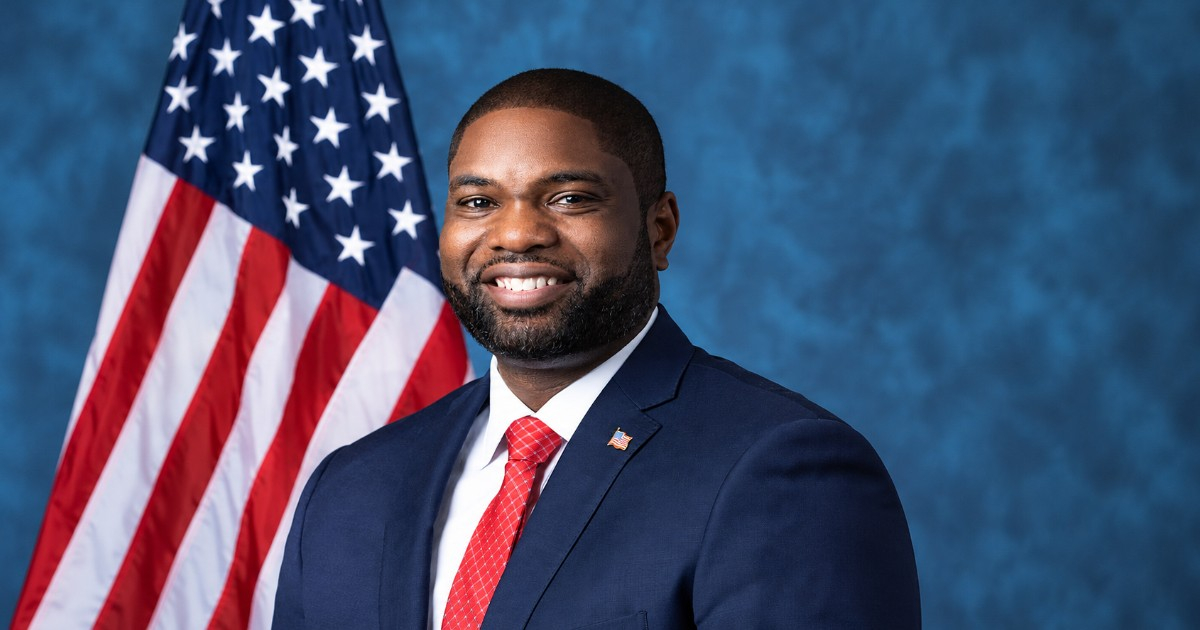
The Republican candidate for governor of Florida, Byron Donalds, visited the Bay of Pigs Museum in Little Havana, Miami, this Friday, where he reaffirmed his opposition to communism and socialism and promised to prevent both ideologies from gaining ground in the state, with less than three weeks remaining until the elections on November 3rd.
We want Cuba to be free from communism, free from socialism, and I want to make something very clear: we will not tolerate communism here in Florida. We will not tolerate socialism in the United States, declared Donalds during the meeting with members of the Cuban exile community, according to reported this Friday by Local 10 (WPLG).
"I have their support," added the congressman, who aims to succeed Governor Ron DeSantis and maintain Republican control of the state government.
The visit once again placed the Cuban-American electorate at the center of the campaign, on a day when his Democratic rival, David Jolly, also traveled through South Florida to meet with pastors and Black voters in Deerfield Beach, in Broward County.
The activities of both candidates reflect the importance of mobilizing their respective voter bases ahead of the election, in a race where Donalds is ahead in a recent poll, but where the cost of living, housing insurance, and immigration are also part of the political debate.
A message against communism from Little Havana
Donalds chose a setting of deep historical significance for the Cuban exile: the Bay of Pigs Museum, dedicated to preserving the memory of Brigade 2506 and the April 1961 invasion against Fidel Castro's regime.
From that location, the Republican candidate linked his electoral speech to the rejection of the political system imposed in Cuba and reiterated his opposition to communism and socialism in the United States.
The statement gained a particularly symbolic dimension in Miami, where generations of Cuban exiles have made the defense of political freedoms and opposition to the Havana dictatorship central to their public engagement.
However, Donalds' speech against the Cuban regime does not necessarily address all the concerns of a community that also faces issues related to the cost of living, housing, and migration uncertainty.
Bryan Ávila, the Cuban-American who accompanies Donalds
Donald's approach to Cuban-American voters also has a strategic component in the selection of his running mate.
The Republican party nominated Bryan Ávila, a Cuban-American state senator from Hialeah and the son of Cuban exiles, who has taken on a prominent role in campaign messages aimed at the Hispanic electorate.
The election of Ávila was announced in August at the Freedom Tower in Miami, another place closely associated with the history of Cuban emigration.
The senator has used his family history to explain his opposition to communism and to defend the positions of the Republican Party.
In October, Ávila starred in an electoral message in Spanish where he presented the priorities of Donalds' candidacy and aimed to connect with the concerns of Hispanic families.
Her presence in the formula allows the Republican campaign to count on a figure of Cuban origin who is familiar with the local politics of Hialeah and Miami-Dade, two key areas for mobilizing voters from that community.
David Jolly seeks support among pastors and Black voters
While Donald was visiting Little Havana, Democrat David Jolly attended a community meeting in Deerfield Beach, Broward, with religious leaders and Black voters from various parts of Florida.
The meeting brought together pastors representing churches from 11 counties in the state and citizens interested in learning about the proposals of Jolly and Joseph Javier Rodríguez, the Democratic candidate for attorney general.
According to Local 10, participants expressed concerns related to the care of seniors and veterans, diversity, equity, and inclusion policies, the rise in homeowners' insurance premiums, and the funding of public education.
Jolly took the opportunity of the meeting to criticize the racial and economic inequalities that, in his view, persist in Florida.
We are a state that has truly promoted marginalization and division. The division between Black and white Americans, in terms of the economy, education, health outcomes, and, I suppose, now what is being taught in our classrooms, is perhaps greater than ever," he stated.
The Democratic candidate added, "I believe we have developed a plan to address that, and I feel good about our platform's position in contrast to that of my opponent."
The day also brought a public agreement between both candidates: Jolly stated that he rejects socialism and the Democratic Socialists of America organization, according to the same source.
This positioning is relevant in a campaign where references to socialism resonate strongly among certain segments of the Cuban and Venezuelan electorate.
A survey places Donald seven points ahead
Donald’s electoral offensive in Miami comes after the release of a poll that placed him ahead of Jolly in the race for governor.
A Mason-Dixon poll, released on October 7 by NBC6 and Telemundo Station Group, gives the Republican candidate 48% of the voter intention, compared to 41% for his Democratic opponent.
The difference was seven percentage points, while approximately 10% of the participants stated that they were undecided.
Among the Hispanic voters surveyed, Donalds received 48% of the preferences and Jolly received 43%, a smaller difference than that recorded in the overall sample.
The survey was conducted between September 28 and October 1, with 625 registered voters who stated their intention to go to the polls.
The results represent a measurement of preferences during that period and do not guarantee the electoral outcome of November 3. Additionally, the data related to specific voter groups have a greater margin of uncertainty.
The survey also showed that the cost of living and inflation were among the top concerns for voters.
That fact helps to explain why, although the anti-communist rhetoric remains present in the Republican campaign, economic issues hold a significant place in the competition for votes.
The Cuban vote amidst the rejection of the dictatorship and migratory discontent
Donald’s visit to Little Havana takes place against the backdrop of a debate within the Cuban exile community regarding the results of U.S. policy towards the island and the consequences of the immigration measures implemented by the Trump administration.
A report published this Friday on the opinions of Cuban exiles in Miami captured expressions of disappointment among individuals who had placed high hopes in Donald Trump and Marco Rubio.
Part of that discomfort is related to the absence of political changes in Cuba that some expected after Trump's return to the White House.
Concerns have also been raised about deportations, immigration detentions, and the situation of Cubans who remain in the United States without a clear path to regularize their status.
ICE operations in communities of South Florida, including Hialeah and Doral, have brought the immigration debate into spaces where the rejection of the Cuban regime coexists with concerns about the future of family, neighbors, and acquaintances.
However, the opinions gathered from reports and individual testimonies do not, on their own, allow for the conclusion that there is a widespread change in the electoral preferences of Cuban Americans.
The community does not constitute a homogeneous political block, and its members may agree in their opposition to the Cuban dictatorship while holding differing positions on immigration, the economy, or the management of state and federal governments.
Two campaign strategies in South Florida
The activities of Donalds and Jolly this Friday reflect different approaches to engaging with segments of the electorate in the final stretch of the campaign.
The Republican went to an emblematic place of the Cuban exile and focused his speech on rejecting communism and socialism.
The Democrat, on the other hand, met with religious leaders and Black voters to address concerns about inequality, education, housing, and public services.
Both meetings were held in a region where electoral participation can be crucial for campaigns and where communities with very diverse political, economic, and migratory experiences coexist.
According to Local 10, Donalds was scheduled to continue his activities through a video call with supporters and to participate alongside Republican federal senator Ashley Moody in a rally in Weston, set for 4:00 p.m.
Jolly, for his part, announced that he plans to return to Broward County the night before the election to hold his final campaign event in Fort Lauderdale.
On the upcoming November 3, voters will decide who will succeed Ron DeSantis, who is not eligible to run for a third consecutive term.
Related videos:
Filed under: