Yoandri Marín, brother of Karildi Caridad Marín Lobaina —a young Cuban who has been missing in Havana since December 2023—, posted on Friday on his Facebook profile a call to unite families of missing persons in Cuba in a mutual support network.
The message marked his return to social media after a period of silence and was amplified by the Gender Observatory of Alas Tensas (OGAT), which spread it to broaden the reach of the call.
“I lost track of time on social media. The pain of not knowing anything about my sister made me withdraw, because there are wounds that one learns to carry in silence, even though they continue to hurt inside,” wrote Yoandri Marín to explain his absence.
Almost three years without a response
Karildi Caridad Marín Lobaina was 24 years old when she left her home in the Párraga neighborhood, Arroyo Naranjo municipality, on December 14, 2023, to attend a party in El Cerro. Since that night, her family has not heard from her again.
The family filed a report at the police station in Capri, but the case remained stagnant nearly 18 months later, as Yoandri reported multiple times. Karildi's youngest daughter turned two years old in March 2025 without her mother's presence.
"Nearly three years without hearing from Karildi Caridad Marín Lobaina. Almost three years of questions, uncertainty, and an absence that changed our lives forever," wrote her brother.
A network without an office, but with determination
The initiative does not yet have a formal structure or funding.
Yoandri Marín acknowledges it straightforwardly: “Perhaps today we don't have an office, financial resources, or all the answers. But we can start with something we do have: will, solidarity, and the desire that no family feels completely alone.”
Her proposal aims to be a meeting point where relatives can share experiences and receive guidance.
"I don't promise miracles. I promise to work to build a support network, to learn alongside other families, and to seek out people willing to collaborate wholeheartedly," she stated.
"And meanwhile, the disappearances continue, the violence continues, and many families keep living a nightmare that few can comprehend unless they have experienced it," wrote Yoandri Marín.
His message concluded with a direct invitation: "If you are going through something similar, or know a family that needs support, I would like to hear from you. We can start together."
The faces of a crisis without a government response
The call comes as several Cuban families are fighting similar battles on their own.
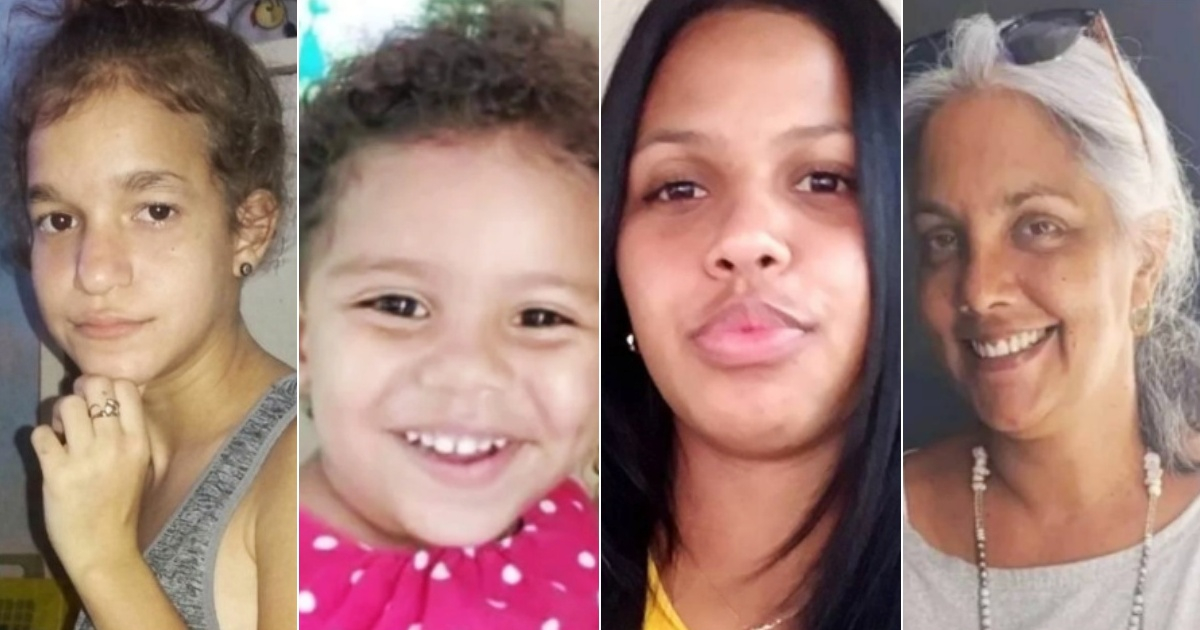
Four cases illustrate the magnitude of the problem.
Maydeleisis Rosales Rodríguez, 16 years old, disappeared in May 2021 in the area of Campanario and the Malecon, Centro Habana.
More than five years later, her mother reported a possible crime after receiving testimony from a man that would implicate her daughter's ex-partner. The police briefly detained those named and released them without charges.
Lali Paola Moliner Bosa, a three-year-old girl, disappeared in February 2024 in the Bahía neighborhood of East Havana, the day after her mother's body was found showing signs of violence near Cojímar.
Two years after his disappearance, his aunt Valia Zaldívar Salazar denounced institutional abandonment: "Our silence is not forgetting; our silence is pain, it is feeling forgotten by the authorities who still have no answers."
Doraiky Águila Vázquez, 48 years old, disappeared in March 2025 during a blackout in the Lawton neighborhood, Diez de Octubre.
Her mother, Maura Vázquez, traveled this week to Cabaiguán, Sancti Spíritus, following a lead that did not yield results after 19 months of searching.
Cuba, without registration or early warning
The OGAT has documented that Cuba lacks a public registry of missing persons and a national early warning system.
In its annual report for 2025, the observatory recorded 40 disappearances of women, girls, and boys: 26 were found alive, six were discovered deceased, and eight remained missing at the end of the year.
In the absence of institutional support, families rely on grassroots initiatives such as the campaign "Don't Forget Me," the #AlertaYeniset —for missing women— and the #AlertaMayde —for minors— none of which have the backing of the Cuban state.
Related videos:
Filed under: