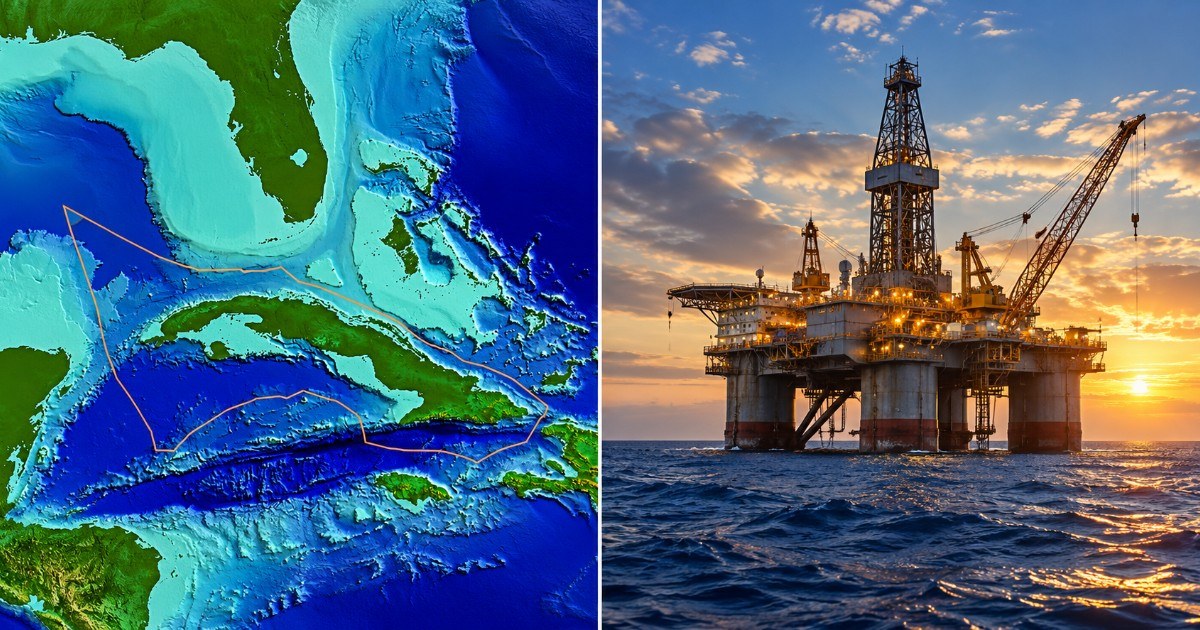
Cuba seeks to expand its oil exploration capabilities in the Gulf of Mexico by utilizing an extension of its continental shelf beyond 200 nautical miles.
Cuban authorities estimate that the area covers approximately 1,700 square kilometers of seabed and subsoil, where future research could be conducted on the existence of natural resources, including oil and gas.
The Minister of Science, Technology, and Environment, Armando Rodríguez Batista, shared this Saturday on Facebook information about the scientific research that supported Cuba's request to the United Nations Continental Shelf Commission, related to an area known as Eastern Polygon of the Gulf of Mexico.
The work received one of the National Awards for 2025 from the Academy of Sciences of Cuba (ACC), which recognized 104 scientific results across various specialties.
The research on the continental shelf was recognized in the category of Technical Sciences.
The objective was to demonstrate, through geological, geophysical, hydrographic, and geodetic studies, that the Cuban continental shelf naturally extends beyond the 200 nautical mile limit, in accordance with the criteria established by the United Nations Convention on the Law of the Sea.
The initiative has roots that date back to 2009, when Cuba submitted its original request to the Commission on the Limits of the Continental Shelf.
Subsequently, on February 15, 2024, the Cuban authorities submitted a revised proposal with additional technical information.
On February 26, 2025, the Commission approved, with modifications, the recommendations regarding the Cuban submission, after evaluating the studies and scientific arguments presented.
The procedure had a legal continuation in 2026. According to official United Nations records, on April 21 of this year, Cuba deposited the geographical coordinates corresponding to the outer limits of its continental shelf, including those located beyond 200 nautical miles, in accordance with Decree-Law 110 of October 17, 2025.
The result allows Cuba to define the boundaries of an area of the seabed and subsoil over which it can exercise specific sovereign rights to explore and exploit natural resources, in accordance with international law.
However, this does not mean that the United Nations has granted Cuba a new portion of national territory, nor that the country has acquired sovereignty over the waters located above that platform.
The rights related to the continental shelf fundamentally pertain to the seabed and its subsoil. Therefore, recognition is of interest for activities such as mineral exploration and potential deposits of oil and gas.
The approximate figure of 1,700 square kilometers was provided by Cuban authorities in the information released by Rodríguez.
The consulted documentation from the United Nations confirms the procedure and recommendations, although that area has not been independently verified through a mapping measurement.
One of the participants in the project was Alejandro Morales Abreu, a specialist from the Scientific and Technological Unit of Geophysics at the Oil Research Center (CEINPET).
According to statements gathered by Rodríguez, the research aimed to "support the demonstration of the expansion of Cuban submerged territory in the Gulf of Mexico."
The specialist pointed out that the establishment of these limits can offer greater opportunities to negotiate, explore, and eventually exploit natural resources from the seabed and subsoil in the medium and long term.
The area under investigation is located in the Eastern Polygon of the Gulf of Mexico, where the continental shelves of Cuba, Mexico, and the United States converge.
The maritime delimitation between these countries has previous agreements. The very documentation submitted by Cuba to the United Nations refers to the continental shelf delimitation treaties signed in 2017 with Mexico and the United States.
Therefore, the Commission's recommendations should not be interpreted as a new territorial negotiation among the three countries, but rather as part of the technical and legal process to establish the outer limits of the Cuban continental shelf.
To support their request, the researchers referred to two-dimensional seismic studies previously conducted by the Cuba-Petroleum Union (CUPET), initially intended for hydrocarbon exploration work.
The information was reinterpreted and supplemented with specialized studies on the geological and geophysical characteristics of the seabed.
In the project, specialists from CEINPET, professors from José Antonio Echeverría Technological University (CUJAE), the National Office of Hydrography and Geodesy, and the Ministry of Foreign Affairs (MINREX) participated, with collaboration from the Higher Institute of Design.
Morales described the process of presenting the results to international specialists as a demanding experience, in which the team had to justify their methodologies, answer questions, and defend their technical conclusions.
"It’s almost like going back to the days of being a student when you take an exam, a very rigorous exam," he recalled.
According to his testimony, the working sessions at the United Nations lasted for a week and required coordination among scientific experts, diplomatic representatives, and translators familiar with specialized terminology.
Amid the energy crisis that Cuba is facing, increasing national production of oil and gas is one of the sector's objectives, although the potential benefits of new explorations would not be immediate.
Morales Abreu acknowledged that the workers at CEINPET also face power outages and the material limitations in the country, circumstances that, as he explained, reinforce the importance they attribute to their research.
"We are people from this town, who equally suffer from blackouts and limitations, and because we experience these hardships, we are aware of the importance of our work being successful," he stated.
The confirmed progress is, therefore, both scientific and legal: Cuba obtained favorable recommendations, with modifications, from the Commission on the Limits of the Continental Shelf and subsequently submitted the coordinates of its outer limits to the United Nations.
Scientific recognition takes on additional significance at a time when the Cuban government is trying to modify the legal framework of the oil sector to expand investment opportunities and business participation.
On October 12, 2026, Decree 184 was published, regulating Decree-Law 135 "On Oil and Gas", which outlines the legal conditions applicable to the exploration, extraction, refining, transportation, storage, and marketing of hydrocarbons.
The new regulation encompasses oil activities both on land and in the continental shelf and exclusive economic zone of Cuba, and establishes procedures for permits, licenses, contracts, and concessions.
Among its provisions is the possibility for certain private Cuban companies to participate directly in oil exploration and exploitation activities, with state authorization.
According to the requirements outlined in the new regulations, micro, small, and medium enterprises, private companies with more than 100 employees, and non-agricultural cooperatives will be eligible for grants, provided they meet the necessary technical and legal criteria.
The procedure requires the involvement of the relevant authorities and the corresponding state approvals. Obtaining a technical accreditation does not guarantee that a company will receive a concession.
The concessions may have a maximum duration of 30 years, extendable for another 10, without transferring ownership of the deposits to private operators.
Additionally, the regime opened new opportunities for private investment in refineries, fuel depots, and other facilities related to the industry, in an effort to attract financial resources and enhance its operational capacity.
Related videos:
Filed under: