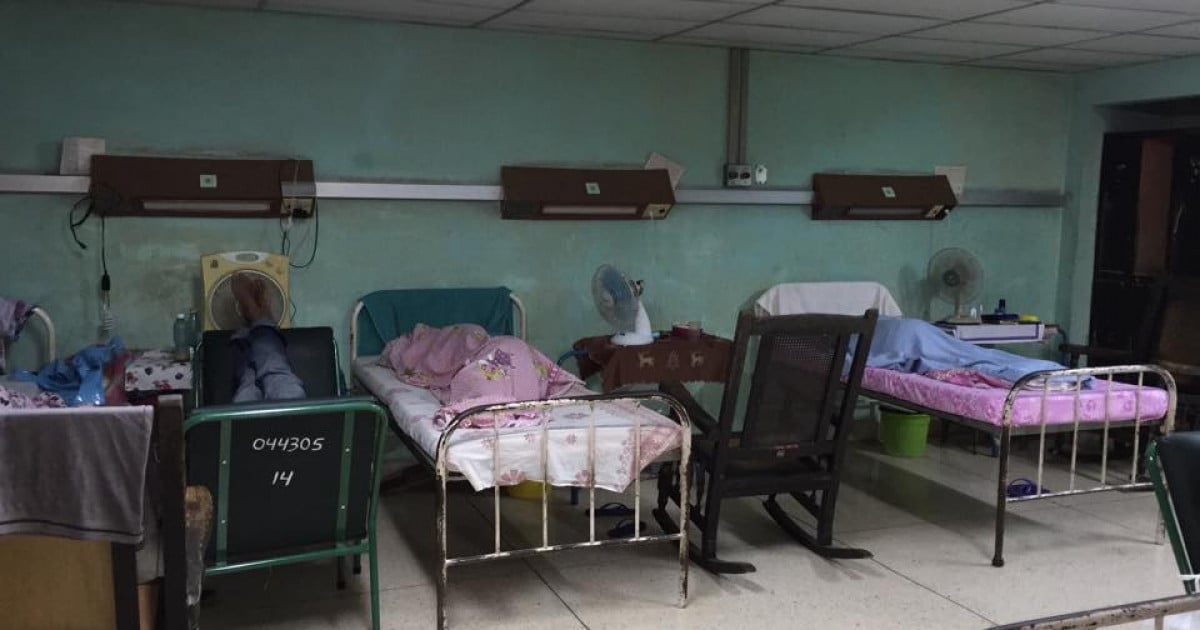
The Cuban doctor Daniel Del Toro González, who works at the Pediatric Hospital of Las Tunas, once again denounced the difficult conditions in which healthcare professionals operate in Cuba and explained why many of his colleagues have decided to leave hospitals to work in small and medium-sized enterprises (mipymes), commerce, and other activities that allow them to earn better incomes.
In a Facebook post, Del Toro responded to those who criticize him for constantly complaining about the challenges of the Cuban healthcare system and suggest that he should leave his profession if he is so dissatisfied.
"Recently, I've read in many of my posts people criticizing me for complaining about working in healthcare. They say if I don't like it, I should leave; that if I complain so much, why do I keep doing it?" she wrote.
The pediatrician lamented that these opinions come not only from individuals aligned with the Cuban regime, but also from other users who, as he explained, question the right of healthcare professionals to denounce their working conditions.
"And, frankly, I still can't understand that mindset," he expressed.
For Del Toro, the issue is not merely that doctors are dissatisfied with their work, but that they must practice under limited resources, economic difficulties, and an increasingly shrinking professional workforce.
Nowadays, working in healthcare in Cuba has almost become a luxury, he stated ironically.
The doctor explained that this reality means caring for patients "with hardly any supplies, often without medications and with increasingly scarce personnel," conditions that complicate the daily work of those who remain in the hospitals.
In his reflection, he pointed out that numerous professionals have chosen to leave the healthcare sector to engage in economic activities that, while not requiring their medical training, can offer them higher pay.
According to Del Toro, some have traded their white coats to join small and medium-sized enterprises, work as sales associates, or take on any other jobs that allow them to bring more money into their households.
The pediatrician assured that he understands those decisions and expressed his admiration for colleagues who have sought other job alternatives.
«A large number of doctors (and I admire them for making that decision) have ended up hanging up their stethoscopes and lab coats to work in a small or medium-sized enterprise, as clerks or in anything else that allows them to bring a little more money home», he wrote.
In his opinion, economic disparity is one of the main incentives for changing professions.
Del Toro noted that outside of hospitals, it is possible to generate higher cash income, an important advantage in a country where state salaries have significantly lost purchasing power.
But money is not the only reason that stands out. The pediatrician also mentioned the treatment that some professionals receive from patients' families, who, in certain circumstances, react with unreasonable demands and insults.
As an example, he mentioned situations where caregivers believe that a brief episode of childhood fever constitutes an emergency that demands immediate attention, and they end up berating the medical staff.
The observation reflects another aspect of professional burnout that it highlights: the pressure of working with insufficient resources while simultaneously confronting the dissatisfaction of those who seek health services.
Del Toro did not hold patients or their families generally responsible; instead, he used those episodes to illustrate some of the conflicting situations that doctors experience during their work.
Her reflection raises a question: why do some professionals continue to work after so many years of sacrifices, low salaries, and scarce resources?
"That's why those of us who are still here continue to stand firm, doing what we can with what we have, trying to pursue a profession that deserves so much more than it receives," he expressed.
The doctor acknowledged that it is not even easy to explain the reasons why he remains in a healthcare system that he openly criticizes.
«Perhaps because we are crazy, because we are too stubborn to accept that what we studied for so many years, what we dedicated so much effort and passion to, ends up reduced to this,» he reflected.
The message ended with a phrase rich in humor and irony that sums up his exhaustion with the challenges of work.
"Because nowadays, working as a doctor in Cuba is, I don't know if it is a matter of vocation, masochism, or if it should directly be included as a diagnostic criterion for some personality disorder," he wrote, accompanying his words with a laughing emoji.
This is not the first time that Del Toro González has publicly explained why he continues to practice medicine despite the challenges.
In June 2026, the pediatrician had already responded to those who asked him why he continued working in Cuba if he complained so much about the conditions.
On that occasion, he defended his commitment to a profession to which he dedicated years of education and effort, even when the economic conditions in the country seemed to push him to seek employment in the private sector.
"We work because we love it. Because it’s our vocation, beyond the economic problems and the reality of the country," he stated then.
His complaint also has an economic background that the doctor himself has explained through comparisons with food prices.
In September, Del Toro used the price of a corn fritter to illustrate how much his purchasing power had decreased since the implementation of the Tarea Ordenamiento.
According to their comparison, while a fritter that once cost one peso now sells for 30, their basic salary increased from approximately 1,400 to 8,400 Cuban pesos.
"The fried foods multiplied their price by 30... and my salary by about 6," he summarized in that post.
A month earlier, the specialist had reported that his monthly salary was not enough to buy a ten-pound package of chicken, a container of oil, and a dozen eggs.
On that occasion, he used a basic salary of 8,500 pesos for a first-grade specialist as a reference, compared to a combined cost of 10,500 pesos for chicken and oil, not yet including eggs or other essential foods.
"The utopia has always been the belief that we could live off our wages," she concluded.
Del Toro has also reported episodes related to the safety of healthcare workers.
In July of this year, he reported that a man appeared at his home with the intent to assault him, days after he attended to a minor for ear discomfort.
According to his testimony, the patient had been referred to a specialized consultation, but his relatives initially did not follow the medical advice and later visited him at home.
The incident prompted the pediatrician to demand greater respect and safety for those working in the healthcare sector.
Related videos:
Filed under: