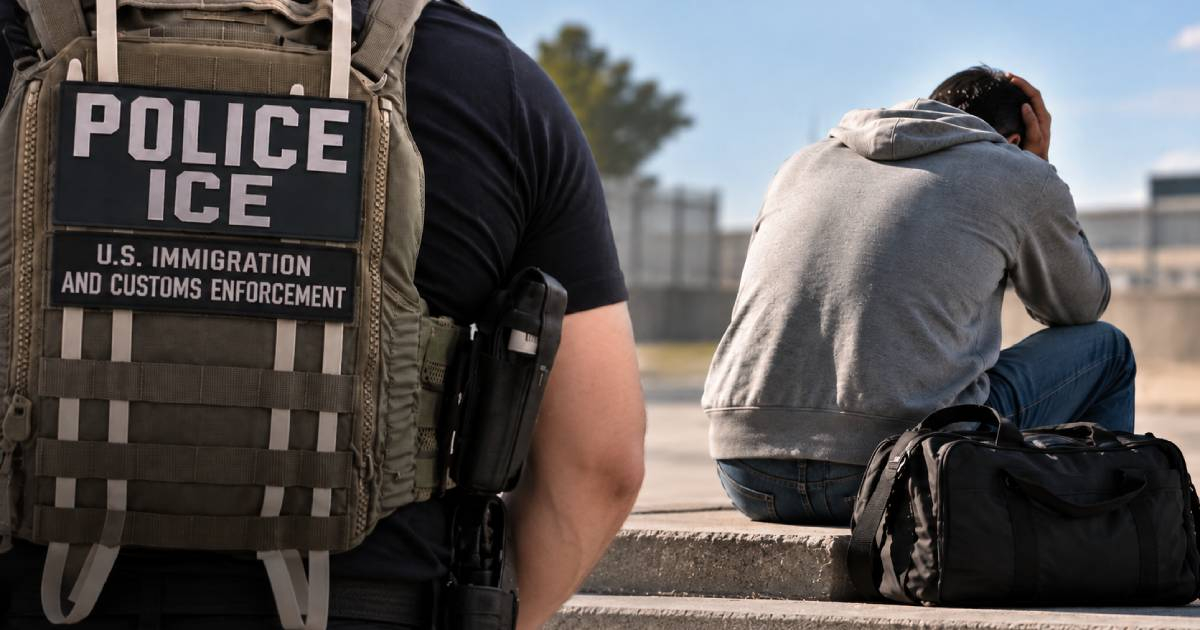
Cuban Rolando Ramírez Fuentes, 57, a resident of Tampa, Florida, became homeless after spending nine months in detention by the U.S. Immigration and Customs Enforcement (ICE), according to a federal lawsuit that accuses the agency of withholding his driver's license and Social Security card even after his release.
Ramírez, who arrived in the United States from Cuba in 1980 at the age of just 11, is among seven immigrants who filed a proposed class action lawsuit against ICE and the Department of Homeland Security (DHS) on October 13 in a federal court in Washington, D.C.
According to the lawsuit backed by the American Civil Liberties Union (ACLU), the Cuban was arrested by immigration agents in July 2025 while he was outside his workplace.
He remained in custody until April 28, 2026, when a federal judge ordered his release after granting him a writ of habeas corpus.
However, after regaining his freedom, ICE did not return his Florida driver's license or his Social Security card, two documents that, according to his lawyers, he needs to find employment and handle daily tasks.
The lawsuit states that Ramírez requested the return of his belongings, but the agency did not respond positively nor provided an explanation justifying their retention. His lawyers claim he also did not receive copies of the documents.
According to the court documents, the lack of documentation has prevented him from finding a job, which in turn has limited his access to medical care for a heart condition.
Without sufficient income to pay for accommodation, he ended up homeless, a situation that persisted when the lawsuit was filed, more than five months after his release.
A deportation order dating back to 2004
According to a court ruling issued in Florida on April 28, 2026, the Cuban received a deportation order on February 12, 2004, following a drug-related conviction in 2003.
Despite that order, he remained in the United States under immigration supervision for years, although he went through other periods of detention.
In July 2025, the ICE revoked his supervised release and detained him again with the purpose of carrying out the deportation.
His defense then approached a federal court to challenge the extension of the arrest.
Judge John E. Steele of the Middle District of Florida concluded that there was not a significant likelihood that Ramírez Fuentes would be deported in the reasonably foreseeable future.
For that reason, he ordered that he be released within 24 hours, although he would still be subject to the conditions of immigration supervision.
The judicial decision did not annul his deportation order nor did it grant him a new immigration status. What it determined was that he could not be held indefinitely under those circumstances.
Seven immigrants report a practice by ICE
The case of Ramírez Fuentes is part of a broader legal action filed under the name Gonzalez v. Department of Homeland Security.
The seven plaintiffs assert that ICE maintains a practice of unjustly retaining documents and belongings after releasing individuals detained for immigration reasons.
Among the items being claimed are passports, work permits, driver's licenses, Social Security cards, cell phones, money, clothing, and even objects of sentimental value.
One of those affected is Vladimir Izmailov, a Russian citizen who applied for asylum in the United States and, according to the ACLU, has been unable to secure stable employment because the agency did not return his work authorization.
Izmailov is also demanding his wedding ring, while his family has had to resort to loans to pay the rent.
Another claimant, the Salvadoran Joel Vigil Rodríguez, states that he has been trying for months to recover his phone, his keys, and other items confiscated when he was arrested.
Lawyers believe that these cases demonstrate consequences that go beyond the material loss of belongings: they affect the ability to work, maintain housing, receive medical care, and establish identity before the authorities.
What do immigrants seek from the justice system?
The lawsuit argues that ICE violates the Fourth Amendment of the U.S. Constitution, which protects individuals against unreasonable searches and seizures.
Lawyers argue that, although immigration authorities may safeguard belongings during a detention, they should not continue to hold them after release if there is no legal justification for doing so.
They also question the adherence to the agency's own administrative regulations regarding the preservation and return of personal belongings.
The plaintiffs request that the court recognize the case as a class action, order the return of documents and belongings that were unjustly withheld, and establish safeguards to prevent similar situations from occurring in the future.
The ACLU explained in a statement that the economic consequences of these detentions can last for months after immigrants regain their freedom.
Michael Perloff, the organization's attorney, argued that the Fourth Amendment exists precisely to prevent government agents from seizing and retaining personal property without legitimate cause.
For now, the accusations are awaiting judicial resolution. The Department of Homeland Security did not respond to a request for comments made by the newspaper El País, which reported on the case of the Cuban citizen on October 16.
Related videos:
Filed under: