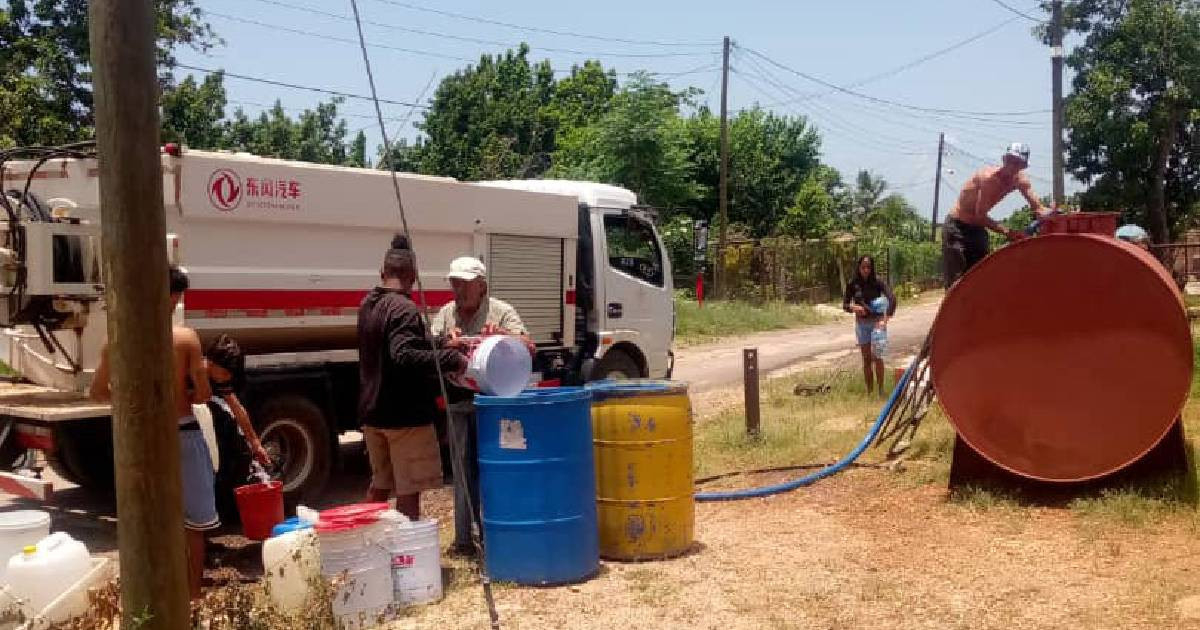
About a third of the residents of the municipality of Artemisa who rely on hydraulic networks for water access do not have this service, according to a report published by the official newspaper El artemiseño, which described the situation as "very complicated."
The combination of malfunctioning motors in various supply sources and the electricity shortage explains the magnitude of the crisis, which is hitting different areas of the municipality simultaneously.
According to the media outlet, the pumping equipment from Las Cañas and the Recompensa community was moved to workshops in San Cristóbal for repair.
The team from the Machinery area in the El Corojal Popular Council reported a major malfunction—it is burnt—and was sent to the workshop in San José de las Lajas, in Mayabeque. Its repair depends on priorities set at the national level and is beyond the control of the Provincial Aqueduct and Sewer Company of Artemisa, according to the publication.
In the same area of El Corojal, the motor of the Incubator remains out of service because the transformer that powers it has also burned out; its solution depends on the Electric Company of Artemisa.
In Los Mongolos, the Drilling Company is working on the repair of the oldest well's motor. An attempt was made to supplement it with a new well built in the same area, but the extracted flow turned out to be insufficient.
Wells one and three at Waterloo also encountered difficulties. The first one suffered the theft of the dielectric oil from its transformers, which caused damage to the equipment.
The installation of new transformers allowed for the resumption of pumping, although the Municipal Assembly of the People's Power warned that considerable levels of distribution are only achieved when both sources of Waterloo operate simultaneously with the protection of the 1500 electrical circuit for at least 12 consecutive hours.
This series of breakdowns is compounded by a shortage of fuel, which prevents the transport of water trucks to neighborhoods without water. Pablo Francisco San Crespo, director of the Water Supply and Sanitation Company of the well-known Villa Roja, pointed out that the delivery by water tanker trucks is reserved for priority facilities.
"Due to the lack of fuel, it is currently not possible to reach the affected population centers with water trucks. However, this service is guaranteed in an orderly manner to prioritized centers for Education and Public Health, located in the municipal seat, always in coordination with their respective administrative units: the Adrián Sansaricq and Tomás Romay polyclinics, the Grandparents' Home, the Maternal Home, children's circles, and other educational institutions," he explained.
In July, official data indicated that power outages and the deterioration of pumping equipment kept around 225,000 people without regular access to water, which is approximately 65% of the population of the province of Artemisa.
The crisis in that territory is part of a nationwide water collapse. At the beginning of October, hydraulic sector authorities acknowledged that 2.7 million Cubans, nearly 35% of the population served by networks, faced partial or total access issues to drinking water, a figure almost identical to that of May.
Eighty-seven percent of the country's aqueducts rely on the National Electric System, meaning that each blackout equates to a simultaneous water cut for hundreds of thousands of people.
Related videos:
Filed under: