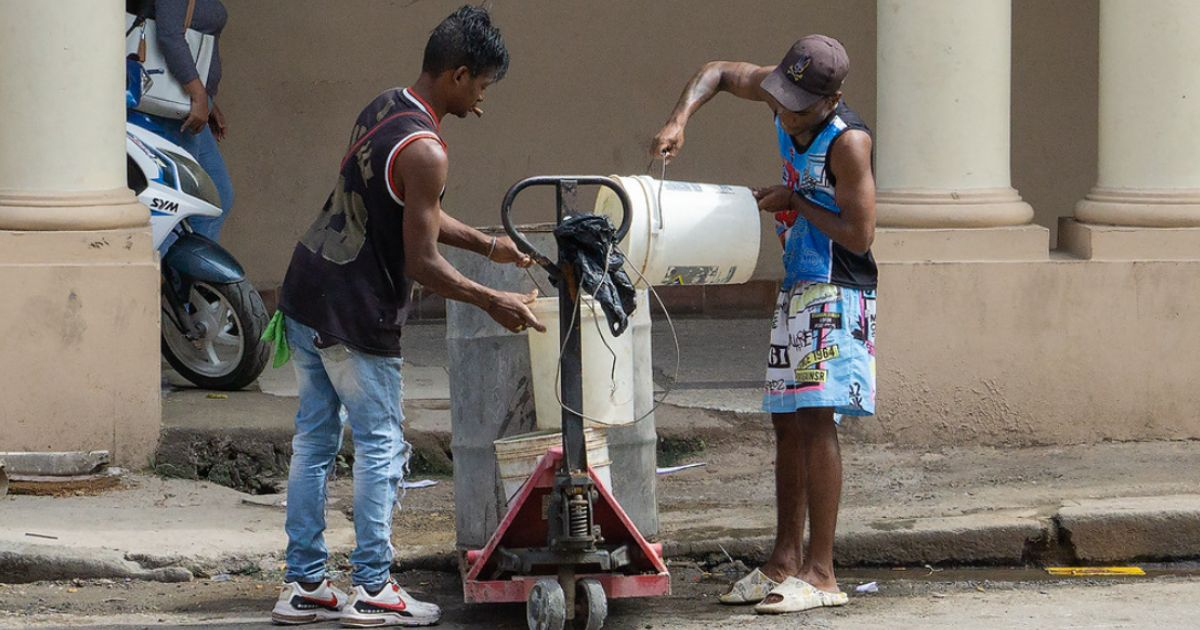
Cuban authorities acknowledged this Friday that 2.7 million people are experiencing total or partial issues with access to drinking water, a figure that represents nearly 35% of the population receiving this service through networks. According to data released by EFE, this figure remains almost unchanged from May, when the regime reported the same number.
The stability of that number over five months contradicts the promises of improvement that Miguel Díaz-Canel has repeated during tours and public appearances, including his visit in September to the North water treatment plant in Havana, where the official Granma announced that around 100,000 people would have been removed from the affected group following work on the Cosculluela system.
The provinces most affected by water supply shortages are Havana, Artemisa, Matanzas, Santiago de Cuba, and Holguín, according to data released by Cuban authorities in the hydraulic sector.
In the capital, the month of September was described as "very complex" by Yosvany Rubí, the general director of the state-owned company Aguas de La Habana, who stated on state television that over 577,000 people faced difficulties with the water supply.
Rubí pointed out that the peripheral municipalities of Boyeros and El Cotorro concentrate the "most complex" situation due to equipment failures in the pumping systems combined with electrical instability.
"We are the largest consumers of electricity in the country, and this directly affects the services we provide," the executive admitted.
In Santiago de Cuba, a television report cited by EFE indicated that nearly 180,000 people are without water due to a combination of drought, power shortage, and equipment failures.
The causal chain is acknowledged by the authorities themselves: over 85% of the pumping stations in the country rely on electricity, so each blackout directly halts the water supply.
This dependency is further compounded by the deterioration of infrastructure that has seen decades without significant investment and inadequate renewal: some of the main pipelines in the capital have been in operation for between 60 and 70 years. Leaks also represent a substantial source of losses: estimates suggest that between 40% and 70% of the water pumped can be lost before reaching homes, although sources linked to the hydraulic sector allow for documentation of losses exceeding 40%.
In early September, Díaz-Canel promised improvements by the end of that month and consolidation in October; data from Friday, October 2 confirms that the national figure has not changed.
The health consequences are equally serious: the Ministry of Public Health admitted at the end of September to a simultaneous increase in dengue —7.4 times above the expected level—, diarrheal diseases, hepatitis A, and respiratory infections, which are directly linked to the limitations in sanitation and water treatment.
The official plan includes the long-term solution of installing 200 MW of solar energy to make the water pumping independent from the national electrical grid, a goal set for the first months of 2027, which means that millions of Cubans will have to continue facing the same crisis for at least several more months.
Related videos:
Filed under: