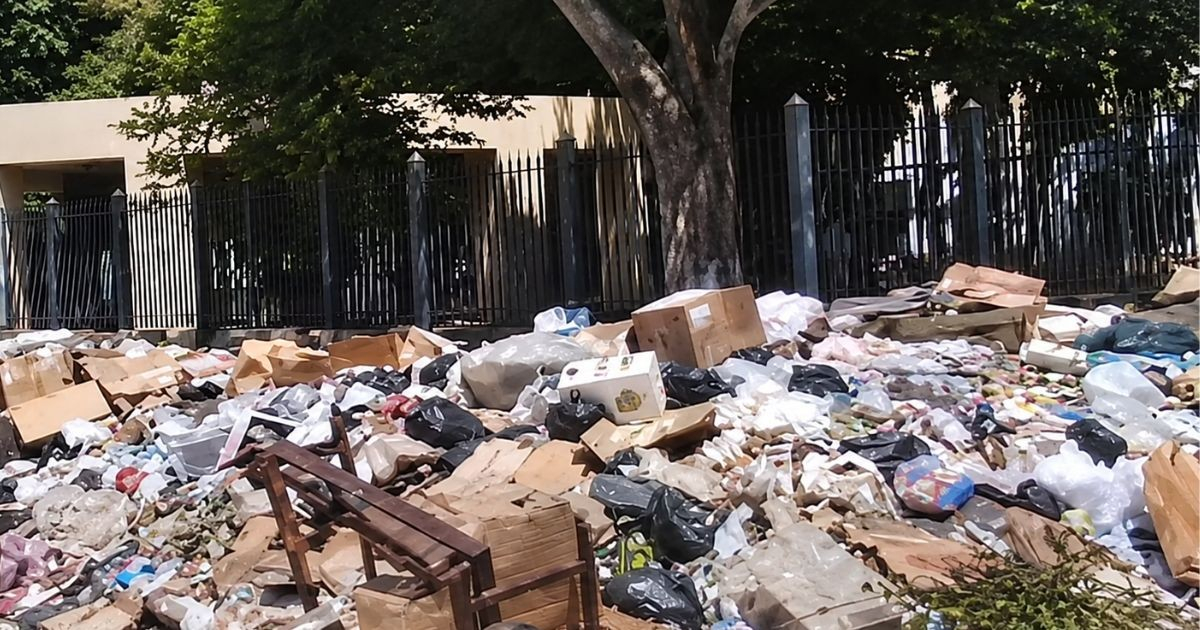
In light of the mountains of trash that overwhelm the streets of Havana and the inability of the state service to ensure regular collection, an article published in the official newspaper Trabajadores proposes to extend private waste collection services and suggests that residents pay 100 Cuban pesos for a pickup.
The proposal appears in an article titled "One Hundred Pesos for a Clean Street", published this Saturday by the official journalist Thalía Fuentes Puebla, who openly acknowledges the deterioration of urban hygiene and questions the inability of the authorities to keep the neighborhoods of the capital clear.
“When did it become normal for trash to be part of the Havana landscape?”, the author asks while describing overflowing containers, litter piled up at the corners, and large accumulations of waste occupying the sidewalks.
The article warns that waste has ceased to be merely an issue of urban image and now poses a threat to the health of residents, who are forced to endure unpleasant odors, flies, mosquitoes, and rodents.
The journalist attributes the problem to a state collection system that fails to maintain the necessary frequency for a city like Havana.
Among the causes, he mentions the lack of fuel, the scarcity of spare parts, and the halt of collection trucks, although he dismisses the idea that these difficulties justify the ongoing problem.
"Shortcomings should not be an excuse for a government that fails to keep neighborhoods clear," he states.
In light of this situation, Fuentes proposes expanding private sector involvement in waste collection, using as a reference initiatives that are already functioning or have been implemented in certain municipalities in Havana.
According to the explanation, some small and medium-sized enterprises use their own vehicles and equipment to collect waste in coordination with state entities in areas such as Playa and Guanabacoa.
It also mentions independent workers who charge for removing waste and the El Rampeño local development project, designed to provide door-to-door collection services using electric tricycles in Vedado.
The author believes that these models could be extended to other communities where state collection is insufficient.
“One hundred pesos for a removal is a modest amount compared to what it costs to live with the garbage dump,” he argues, referencing the health risks, pests, and foul odors that the residents endure.
The statement is significant because it suggests that residents are directly incurring additional expenses to meet a basic need that the public system is failing to address adequately.
However, the 100 pesos mentioned in the article do not constitute a new official rate approved for all of Havana. It is an amount proposed by the journalist as an example of what she considers a reasonable payment for the service.
In his proposal, Fuentes considers it necessary to simplify permits, establish clear rules, and designate authorized locations where private operators can dispose of collected waste.
It warns that removing trash from a street does not solve the problem if there is no appropriate place to dispose of it afterward.
The approach also acknowledges that private initiatives cannot fully replace the responsibilities of the State, especially when it comes to a service directly related to public health.
The journalist advocates for institutions to continue regulating, coordinating, and ensuring a public structure capable of serving neighborhoods where there are no private alternatives.
However, the proposal comes at a time when some of the projects it references have already faced significant difficulties.
In July, the Rampa People's Council launched a pilot program for the El Rampeño project, designed to collect garbage door to door using electric tricycles.
The initiative proposed a fee of 100 pesos per month per household and payments starting at 15,000 pesos for private businesses, small and medium-sized enterprises, and state entities, along with exemptions for individuals in vulnerable situations.
The residential fee announced for El Rampeño was, therefore, a monthly charge and not a collection of 100 pesos for each pickup, as suggested in the opinion piece published now.
The project initially envisioned the use of 30 electric tricycles and a charging station powered by solar panels, aimed at reducing dependence on conventional fuel.
However, when the pilot test began, only five of the 30 planned vehicles were available.
The difficulties continued in the following weeks. In August, the president of the Rampa People's Council, Pedro Lizardo Garcés Escalona, publicly acknowledged that the project had not achieved its original goal.
"Unfortunately, the initial idea and the objective with which the collection of solid waste using electric tricycles was designed has not been realized," he admitted.
Among the obstacles, he mentioned that the solar charging station planned for the intersection of 23rd and J streets had not yet been completed, as well as delays in finding solutions to keep the vehicles operational.
According to what was explained, some institutions had collaborated by facilitating the recharging of the tricycles, but those alternatives were not sufficient to develop the service as planned.
This background raises an important issue in the debate: even private or community initiatives require infrastructure, energy, operational equipment, and coordination to ensure regular waste collection.
Therefore, the presentation of El Rampeño as an experience that could be extended to other municipalities must be contrasted with the difficulties acknowledged by its own leaders just two months prior.
In other neighborhoods of Havana, residents have also attempted to find solutions on their own due to the absence of garbage collection trucks.
In May, residents of Casino Deportivo, in the Cerro municipality, organized a community initiative to clean up the trash, with the participation of neighbors and local delegates.
The project arose after the lack of fuel prevented the usual collection service by trucks from being maintained.
A video circulated on social media showed participants calling on residents to hand over their waste, while others requested to extend the initiative to their own neighborhoods.
Private participation in waste collection also began to spread outside of Havana.
In August, a small and medium-sized enterprise from the Isle of Youth announced a garbage collection service with a fee of 100 pesos per month per household, initially aimed at certain communities.
The experience was presented as an alternative to improve local hygiene through a direct payment system from residents, with the intention of subsequently expanding its coverage.
These initiatives emerge amid a waste collection crisis that has been deteriorating the sanitary conditions of the Cuban capital for years.
In February 2026, according to data released about the municipal services in Havana, only 44 out of the 106 garbage trucks in the city were operational.
The capital generated between 24,000 and 30,000 cubic meters of waste daily, while the number of vehicles and containers available was insufficient to handle that volume.
Official attempts at cleansing have also failed to consistently resolve the issue.
In October 2025, authorities reported that they had removed more than 396,000 cubic meters of waste during an intensive cleaning campaign, but acknowledged that there was still much to be done.
A month later, it became known that the Government itself did not have an accurate measurement of the amount of waste generated by the city, a shortcoming that complicated the organization of collection routes, calculating equipment needs, and assessing the results of the campaigns.
Related videos:
Filed under: