
Related videos:
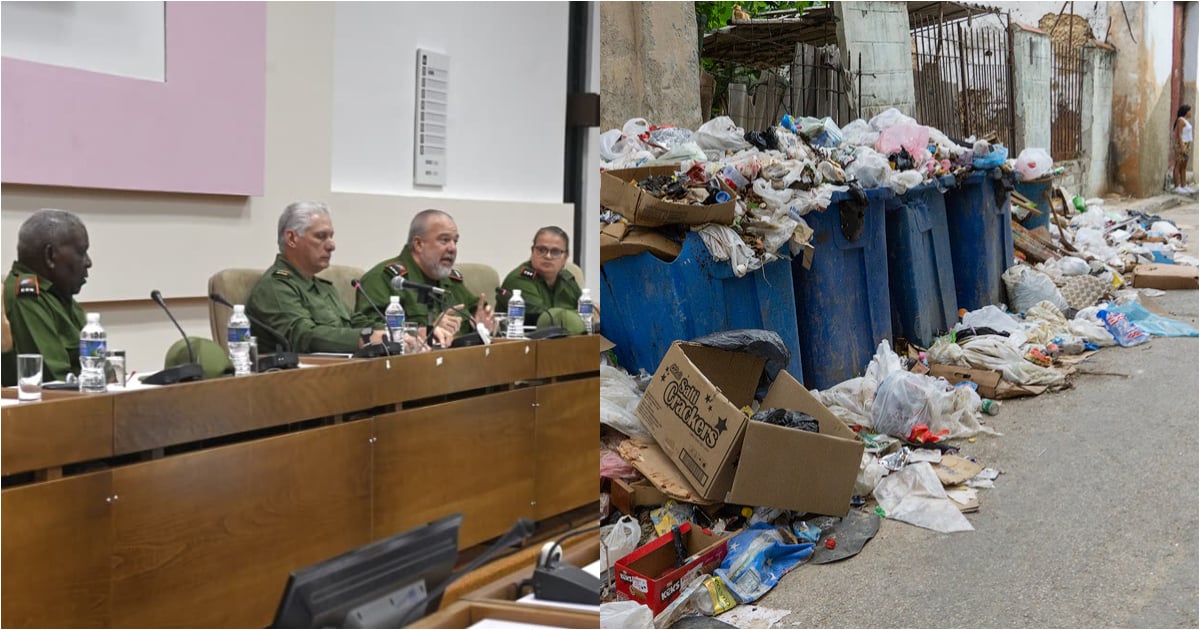
The government acknowledged on Saturday that it does not have an accurate figure for the amount of waste produced by Havana, a fundamental shortcoming that affects any cleaning and urban infrastructure strategy.
The admission took place during the weekly meeting between national and Havana authorities, where the initial results of a pilot study on waste generation in households and state and non-state entities of a local council were presented.
The research, led by the Ministry of Science, Technology, and Environment along with several universities, aims to establish a piece of information that should be a fundamental input for planning the collection system.
“This is an essential topic because we need to know how much solid waste is actually generated in the capital today,” commented Prime Minister Manuel Marrero Cruz, reported the digital portal of the Presidency.
In the meeting, presided over by the leader Miguel Díaz-Canel, also participated Esteban Lazo Hernández, president of the National Assembly; the first vice prime minister Inés María Chapman; the first secretary of the provincial party committee in the capital, Liván Izquierdo Alonso, and the governor of the territory, Yanet Hernández Pérez,
While that baseline is still being established, the city is operating on partial figures. Between November 21 and 27, 91,695 cubic meters of waste were collected, an average of 13,101 cubic meters per day, lower than the previous week due to a reduction in available equipment.
During the period, about 221 equipment units were used, 73 fewer than those employed the previous week.
The irregular arrival of fuel prevented compliance with the system that requires vehicles to be prepared the day before, compounded by breakdowns due to a lack of oils and lubricants, as well as stoppages caused by tires and batteries.
The situation confirms that the response capability continues to be hindered by material limitations that recur week after week.
The authorities highlighted some operational progress. The sweeping brigades total 85, active in 650 sections and 47 avenues.
The Cuban Steel Company is working on the production of 40 piker carts, while a program to recover ampiroll boxes has already rehabilitated 21 of the 40 planned, with 10 new units ready for delivery this Monday, it was reported.
Containers were also distributed: 30 for the municipality of Playa, another 50 to be picked up this Monday, and 80 more intended for Old Havana once their production is completed.
The government also highlighted a growth in the recovery of recyclables, which reached 197 tons in the last week.
According to the information provided, private enterprises delivered 109.2 tons, the Reciclo mi barrio movement accounted for 77.31 tons, and an additional 11.29 tons were collected on the avenues.
These figures not only contribute to improving cleanliness but also generate income— including foreign currencies—that could sustain part of the sanitation efforts, the text emphasized.
In parallel, 4,111 private businesses were inspected, and an equal number of agreements were signed for the management of their waste, reaching a total of 19,005 contracts.
However, all these efforts operate in a conceptual vacuum: the city still does not know how much waste it produces.
This lack of knowledge diminishes the ability to plan routes, size fleets, anticipate resources, evaluate results, or measure the actual impact of any program.
The government now acknowledges it as an "essential" matter, but its absence for years provides one of the explanations for why the main Cuban city is facing a severe waste management crisis, with mountains of garbage piling up in the streets, leading to unsanitary conditions and public health risks.
The authorities have attempted to implement cleaning operations, but the lack of resources and the ineffectiveness of the adopted measures have hindered a sustainable solution.
Soldiers, officers, and civilian workers of the Revolutionary Armed Forces (FAR) have been leading the so-called "Clean-Up Operation" for several weeks, an initiative aimed at improving the sanitary conditions of the capital.
Since November 17, the government of La Habana Vieja has implemented a system whereby residents and private businesses must take their trash directly to the truck and not leave it on the street.
The situation was summarized weeks ago by the official journalist Ana Teresa Badía, who stated that “Havana smells of garbage” in a post on her Facebook account, where she reported on “galloping institutional indifference.”
In Badía's opinion, “it cannot be normalized to have to live with garbage,” while he stressed that “Havana is an eternal dump waiting for someone to feel compassion. Too much indifference.”
Filed under: