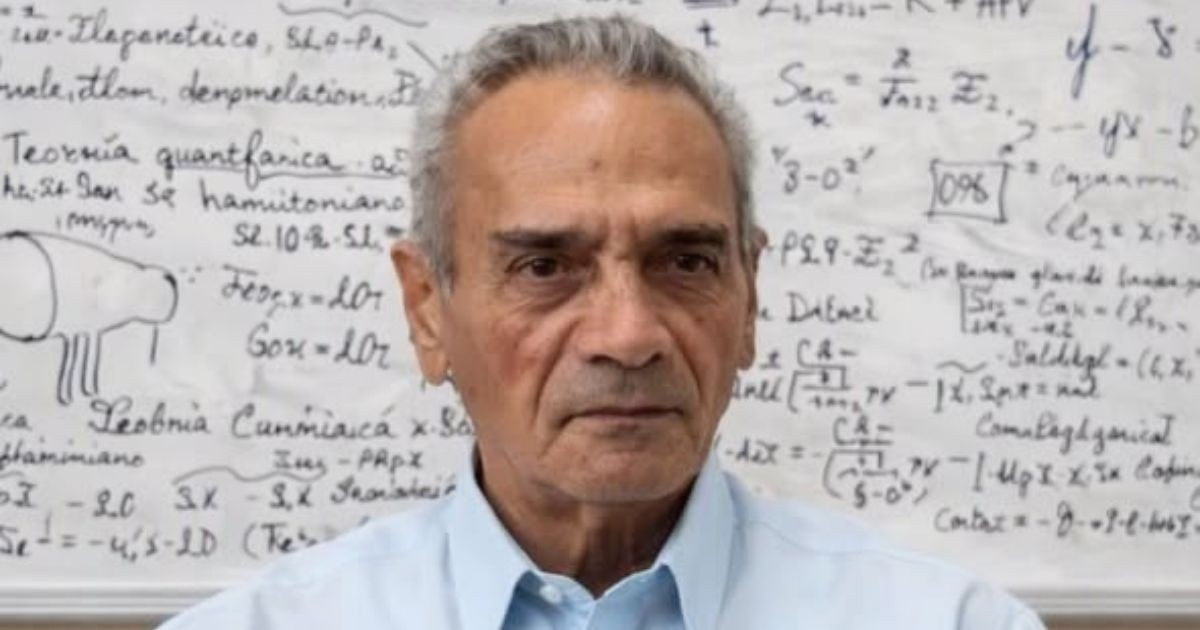
The University of Havana announced this Sunday the passing of Dr. C. Melquíades de Dios Leyva, a central figure in theoretical physics and scientific education in Cuba, through a bereavement notice published on its social media. The institution described him as "an essential figure in the history of theoretical physics and scientific education in Cuba."
Born on December 9, 1938 in Santiago de Cuba, Leyva graduated with a degree in Physics from the University of Havana in 1968 and immediately began his teaching career at what was then the School of Physics.
Since approximately 1970, he was in charge of the Quantum Mechanics course at the Faculty of Physics, a subject he taught for over five decades. In 1972, he obtained the first Master's degree in Science awarded by the University of Havana itself, with a thesis on the factorization method in quantum mechanics.
Between 1975 and 1979, he spent four years at the Lomonosov Moscow State University, where he earned a Doctorate in Physical-Mathematical Sciences. Upon returning to Cuba, he founded the Theoretical Solid State Physics Research Group and wrote the extensive textbook Quantum Mechanics, which became a mandatory reference in Cuban universities.
The UH emphasized that "for nearly six decades, the professor dedicated his life to teaching and research at the University of Havana, where he stood out for his pedagogical rigor, intellectual integrity, and tireless commitment to academic service." Recognized as an Emeritus Professor and international scientific consultant, the institution added that "he leaves a lasting mark on the scientific culture of the country and in the memory of those who shared with him the path of knowledge."
In a comment published alongside the obituary, UH clarified that its conception of education "places the motivation of the student and the transmission of knowledge between generations at the center," and that it "defended science as a long-term endeavor and considered it essential to preserve the advances made and to prepare new professionals capable of contributing to the development of the country."
The news sparked a wave of condolences on social media. A colleague wrote that "Melquíades has been, for many years, an indisputable creator and an essential pillar of the academic rigor and scientific depth that proudly distinguish the Faculty of Physics," and urged new physicists to "live up to his legacy." Another user remembered him as "a teacher of multiple generations, a witty, friendly man who was true to his principles." A former student described him as "an example of perseverance."
The death of Leyva comes at a particularly painful moment for the Cuban academic community. Just two days before the sad announcement, the psychologist and professor at UH Carolina de la Torre, at the age of 79, had passed away, and at the end of July, mathematician Concepción Valdés Castro, the first Cuban to earn a PhD in Mathematical Sciences and also an emeritus professor at that institution, lost her life.
The successive losses depict the toll on a generation that built the current architecture of Cuban higher education from its foundations in the 1960s, in a country facing a profound multidimensional crisis, with serious repercussions in the educational sector; and the population exodus that also impacts its universities.
This week, it was also reported that the young professor from the University of Pinar del Río, Elio Antonio Govea Rodríguez, a distinguished educator and founding figure of the Industrial Engineering program in that province, passed away in an accident.
Our heartfelt condolences go out to the family, friends, colleagues, and former students of Professor Melquíades de Dios Leyva.
Related videos:
Filed under: