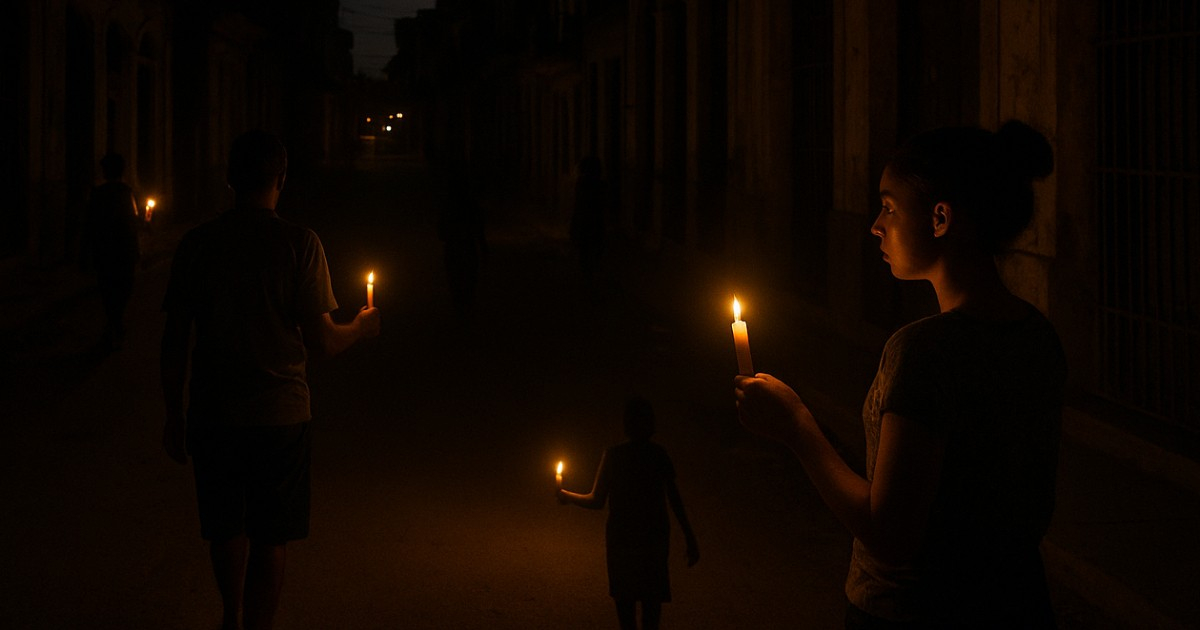
The journalist Yirmara Torres Hernández reported this Saturday on social media that her neighborhood, Los Mangos, in Matanzas, had been without electricity for 44 consecutive hours, with the last sign of power recorded on Thursday, between nine and eleven at night.
Before that brief two-hour supply, the neighborhood had already been in the dark for 53 hours. The sequence of consecutive outages led Torres to a conclusion that encapsulates the resignation of thousands of Cubans: "Not having electricity ever, that is normal, it is our routine."
Torres, who chaired the government-aligned Union of Journalists of Cuba (UPEC) in Matanzas for several years before resigning in 2023, has repeatedly documented the deterioration of the electrical system in her area. In June, she reported 55 consecutive hours without electricity in Matanzas, and in March described blackouts lasting 32, 24, and 26 hours straight as a “psychological torture”.
In her Facebook post this Saturday, the journalist pointed out that the situation has ceased to surprise those who experience it daily: "The worst part is that we are already used to this [...] we don't even have the power to be amazed anymore." She added: "The news would be having electricity again. Not having it, that everything is difficult, and that the electrical system is failing—that is no longer news for us."
The comments on his post painted a picture of the crisis overwhelming Los Mangos. A neighbor from the area stated that they had already been without power for 47 hours at the time of writing. From Unión de Reyes, they reported a total of 75 hours without electricity. A resident from the Iglesia neighborhood, within the city of Matanzas, noted that they had been without service for almost four days since noon on October 12.
The most extreme testimony came from Colón: a resident reported that her neighborhood had been without electricity for 56 consecutive days due to a transformer failure, unable to specify how long they had also been without water. “The little youth we have left is slipping away, I feel so miserable,” she wrote. Another internet user summed up the new reality with a phrase: “Electricity is no longer a service. It is now an event.”
The critical electric situation in Matanzas has been worsened by the disconnection of the National Electroenergetic System (SEN) on October 14 from the Antonio Guiteras thermoelectric plant, located in that province and considered the largest unit block of thermoelectric generation in Cuba. The facility was taken out of service due to a leak in the economizer of its boiler, which caused additional damage to the low-temperature reheater.
According to Román Pérez Castañeda, the general director of the plant, the repairs required the replacement of 11 sections of piping, as well as conducting metallographic inspections and safety tests. Amid the generation deficit affecting the country, the director of the Electric Company of Matanzas, Alejandro Rodríguez Aspeitía, acknowledged a provincial impact exceeding 130 megawatts.
Other municipalities in Matanzas were recording equally alarming figures: Manuelito and Bolondrón were approaching 70 hours without power this Saturday, while circuits in Jagüey Grande exceeded 60 hours.
Meanwhile, faced with a national demand of 2,800 MW and an availability of only 920 MW, the Electric Union forecasted an impact of 1,910 MW during peak hours this Sunday.
The Electric Company of Guantánamo announced that it could only guarantee around two hours of electricity daily per customer.
In the province of Pinar del Río, the First Secretary of the Communist Party, Yamilé Ramos Cordero, acknowledged this Sunday that some circuits had accumulated over 90 hours without power, with the supply restricted only to three hospitals and, at times, to the well field that supplies the provincial capital.
Desperation has led to spontaneous protests in several provinces. In Real Campiña, Cienfuegos, residents banged pots and played horns after five days without electricity. In Santa Rita, Granma, they took to the streets on Saturday shouting "We want electricity!", and in Cabañas, Artemisa, there were two days of protests on October 9 and 14.
On Friday, a fire at the Ernesto Guevara thermoelectric plant in Santa Cruz del Norte, Mayabeque, raised the simultaneous impact to 75.5% of the national territory, the highest level recorded since statistics on generation began to be published in 2022, according to a report from the news agency EFE.
UPDATE: According to a post from this Sunday by the journalist herself, the blackout that lasted 44 hours had already exceeded 60.
Related videos:
Filed under: