
Related videos:
The Cuban journalist Yirmara Torres Hernández described this Saturday the energy crisis that the country is experiencing as a form of "psychological torture," referring to the physical and mental exhaustion that citizens endure after days of prolonged blackouts and the recent collapse of the National Electric System (SEN).
In a public reflection on his Facebook profile, Torres recounted that even before the SEN collapse on Wednesday at noon, some circuits had been experiencing minimal electricity for several days.
He explained that in the area where he lives, in Matanzas, the power outages lasted up to 32, 24, and even 26 hours consecutively, with only two or three hours of service.
He also mentioned the case of the circuit where his parents live, in the municipality of Colón in Matanzas, where power outages have lasted over 40 continuous hours.
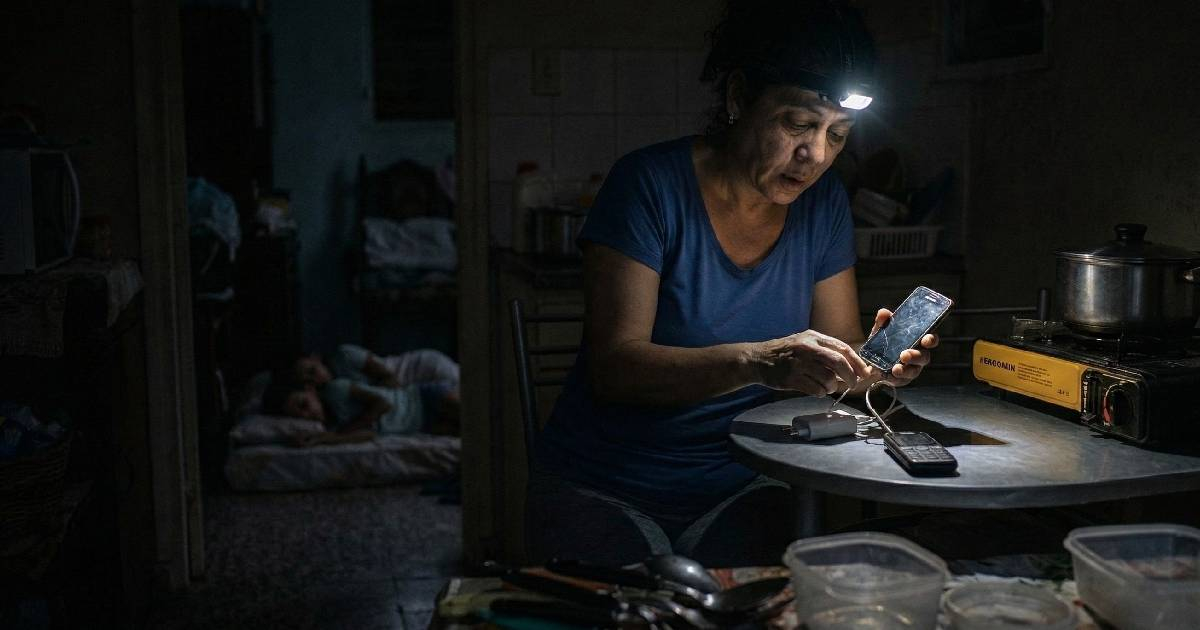
"One is a seeker of the scraps of electricity they give you," wrote the communicator, describing how citizens must organize themselves early in the morning or at any moment to cook, charge their phones, or light their homes when electricity briefly appears.
The former president of the Union of Journalists of Cuba (UPEC) in the western region stated that the current situation further worsens the precariousness, as some areas continue to lack electricity following the collapse of the SEN, while others are able to restore it partially.
"I honestly don’t even think anymore. I’m delirious, but not from fever," he stated in his post, where he also questioned whether those without batteries, generators, or solar panels could recover from the psychological impact of living for years with blackouts.
Her testimony extended beyond the electrical issue and mentioned other daily difficulties, such as food shortages, lack of water—which she said she has been addressing by buying water trucks for months—deteriorating transportation, and the challenge of acquiring medications.
The text generated numerous reactions from citizens who shared similar experiences.
Some users spoke of "cruelty" and a progressive deterioration of mental health caused by prolonged blackouts, while others stated that many families feel they are barely "surviving" under the current conditions.
Torres' testimony comes amidst one of the most severe energy crises in recent years in Cuba.
In recent days, the generation deficit has exceeded 2,000 MW during peak hours, resulting in blackouts that in some areas surpass 20 hours a day.
The outage of the Antonio Guiteras thermoelectric plant, the largest in the country, on Wednesday due to a boiler failure, triggered a chain reaction that left a large part of the national territory without electricity.
The electricity crisis is due to a combination of structural factors, including the deterioration of thermal power plants, a lack of maintenance, and a shortage of fuel that has left a significant portion of distributed generation inactive.
Torres has questioned the crisis management within the island on other occasions. In previous publications, he denounced the lack of transparency in handling the chikungunya epidemic in Matanzas and also warned about the increase in the number of Cubans who are going hungry.
His new testimony adds to a wave of citizen complaints that reflect the social exhaustion caused by prolonged blackouts, in a context where the national electrical system continues to operate with very limited capacity.
Filed under: