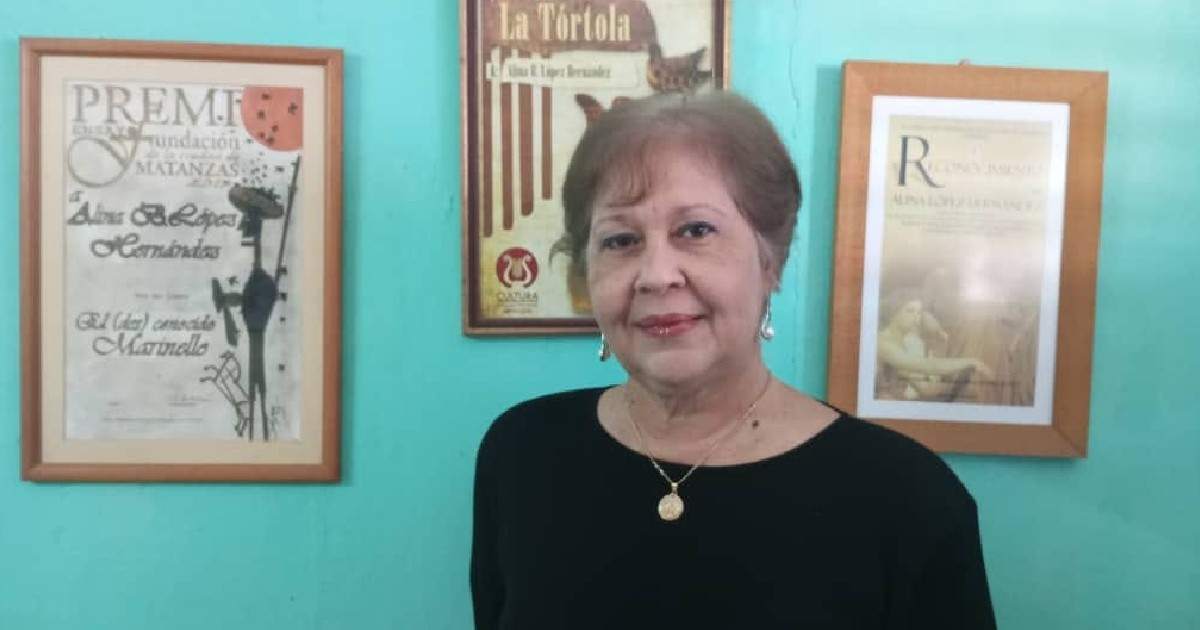
The Cuban philosopher and historian Alina Bárbara López Hernández, confined in Matanzas under house arrest, published an essay in the magazine Journal of Democracy, published by Johns Hopkins University Press, in which she examines the state of Cuban civil society and the real possibilities for a democratic transition on the Island.
In the text titled "Cubans Lead from Within," the scholar argues that social discontent has moved from social media to the streets, but she warns about the fragmentation of activism and the lack of structures capable of sustaining political change.
Consider that civil society on the Island is undergoing a transformation amidst power outages, shortages, and the decline of public services, but warns that discontent alone does not guarantee a democratic transition.
In an article, the professor also examines the evolution of independent activism in Cuba, the challenges it faces under state repression, and the obstacles that still prevent local protests from becoming an organized national movement.
López Hernández explained on Facebook that the text was created collaboratively: the analysis of the Cuban reality reflects his perspective, while the final assessment was informed by the editors' experience in studying pro-democracy movements around the world.
The Cuban crisis and social discontent
The author describes a country struck by energy collapse, worsening poverty, and the loss of Venezuelan oil supplies that for years helped sustain electric generation and transportation.
This scenario is compounded by the emigration of lawyers, journalists, organizers, and other individuals with the necessary skills to promote a democratic opening. The departure of these professionals, it points out, makes it difficult for activism within Cuba to establish stable structures and replace the leaders who leave the country.
According to the explanation, the current crisis is not solely due to material difficulties. The deterioration of living conditions is compounded by decades of restrictions on civil and political rights, as well as the growing ability of citizens to access information and challenge the official narrative through the Internet.
The author identifies three fundamental transformations: dissent has begun to emerge from the virtual realm, the Cuban government has lost Venezuela as its main benefactor, and immigration restrictions have diminished the possibility of emigration functioning as a safety valve. "Cubans understand that they will have to confront the crisis from within," she stated.
From social media to protests in the streets
López Hernández identifies one of the turning points in the protests of July 11, 2021, when thousands of Cubans took to the streets in various locations to express their discontent.
However, it is important to consider that the ways of mobilization have changed. Prolonged power outages and the deterioration of telecommunications infrastructure hinder national coordination in real time, which is why many protests are now concentrated in neighborhoods, blocks, and municipalities.
The author also highlights the protests at universities following the rise in Internet prices on May 30, 2025. In her view, the restriction of access to the Internet ultimately pushed discontent into the public sphere, rather than keeping it confined to the digital environment.
Another important change, he argues, is that the demands have ceased to focus exclusively on basic needs. Alongside requests for electricity, water, food, and medicine, explicit calls for freedom and political change have emerged.
As an example, mention the events of last March in Morón, Ciego de Ávila, where a group of protesters burst into the headquarters of the Communist Party and burned documents and furniture, as well as daytime protests, street closures, garbage burning, demonstrations in front of government buildings, and the appearance of graffiti with slogans such as “«Freedom», «Homeland and Life» and «Down with the dictatorship».
"People are learning not to wait for permission to demand, inform, organize, and assert their right to participate in public life. (...) Today, it is rare to find someone who does not acknowledge, either publicly or privately, that they urgently desire change," emphasizes López Hernández, who, however, stresses that for this shift to be lasting, there must be "a serious education and civic practice."
Repression seeks to prevent activism from organizing
One of the central arguments of the article is that Cuban civil society exists despite legal restrictions and repression against independent organizations.
Activism encompasses a wide range of causes: from the defense of human rights and the documentation of abuses against political prisoners to protests over basic services, opposition to Mandatory Military Service, the protection of animals, and support for poor or ill families.
"From the outside, it is often assumed that state repression is driven by ideological motives, but that is not the case," clarifies the historian, who notes that both critical opinions and leadership roles, as well as connections that could enable citizens to organize, are punished. Among the mechanisms she describes are pressures to force emigration, restrictions on returning to the country, and movement limitations imposed on individuals still in Cuba.
The main obstacle: the lack of unity and organization
Although he acknowledges the growing discontent and the bravery of those who protest, López Hernández warns that the pro-democracy movement in Cuba continues to face significant weaknesses.
It mentions the personal rivalries among opposing figures, the lack of collaboration on common platforms, and the difficulties in presenting proposals that resonate with the everyday concerns of the population, without being reduced to ideological labels.
It also highlights a gap between some activists and the communities they aim to represent. Repression, it points out, keeps them isolated from their own environments, while international attention often focuses on visible figures from the outside, leaving those protesting within the neighborhoods with less support.
For the author, the issue is not the lack of ideas for a transition. She cites initiatives and roadmaps developed by organizations such as the Council for Democratic Transition in Cuba, D’Frente, Cuba Próxima, and CubaxCuba Civic Thought Laboratory.
The challenge lies in linking those proposals with the local networks that are emerging amid the crisis and building a structure capable of sustaining mobilization beyond isolated episodes.
But for her, the most important aspect of Cuban activism is not the organizations or their actual power. "It's simpler than that; people are learning to stop waiting for permission, to make demands, generate information, organize, and assert their right to participate in public life," she said.
The teacher praises the work of citizen journalism and independent media in documenting repression, the decline of healthcare, education, and transportation, as well as the rise of crime and corruption.
"There's still a long way to go. Cuba needs people to organize from within and support from outside. But the path has been opened, and what comes next may depend less on its scope than on the level of organization that is achieved. A society begins to move beyond totalitarianism the moment it understands that it can think, organize, and act without asking for anyone's permission," he expressed.
The transition depends on a civil society capable of acting from within
The final part of the essay, developed with contributions from the editors as explained by López Hernández, compares the experiences of Poland and South Africa, where civil movements had developed organizational structures prior to transitions, with those of Libya and Syria, where fragmentation hindered the consolidation of political alternatives. The analysis suggests that Cuba needs to strengthen its civic organization to turn a potential opening into a democratic transition.
The comparison suggests that the value of activism does not solely depend on the number of protests or the bravery of those involved, but rather on its ability to endure over time and represent the demands of the citizenry.
In the case of Cuba, the analysis indicates that mutual aid networks, protests occurring in broad daylight, and the expansion of demands for freedom may become the foundation for a more solid organization.
However, the analysis warns that this process requires overcoming fragmentation and establishing connections between existing initiatives and the citizens who are mobilizing in their communities.
López Hernández argues that democratic change cannot rely solely on the collapse of the system or on negotiations between Cuban authorities and foreign actors. It requires a citizenry capable of formulating its own demands, informing itself, organizing, and participating in public life without depending on the permission of those in power
Related videos:
Filed under: