The crisis of the Cuban socialist model did not begin yesterday. It is the result of decades of economic, political, and institutional decisions that ultimately weakened its own foundations. The system promised prosperity, equality, and social justice, but built an economy incapable of producing enough wealth, a society dependent on the State, and a citizenry that for a long time was denied the possibility of organizing outside of political power.
However, there is something that the regime has not been able to control completely: the awakening of civil society.
For decades, the State presented society as a uniform block. The propaganda spoke of "unity," but that unity meant, in practice, political subordination. Trade unions, student organizations, professional associations, and mass organizations became integrated into the state apparatus and the Communist Party. Citizen participation ceased to be a free expression of society and turned into an activity organized from above.
But no political structure can forever control the needs, aspirations, and frustrations of millions of people.
An economy that stopped responding
The economic crisis is one of the fundamental factors contributing to the deterioration of the model. The centralized economy progressively replaced private initiative with state planning. The state determined what to produce, how much to produce, where to invest, and largely what to consume. The result was an economy with few incentives, low productivity, dependency on foreign markets, and limited capacity to respond to the actual needs of the population.
The disappearance of the European socialist bloc dramatically exacerbated that fragility. Cuba lost preferential markets, credits, supplies, and sources of fuel. The so-called "socialist option" failed to prove that it could stand on its own.
Subsequently, there were periods of recovery, but without any fundamental structural transformation. The economy continued to depend on tourism, remittances, imports, foreign aid, and certain exports, while agriculture remained unable to adequately ensure national food supply and a significant portion of the industry lost productive capacity.
But the problem was not only economic; it was also political.
When a state controls most of the economy, it also controls a significant part of the lives of its citizens. Employment, wages, housing, and numerous social opportunities have been tied for decades to obedience and political position. That is why the economic crisis inevitably became a crisis of citizenship.
A citizen who cannot decide what to produce, where to work freely, what company to create, what association to organize, or what media outlet to establish does not have true autonomy in relation to power.
From silence to discontent
For a long time, fear was one of the most effective tools of the system. Repression, surveillance, interrogations, expulsion from workplaces, academic sanctions, and political persecution created an environment where many people learned to remain silent.
But remaining silent does not mean agreeing. Beneath the surface of apparent unanimity, generations of frustrations have been accumulating. Children who heard critiques in their homes that they could not repeat publicly. Young people who began to question official propaganda. Workers who discovered that their salaries were not enough to make ends meet. Professionals who compared their reality with that of other countries. Artists who demanded freedom of creation and independent journalists who chose to report outside of state media.
Thus began a fundamental change: society started to lose its fear. This process was not sudden. It was cumulative. Traditional political opposition began to coexist with new forms of social, cultural, and civic protest. The artist began to transform into an activist. The independent journalist became a citizen communicator. The Internet user turned into a witness of reality. And the young person protesting on a corner began to realize that they were not alone.
Internet: a window that the State could not close
The expansion of the Internet profoundly changed Cuban society. For decades, citizens relied almost exclusively on official media for news. Television, radio, and press were under state control. The official version could present a reality very different from what people experienced daily.
The internet partially broke that monopoly. A mobile phone allowed people to broadcast a protest, photograph a line, report an arrest, show a blackout, or publish a testimony in a matter of seconds. Information no longer flowed solely from the top down; it began to circulate from citizen to citizen as well.
The state could arrest a protester, but it faced greater challenges in preventing thousands of people from seeing images of that arrest. It could censor a media outlet, but it could not completely control the conversation taking place on social media.
Society began to turn into a producer of information. And when a society starts to produce and share information independently of power, it also begins to construct its own public sphere.
San Isidro, July 11, and the new protest
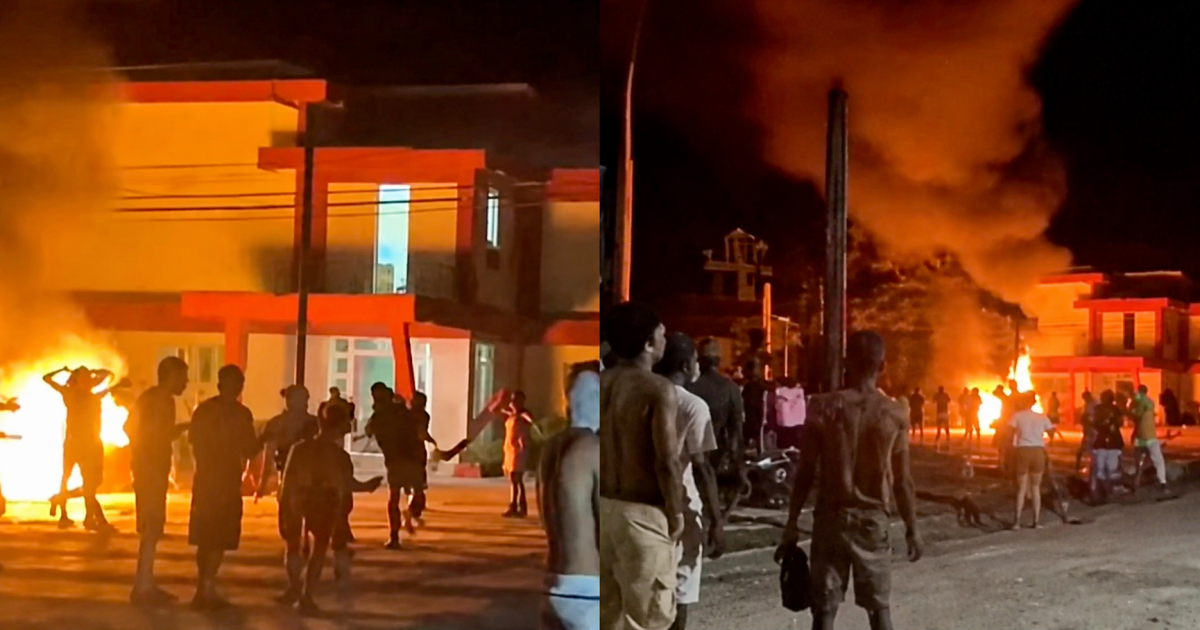
In this process, the new expressions of opposition that have emerged in recent years take on special importance. The San Isidro Movement showed that a segment of the artistic community could transform a cultural demand into a political one. The protests of July 11, 2021, demonstrated something even more significant: thousands of Cubans spontaneously took to the streets in various parts of the country to call for change.
It was not merely a protest organized by a traditional political structure. It was, to a large extent, a social explosion. People took to the streets for various reasons: lack of food, power outages, deterioration of services, poverty, absence of freedoms, and the exhaustion of a system that had been promising a future that never arrived for decades.
The cry of "freedom" then took on a national dimension. This represented a turning point. Those in power discovered that discontent no longer belonged exclusively to small opposition groups. It had deeply permeated society.
And society discovered something even more important: that it could take to the streets.
From traditional opposition to active citizenship
One of the most significant transformations in contemporary Cuba is the emergence of forms of participation that do not necessarily adhere to the traditional model of political parties.
Independent journalists, artists, community activists, aid organizations, family groups, human rights defenders, entrepreneurs, digital communicators, and citizens have emerged, using social media to organize and express their opinions.
Not everyone shares the same ideas. Not everyone belongs to the same political movement. Not everyone wants to participate in parties. And therein lies an essential characteristic of modern civil society: its plurality. A genuine civil society does not need to think alike. It needs the freedom to organize itself.
In a democracy, liberals, conservatives, social democrats, Christian democrats, republicans, independents, and citizens who simply wish to live in freedom without belonging to any organization can coexist. The issue with the Cuban model has precisely been the denial of that diversity.
For decades, citizens were led to believe that there was only one legitimate way of thinking: that established by the Communist Party. However, society is proving that diversity is not a threat. Diversity is society.
The citizen as the protagonist
The great transformation we are witnessing is not only about the growth of political opposition. It is something deeper: it is the birth of a civic consciousness. Cubans are beginning to question not only who governs, but also what the purpose of government is and what its limits are.
Start demanding rights, not favors. Understand that education, healthcare, housing, work, and food cannot be used as instruments of political obedience. Begin to claim freedom of expression, association, economic activity, religion, movement, and participation in national decisions.
This transformation is essential because a democracy is not built merely by changing a government. It is built by educating citizens who can defend their rights and respect the rights of others.
The Cuba of the future will need political parties, but also civil associations, independent labor unions, free universities, diverse media, professional organizations, churches, entrepreneurs, cooperatives, cultural institutions, and citizens capable of actively participating in public life.
The true awakening
The crisis of the Cuban socialist model is, therefore, much more than an economic crisis. It is a legitimacy crisis. The argument that all difficulties are solely the result of the U.S. embargo is insufficient to explain a much more complex reality. External restrictions exist and must be analyzed, but they do not, on their own, account for decades of unproductivity, bureaucracy, centralization, corruption, lack of incentives, and absence of economic freedoms.
The fundamental problem also lies within the model itself. While the economy deteriorates, society changes. A new generation of Cubans has grown up connected to the world. They are aware of other realities, make comparisons, ask questions, and challenge assumptions. They no longer easily accept the official explanation that present sacrifices inevitably lead to a better future.
That future has been elusive for more than six decades. This is why the awakening of civil society represents one of the most significant historical events in contemporary Cuba.
The opposition can no longer be understood solely as the activity of certain political leaders. It is also present in the citizen who demands transparency; in the mother who advocates for food, in the worker who calls for better conditions, in the artist who defends their creative freedom, in the journalist who reports without official permission, and in the young person who asks why they cannot freely decide their own future.
History shows that political systems can withstand for a long time through force. However, no system can remain indefinitely detached from the aspirations of its own society.
Cuba is experiencing, with pain and contradictions, the transition from a society subjected to one that is beginning to see itself as a citizenry. This process is still incomplete. Its outcome will depend on the ability of Cubans to turn protest into organization, discontent into participation, and the desire for freedom into democratic institutions.
Because dismantling a political model can be difficult. Building a free, diverse, and responsible society will be even harder. And that will be one of the great tasks of the Cuba that lies ahead.
Related videos:
Filed under:
Opinion article: Las declaraciones y opiniones expresadas en este artículo son de exclusiva responsabilidad de su autor y no representan necesariamente el punto de vista de CiberCuba.