If you have been in the United States for more than a year and have not yet applied for asylum, it's not always too late. The law requires that you submit your application within the first year of your last arrival in the country, but it allows for two types of exceptions: changed circumstances and extraordinary circumstances.
If you provide any of these and present the case within a reasonable timeframe, your request may be considered.
For many Cubans, one of the most important exceptions is having maintained parole or a valid immigration status until shortly before applying for asylum.
The federal regulations expressly contemplate that possibility. However, the expiration of the parole does not initiate a new legal timeframe of one year: the individual must submit the application within a reasonable period, the length of which depends on the circumstances of their case.
How is a one-year period counted?
The rule is in 8 CFR 208.4 of the Code of Federal Regulations.
These are your key points:
- The year starts to count from your last arrival in the United States. If you left the country and returned, count the date of your most recent return.
- You must provide clear and convincing evidence that you presented within the year. This is a high standard of proof: keep the I-94, stamps, tickets, or any documents that validate your date of entry.
- If the last day falls on a weekend or holiday, the deadline is extended to the next business day.
- In front of the immigration court, the application is considered submitted on the day the court receives it. If it did not arrive on time but you have clear documentary evidence that you mailed it within the deadline, you can count the mailing date according to the applicable rules.
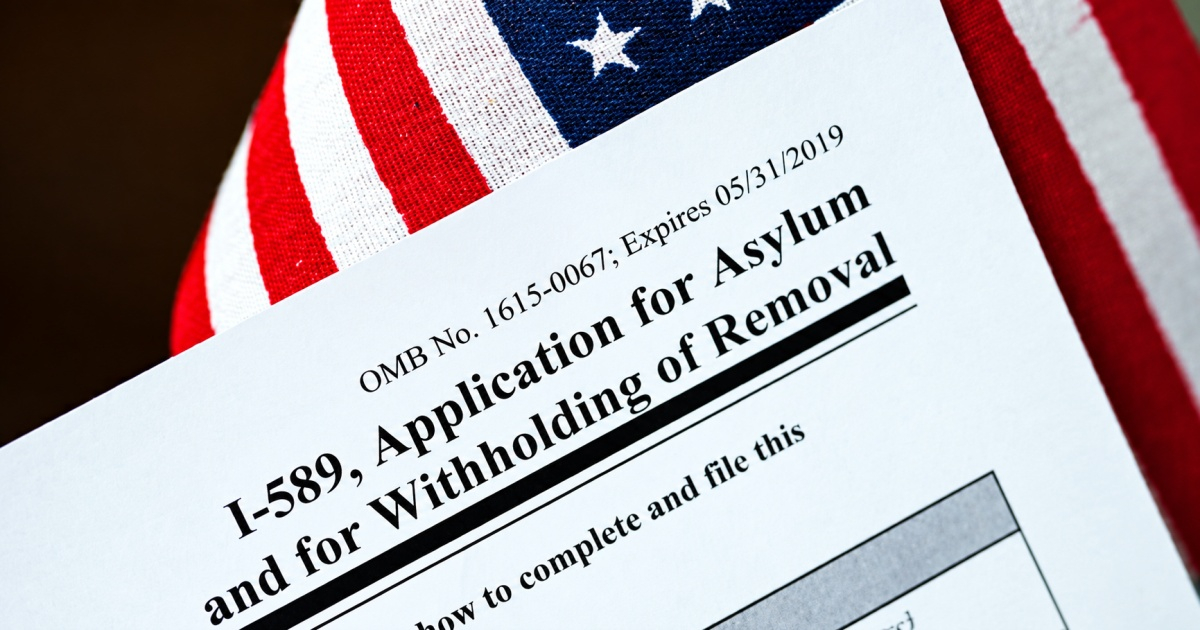
The application is made using Form I-589, which according to 8 CFR 208.3 serves as both an asylum application and a request for withholding of removal.
First exception: changes in circumstances
The regulation accepts changes that significantly affect your right to asylum. It provides three examples:
- Changes in the conditions of your country. For example, a tightening of the persecution against a group to which you belong.
- Changes in your personal situation. This includes changes in U.S. law and activities you begin to engage in outside the country where you fear persecution. For a Cuban, this may involve activism against the regime from exile, participation in protests, or public denunciations that could expose you to reprisals if you return.
- Loss of dependent status. If you were included in the application of your father, mother, or spouse and cease to be so due to divorce, the death of the primary applicant, or because you turned 21 years old.
Additionally, you must submit the application within a reasonable timeframe after the change.
The Board of Immigration Appeals (BIA) clarified in Matter of T-M-H- & S-W-C- (2010) that a change in circumstances does not automatically grant an additional year.
The judge or the officer analyzes each case based on the reasons for the delay.
Second exception: extraordinary circumstances
They are facts directly related to your inability to present on time. You must demonstrate that you did not cause them and that the delay was reasonable. The regulations mention these examples:
- Serious illness or disability during the first year, including the effects of persecution or violence experienced.
- Legal incapacity, such as being an unaccompanied minor or having a mental health issue.
- Poor representation by a lawyer (ineffective assistance of counsel). Requires a detailed affidavit regarding what was agreed upon with the lawyer, having been informed of the charges in a timely manner to respond, and explain if you filed a disciplinary complaint.
- To have maintained TPS, a legal status of immigrant or non-immigrant, or parole until shortly before applying.
- A timely application that was rejected due to formal defects, if you resubmitted it within a reasonable timeframe.
- Death, serious illness, or disability of your legal representative or an immediate family member.
If you had parole: how much time do you have to apply for asylum after it expires?
The exception of parole is especially relevant for Cubans who entered under the CHNV program, with humanitarian parole, or with parole at the border. But it is not a blank check.
The general one-year deadline to apply for asylum is counted from the last entry to the United States, not from the date the parole ends.
However, having maintained that permit until shortly before submitting the application may constitute an extraordinary circumstance that justifies exceeding the initial deadline.
When the Department of Justice approved these regulations, it explained in the preamble to the asylum rule dated December 6, 2000, that it expects the individual to apply for asylum as soon as possible after losing their status.
The document states that, as a general rule, a delay of six months or more is not considered reasonable.
This does not mean that there is an automatic additional six-month period, nor that all applications submitted after that timeframe must be rejected without considering their circumstances.
The reasonableness of the delay is assessed on an individual basis, taking into account the specific reasons for the delay and the evidence provided.
The BIA also addressed the importance of justifying the delay in Matter of T-M-H- & S-W-C- and noted that prolonged delays require circumstances to explain them.
In practice, if your parole has expired or was canceled months ago, it is advisable to act as soon as possible. If you find yourself in that situation, also review our guide on what to do if your parole has expired.
If you have an I-220A, be careful with this exception
The regulation discusses parole. And the BIA decided in Matter of Cabrera-Fernández (2023) that release with I-220A is legally distinct from humanitarian parole. Therefore, someone with an I-220A should not assume that they can use the parole exception to justify a late asylum claim.
Many Cubans with I-220A have already applied for asylum before the immigration court. If you haven't done so, your case needs urgent review by a lawyer, who will assess whether there is another applicable exception.
We explain the document in detail in what the I-220A is and why it is not a parole.
What happens if they don't accept your exception?
It depends on where your case is and your immigration status
- Before USCIS (affirmative asylum): según el Article 8 CFR 208.14, si el oficial no concede el asilo, la decisión posterior depende de las condiciones migratorias y procesales del solicitante. En los casos que corresponda, USCIS remite la solicitud a un juez de inmigración para que sea examinada en un procedimiento de deportación. Si la persona mantiene un estatus migratorio válido o un parole vigente, el reglamento contempla la denegación de la solicitud sin remisión automática a la corte. Existen además procedimientos específicos para determinadas personas cuyo parole ha vencido o ha sido cancelado.
- Before the immigration court: the judge may deny you asylum due to the timeline, but the one-year rule only applies to asylum. The article 8 CFR 208.4 clarifies that it does not apply to withholding of removal, which the judge can continue to consider.
The denial of asylum due to late submission does not necessarily mean that all forms of protection against expulsion are ruled out.
In addition to the withholding of removal, it may be necessary to evaluate the protection provided under the Convention Against Torture, depending on the facts of the case.
These protections have different requirements and do not offer the same benefits as asylum. Therefore, it is advisable to avoid losing eligibility due to the time limit when an applicable exception exists.
How much does it cost to apply for asylum?
According to the notice published in the Federal Register on October 1, starting from October 16, 2026, the initial filing fee for Form I-589 is $100.
Additionally, pending applications are subject to an annual fee of $105, in accordance with the applicable rules.
For applications submitted after October 1, 2024, the first annual payment is generally due 365 days after the pending processing begins.
The oldest applications may be subject to a different schedule.
The collection process, notifications, and consequences of non-payment depend on the authority handling the case and the applicable regulations.
Therefore, it is important to review the official communications from USCIS or the immigration court and not to assume that all applicants have the same payment date.
You can find more details in our guide on the new USCIS fees for Cubans.
What to do now?
- Calculate your dates. Note the day of your last entry and, if you had parole or status, the exact day it expired or was canceled.
- Gather the evidence for the exception. A copy of the I-94 and the parole document, cancellation notices, medical reports, evidence of your activism or changes in your situation.
- Explain the delay. It's your turn to demonstrate the exception. Provide the truth about why you did not submit on time and support it with documents.
- Don't wait until everything is perfect. If your parole has ended and you still haven't applied for asylum, seek advice as soon as possible. The passage of time can make it challenging to justify the delay, even if less than six months have passed.
- Seek advice now. A lawyer or accredited representative can assess which exception fits your case best.
Aviso legal: este artículo ofrece información general con fines exclusivamente informativos y no constituye asesoría legal. Las leyes y políticas migratorias de EE. UU. cambian con frecuencia. Para evaluar tu caso concreto, licenciado o un representante acreditado por el Departamento de Justicia.
Related videos:
Filed under: