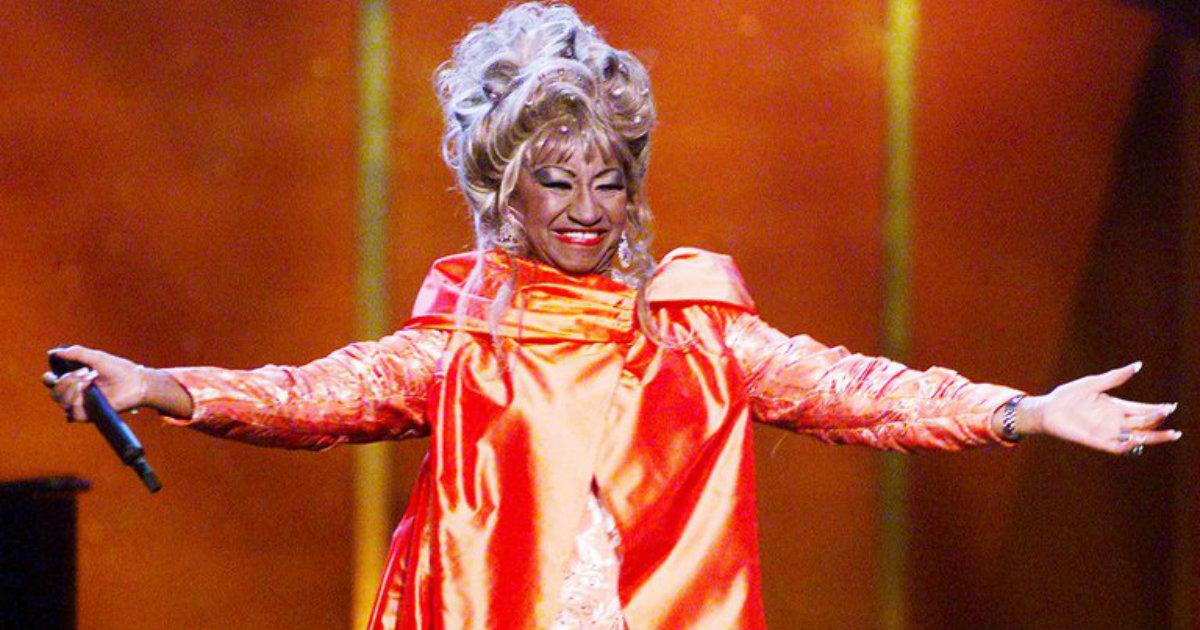
The city of Miami will build a plaza dedicated to Celia Cruz in the heart of Little Havana, in tribute to the legendary Cuban singer who would have turned 101 years old this Wednesday, October 21.
The space will be named "Plaza Azúcar", in reference to the phrase that turned the artist into one of the great symbols of Latin music.
The project was announced by the Miami Mayor's Office, according to the agency EFE, and will be located in the Eight Street corridor, one of the most representative areas of the Cuban exile in the United States.
The initiative aims to preserve the memory of the Queen of Salsa through a new cultural space dedicated to her career and artistic legacy.
One of the main attractions of the future plaza will be a large-scale sculpture designed by Alex Kaufman, an artist specialized in monumental works.
The announcement coincides with a celebration scheduled for Wednesday night, during which the project will be presented and a recreation of Celia Cruz's voice using artificial intelligence will be revealed.
In the event, Omer Pardillo Cid, the executor of the artist's estate and responsible for preserving her legacy, will participate. He has spent years promoting initiatives to keep her work alive and to bring it to new generations.
Attendees will also receive 25-cent American coins featuring the image of Celia Cruz, issued as part of the American Women Quarters program, an initiative that honors prominent female figures in the history and culture of the country.
In August 2024, Celia Cruz became the first Afro-Latin artist represented on a 25-cent U.S. coin, a recognition that highlighted her contributions to music and her influence on American culture.
The project comes at a particularly significant time for Little Havana. Just a week earlier, the mural dedicated to Celia Cruz, Héctor Lavoe, Tito Puente, and other salsa legends was removed from a wall located at the intersection of Calle Ocho and 19th Avenue, where it had been since March 2023.
The disappearance of that artwork generated sadness among artists and members of the Latin community in Miami.
Its author, the Venezuelan Pedro Aguiar, expressed sorrow over the loss of the mural, which he had created together with Walter Santiago from the KCULL Life Foundation, who contributed personal resources to the project.
The building owner, Santos Campaneria, explained that he decided to remove the paint after feeling disappointed with the municipal authorities over the administrative and financial demands related to his property.
Municipal Commissioner Rolando Escalona expressed his willingness to explore alternatives to recover the mural, whether in the same building or in another space on Calle Ocho.
Born in Havana on October 21, 1925, Celia de la Caridad Cruz Alfonso began her artistic journey in Cuba and gained international recognition as a singer with the Sonora Matancera, before building an extensive career in the United States.
He left the Island on June 15, 1960, alongside the Sonora Matancera to fulfill artistic commitments in Mexico and did not return to Cuba. In 1961, he settled in the United States, where he became one of the most recognized voices of the Cuban exile and maintained a public stance against Fidel Castro's regime for decades.
His confrontation with the Cuban authorities had especially painful personal consequences. The singer was unable to return to Cuba to say goodbye to her mother, who passed away on April 7, 1962, an experience she remembered for years as one of the deepest wounds of her life.
In an interview featured in the Colombian newspaper El Tiempo, Celia recounted that she tried to travel to Cuba after hearing about her mother's death, but the authorities did not allow her to return.
"Honestly, I never forgave him," she said while recalling that incident.
The singer also publicly denounced the censorship of her music and the restrictions imposed by the Cuban regime. In an interview given in 1995 to the Brazilian newspaper Folha de S.Paulo, she explained that Fidel Castro's government prohibited her albums and her return to the country.
Despite being away from Cuba for more than four decades, the artist maintained a deep connection with Cuban musical traditions, evident in her recordings, concerts, and collaborations with figures from the international salsa scene.
Died on July 16, 2003, at the age of 77, without having been able to return to his homeland.
In the United States, her journey has been recognized through numerous public tributes. Among them is the Celia Cruz Way, inaugurated on October 11, 2023, in Miami Beach, and the Celia Cruz Park, in Union City, New Jersey, which also features a walkway dedicated to figures of Latin music.
In Little Havana itself, the singer received a star on the Hollywood Walk of Fame on Calle Ocho in 1991, after that iconic street was also designated in her honor in 1990.
Her image has inspired various public art pieces, including a mural unveiled on April 24, 2021, in front of her star, created by the artist Miss Lushy and the KCULL Life collective.
Related videos:
Filed under: