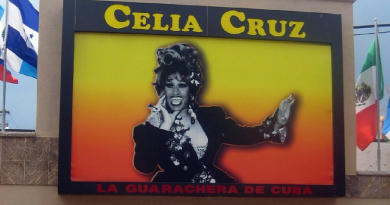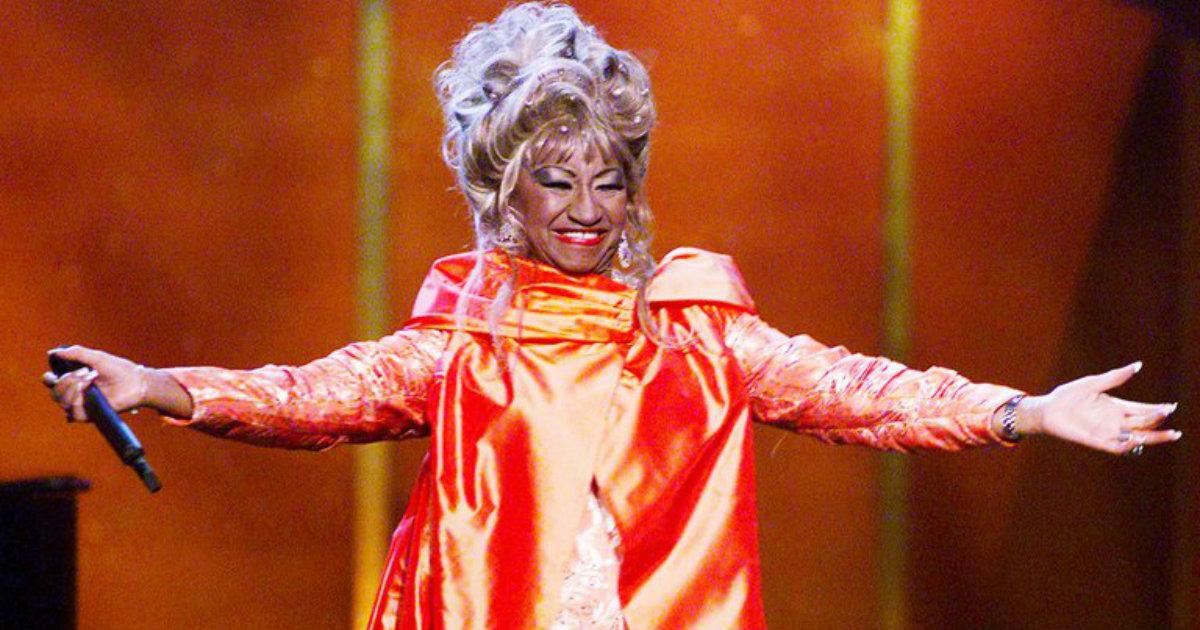
Úrsula Hilaria Celia de la Caridad de la Santísima Trinidad Cruz Alfonso, the full name of Celia Cruz, was a famous and renowned Cuban singer born in Santo Suárez on October 21, 1925. Biographers note that she displayed a talent for singing and a passion for music from a young age. Her father wanted her to become a schoolteacher, but her mother supported her in pursuing her dream of being a singer.
In its early days, he participated in several radio programs such as: La Corte Suprema del Arte, a competition by the CMQ station that aimed to discover new vocal talents, and Radio Cadena Suaritos, where he recorded his first recording alongside Obdulio Morales.
In 1948, she joined the dance group Las Mulatas de Fuego as a singer, founded by Rodrigo Rodney. With them, she began to achieve success and build a career outside the Island, traveling through Mexico, Venezuela, and in 1949, she went to Capernaum (Israel).
In 1950, the singer of La sonora Matancera, Mirta Silva, returned to her homeland, Puerto Rico, and Celia passed the selection tests to replace her. In this group, she spent 15 years and toured throughout Latin America. From this period, well-known songs include: El yerbero moderno, Burundanga, Ritmo tambó y flores, Caramelos, La sopa en botella, Tu voz, Pa' la paloma, Vallán vallende, among many others.
In 1960, she traveled to Mexico with La Sonora to fulfill the commitments of a contract and did not return to the Island. In 1961, Celia moved to the United States, where she lived until her passing in 2003 due to a brain tumor.
In 1966, Tito Puentes, with whom she recorded several albums, invited her to join his Orchestra, marking the beginning of her solo career. Her manager would be her husband, the trumpeter Pedro Knight, with whom she had married in 1962.
Throughout his extensive and prolific recording career, he worked for several record labels: Tico Records, Masucci Vaya Records (which marked a musical shift in favor of salsa), FANIA, Barbara Records, Sony Music Entertainment, RMM Records, among others.
Among his most memorable performances are the concert in 1975 at Yankee Stadium, recorded live with The Fania All-Stars and directed by Johnny Pacheco, and the one in 1982 at Madison Square Garden where he was honored for his successful music career. He also participated in the 1999 concert Pavarotti and Friends that took place in Modena.
In 1990, he gave a concert in Guantánamo. From there, he took a little bit of soil that he requested to be placed in his coffin when he died.
His concert in Santa Cruz de Tenerife in 1987, attended by 250,000 people, is recognized by the Guinness World Records as the largest outdoor concert.
She was nominated thirteen times for the Grammy Awards and six times for the Latin Grammy Awards. In total, she won five: in 1989 in the Best Tropical Latin Performance category for the album Ritmo En El Corazón alongside Ray Barreto, in 2000 for Best Salsa Album for Celia Cruz and Friends, in 2001 for Best Tropical Traditional Album for Siempre Viviré, in 2002 for Best Salsa Album and Best Tropical Song for La Negra tiene su tumbao, and posthumously in 2004 for Best Salsa Album for Regalo del alma (an album she never got to see) and Best Tropical Song for Ríe y llora.
She was recognized and awarded multiple times: in 1987, she was given a star on the Hollywood Walk of Fame; in 1995, she received one on the Walk of Fame in Caracas (Venezuela); in 1997, San Francisco declared October 25 as Celia Cruz Day; and in 2004, a year after her death, she was awarded the Premio Lo Nuestro for her last album. She was also bestowed with Honorary Doctorates on three occasions from three universities in the United States: Yale University, Florida International University, and Miami University.
He also ventured into cinema: Salsa (1975, documentary), Los reyes del mambo (1992), Cuando salí de Cuba (1995), and on television: Valentina (1993, telenovela), El alma no tiene color (1997, remake of the 1948 Mexican film Angelitos negros).
Some of her Albums: Canta Celia Cruz (1956), Cuba's Queen Of Rhythm (1958), La Incomparable Celia (1958), Cuba's Foremost Rhythm Singer (1958), Su Favorita (1959), La Dinámica (1960), Reflexiones de Celia Cruz (1960), Canciones Premiadas (1961), La Tierna, Conmovedora, Bamboleadora (1962), Mi Diario Musical (1963), Canciones que Yo quería haber Grabado Primero (1964), Con Amor (1964), Homenaje a los Santos (1964), Canciones Inolvidables "La Guagua" (1964), Homenaje a los Santos Vol.2 (1965), El Nuevo Estilo de la Guarachera (1965), Son Con Guaguancó (1966), Cuba y Puerto Rico Son... (1966), Sabor y Ritmo de los Pueblos (1964), Bravo (1967), Celia Cruz 67' (1967), A Ti, México! (1968), Algo Especial Para Recordar (1972), Only They Could Have Made This Album (1977), Eternos (1978), Ritmo en el Corazón (1988), Tributo a Ismael Rivera (1992), Azúcar Negra (1993), Irrepetible (1994), Azucar! (1997), Mi Vida Es Cantar (1998), Siempre Viviré (2000), La Negra tiene Tumbao (2001), Carnaval de Éxitos (2001), Hits Mix (2002), Regalo del Alma (2003), Feliz Navidad (2003), Celia Cruz In The House (The Ultimate Classic Hits Remix Collection) (2003)
Celia Cruz is regarded as one of the most influential and important artists of her generation and a musical symbol of Latin music. Her legacy has been honored through numerous tributes in the form of series, documentaries, and biographies. In 2003, a music school was opened in the Bronx called Celia Cruz Bronx High School of Music.
Throughout her long musical career, she shared the stage with numerous personalities such as Tito Puente, Héctor Lavoe, Marc Anthony, Gloria Estefan, La India, Willie Colón, Patti LaBelle, Ricky Martin, Lola Flores, Jarabe de Palo, Raphael, Vicente Fernández, Juan Gabriel, Los Fabulosos Cadillacs, Ángela Carrasco, Olga Guillot, Yuri, Willy Chirino, Óscar D'León, Olga Tañón, Toña la Negra, Dionne Warwick, Martha Jean Claude, Luciano Pavarotti, Aída Cuevas, Rubén Blades, La Sonora Santanera, Johnny Pacheco, Albita Rodríguez, Wyclef Jean, Lauryn Hill, Paulina Rubio, and El General among others.