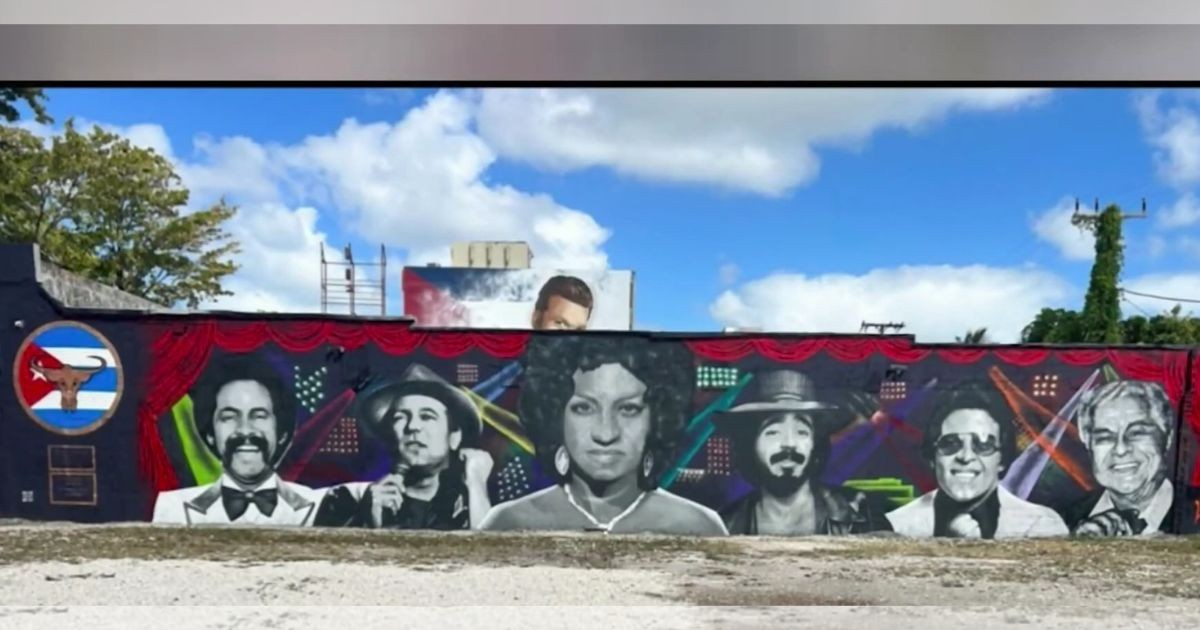
The Latino community in Miami has lost one of the tributes that added color and identity to Little Havana: the mural of Celia Cruz, Héctor Lavoe, Tito Puente, and other salsa legends that adorned a corner of Calle Ocho has been erased, leaving a wall that celebrated the musical history shared by Cubans, Puerto Ricans, and other Latin Americans without their faces.
The work, located at the intersection of Calle Ocho and 19th Avenue, disappeared at the decision of the building owner, Santos Campaneria, who explained to Telemundo 51 that he felt let down by the authorities in Miami due to the demands he has faced to keep his property and business running.
The mural was inaugurated in March 2023 as a tribute to the artists who helped turn salsa into one of the great cultural symbols of the Caribbean and the Hispanic community in the United States. Its disappearance has caused sadness, especially among those who participated in its creation.
Pedro Aguiar, the Venezuelan artist who painted the work, learned that it had been erased through social media. For almost a month, he worked on the project, mostly at night, alongside Walter Santiago from the Kcull Life Foundation, who also contributed with his own resources.
The artist explained that the mural held a personal and cultural significance that went far beyond merely decorating a facade.
"For me, as a Hispanic-Venezuelan, this has meant a lot to me because it represents my culture," he declared.
Aguiar expressed sorrow over the loss of a job he considered part of the identity of Calle Ocho, but he stated his willingness to repaint it.
He also assured that he now possesses greater artistic skills than when he created the original version.
For his part, Campaneria defended his decision by stating that he spent approximately $50,000 to meet requirements related to the building's 40-year inspection, demands that he believed were excessive and unnecessary.
The owner stated that he had relinquished the wall for a cultural project that did not receive municipal sponsorship, but later he did not find the support in the city that he expected to resolve the administrative difficulties related to his property.
"All the promises they made to help me were useless," said Campaneria, who explained that the authorities kept imposing requirements on him that, if not fulfilled, could force him to close his business.
The controversy also reached the district municipal commissioner, Rolando Escalona, who stated that he was unaware that the mural had been removed and expressed regret for not having had the opportunity to intervene before it happened.
Escalona noted that, within the legal powers of his position, he could have explored alternative assistance for the owner. He now plans to meet with Campaneria to try to obtain permission to restore the painting to its original location.
If that possibility does not come to fruition, the commissioner committed to finding another space on Calle Ocho where the tribute can be held again.
The disappearance of the artwork is particularly significant given its location: Little Havana is one of the main cultural references of the Cuban exile and the Latin presence in Miami, with an identity built around music, art, cuisine, and businesses established by generations of immigrants.
Celia Cruz maintains a prominent presence in that cultural landscape. In 1991, she received a star on the Walk of Fame on Calle Ocho, a recognition that her fans continue to remember as one of the most significant tributes to the Queen of Salsa.
The Cuban singer has also inspired other public art works in the neighborhood. In April 2021, another mural featuring her face was inaugurated on Calle Ocho, in front of her star on the Walk of Fame. That painting was created by the artist Miss Lushy and the local collective KCULL Life.
The tradition of honoring figures from Cuban culture through murals extends to other musicians. In October 2022, the iconic avenue also unveiled a work dedicated to the 50-year career of Willy Chirino, another artist closely linked to the musical history of the exile.
These recognitions are part of a cultural journey where the Walk of Fame, galleries, historic establishments, and spaces like Máximo Gómez Park, known as the Domino Park, coexist.
They are places that have made Little Havana one of the most representative destinations of Cuban culture in the United States.
Related videos:
Filed under: