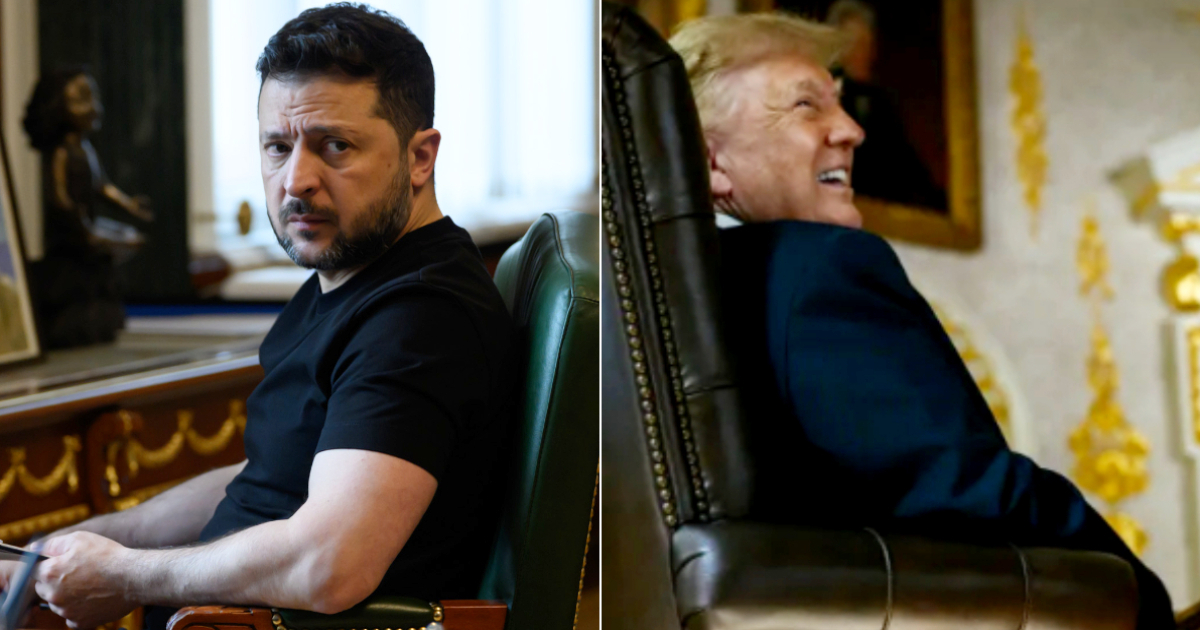
The Ukrainian president Volodymyr Zelensky abandoned the restraint that had characterized his relationship with Washington and adopted a distinctly confrontational tone with Donald Trump, as documented by The Kyiv Independent in an article published on Tuesday.
A Ukrainian official summed up the mood in Kyiv with a striking phrase: "Frankly, Trump has crossed the Rubicon."
The shift marks the end of nearly two years of calculated praise and diplomatic concessions with which Zelensky sought to maintain U.S. support while the war with Russia continued.
The turning point was the energy agreement announced on October 9 between Trump and Putin to facilitate the export of up to 4.8 million tons of Russian diesel, with a U.S. Treasury license valid until April 2027.
Zelensky described the pact as "unfair and dishonest" and warned that the revenues could finance the Russian military machinery.
Tensions escalated on October 16, when Trump signed an executive order to suspend the main sanctions against Russia outlined by the Lindsey Graham Act, just two days before they were set to take effect, citing reasons of "national interest."
On October 14, Zelensky broke his usual restraint and accused Trump of being "on the wrong side of history." "I don't know who is pressuring him, but this is not the right side of history," he stated, adding that Trump "does not want Ukraine to win."
Four days later, the tone became even harsher. Zelensky warned that it would be "a historic error" and "a great tragedy" for the United States to side with Putin, although he emphasized that Ukraine still viewed Washington as an ally.
Trump responded on Monday in front of the White House: "Zelensky doesn't know what he's talking about," and suggested it was time for "someone else to negotiate on behalf of Ukraine." That same day, Trump expressed openness to tripartite negotiations with Putin and Xi Jinping to address the conflict, even without the participation of Kyiv.
The immediate context also included 76 Russian attacks on Ukrainian energy infrastructure since the announcement of a supposed "energy truce" unilaterally proclaimed by Trump on October 11, which Moscow never officially confirmed.
Oleksandr Merezhko, chairman of the Ukrainian parliamentary committee on Foreign Affairs, described Zelensky's stance to the Kyiv Independent as "delicate yet firm": "The president cannot remain silent when Trump has effectively reached an agreement with Putin. The masks have fallen."
Merezhko emphasized that Zelensky's strategy aims to criticize Trump's actions without converting it into a personal attack that could hurt his ego, a distinction that the Kyiv Independent itself points out as key to understanding the new balance that Kyiv is trying to maintain.
In that scenario, Putin agreed on Wednesday to resume tripartite negotiations in November between Russia, Ukraine, and the United States, suggesting that the peace process is moving forward, but with Ukraine in a position of less influence than at any previous moment in the conflict.
Related videos:
Filed under: