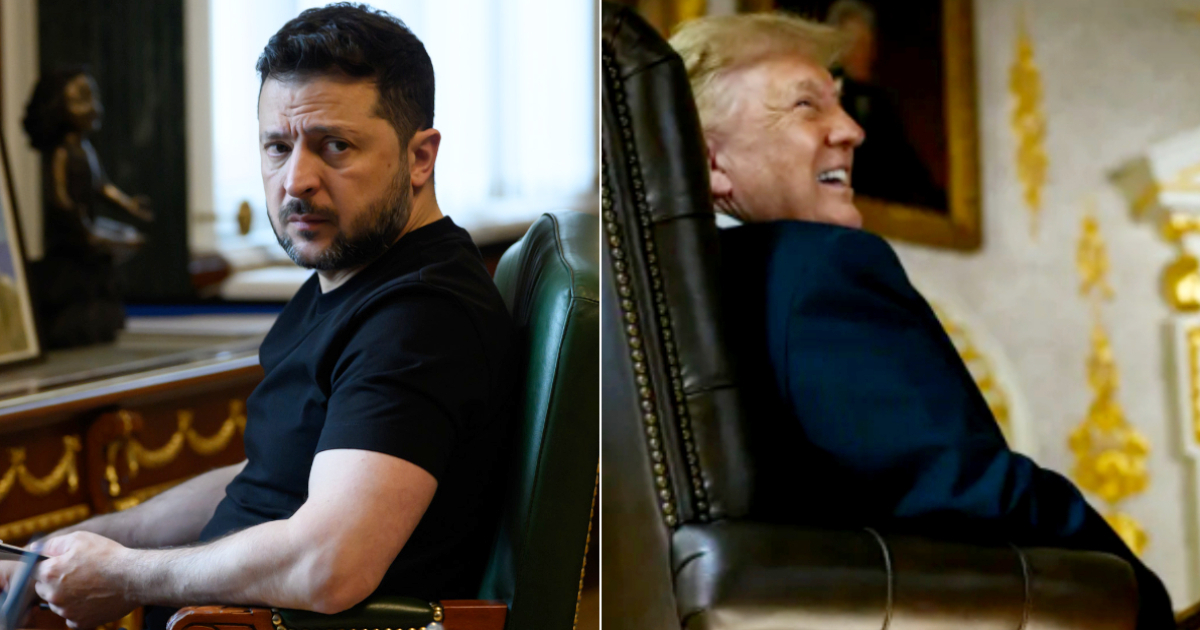
The Ukrainian president Volodimir Zelenski called the decision of U.S. President Donald Trump to close a deal with the Kremlin to allow exports of Russian diesel "weak" this Friday.
At the same time, the leader accused Washington of using the Ukrainian negotiators sent to Miami as a façade while sealing that energy deal behind their backs.
In a voice message sent to reporters on Friday, Zelenski denounced that, at the same time Ukrainian and American delegations were conversing in Florida about a possible negotiated end to the war, Trump was on the phone with Vladimir Putin agreeing to lift the restrictions on Russian diesel.
"This means millions, billions. Ultimately, everything is directed towards war against the people, against Ukraine, against all of us," stated the Ukrainian leader.
"I believe that our team is being used simply as a smokescreen. This is not honest; this is not how partners should act. And, in my opinion, it is a weak decision —unfortunately, a weak decision made by strong partners," Zelenski noted in his message.
The agreement announced by Trump includes the supply of more than 4.8 million tons of Russian diesel to the U.S. and international markets in various phases. The Department of the Treasury formalized the measure through OFAC General License 135, which authorizes the purchase and importation of this fuel until April 7, 2027.
The Russian response arrived hours later. This Saturday, Zelensky reported from his official account that Russia launched five guided aerial bombs against residential areas in Zaporizhia, leaving at least 12 dead—among them three children—and 14 wounded, two of whom are in critical condition. That same night, 13 Ukrainian regions suffered attacks that damaged buildings, infrastructure, and railway lines.
"Today, Russia expressed its gratitude for the lifting of sanctions on diesel exports by launching five bombs on residential buildings in Zaporizhzhia," wrote Zelensky on the social media platform X, directly linking the bombing to Trump's decision.
The Ukrainian president was explicit about the continuation of attacks on Russian energy infrastructure: "In Russia, they interpret any easing of pressure as a signal that they can continue fighting, that they can continue dropping bombs on cities. Different signals are needed. Right now, it is our long-range capabilities that ensure Russia feels its losses. And we will respond to Russian attacks."
The oil agreement comes just 21 days after Trump himself signed the Sanctions Act against Russia and Iran Lindsey O. Graham, which was passed with broad bipartisan support — 86 votes in favor and 11 against in the Senate — and its stated purpose was to cut off the revenue that finances the Russian war.
Criticism came from both parties. Republican representative Don Bacon warned that Putin is seeking to have Washington pressure Ukraine to stop attacking its refineries, calling the agreement a "reward for a dictator." Democratic senators such as Chuck Schumer, Jeanne Shaheen, and Elizabeth Warren labeled it a betrayal of Ukraine and its European allies.
The energy backdrop that Trump invokes as justification is real: the price of diesel in the U.S. exceeded $6.28 per gallon in September, partly pressured by Ukrainian attacks on Russian refineries—Kiev claims to have taken 51% of Russian refining capacity offline—and by the energy crisis linked to the conflict with Iran.
The decision comes amid the ongoing midterm legislative election campaign, which several analysts point out as an additional political motivation.
The peace talks in Miami, according to the Ukrainian media Hromadske, concluded prematurely partly as a direct result of the impact of the announcement regarding the energy agreement.
Related videos:
Filed under: