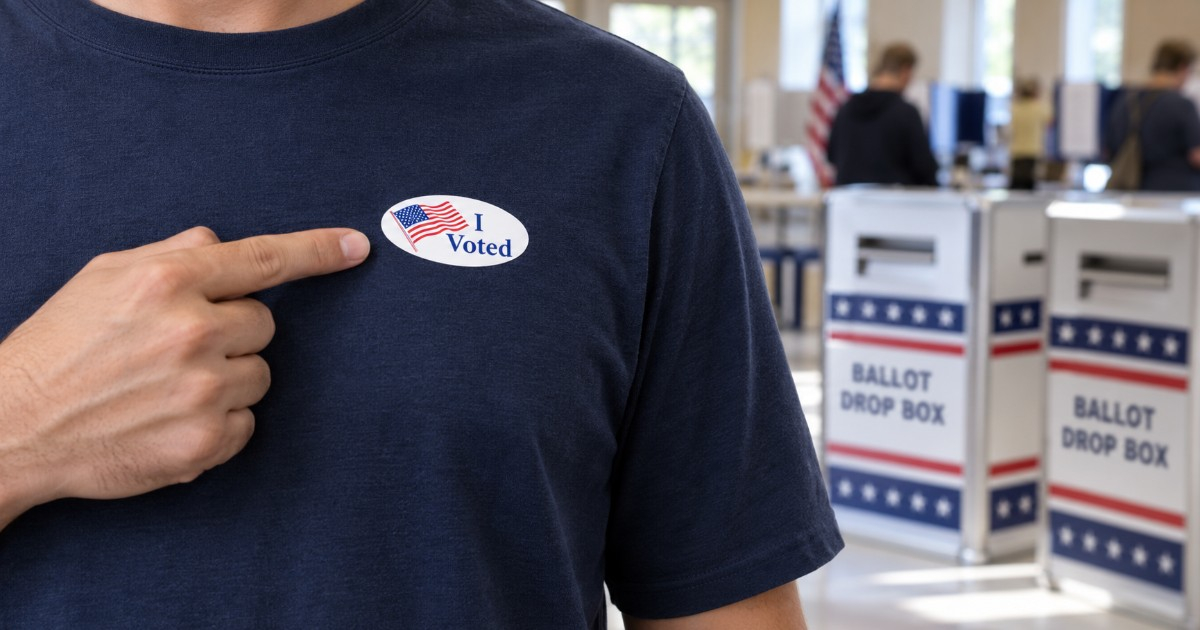
The midterm elections on November 3 are off to an unprecedented early voting turnout: more than 18 million voters have already cast their ballots across the country, according to data from the Electoral Lab at the University of Florida, and Democrats are significantly leading this wave of votes.
The most striking aspect of this day is the party imbalance: 47.4% of the early votes already cast belong to voters registered as Democrats, compared to 29.2% for Republicans, according to the same university source.
Early voting has begun in more than thirty states and is breaking historical records in several of them.
In Texas, on the first day of early voting, Harris County —the largest in the state— recorded 104,000 votes, a record for a midterm election, while Dallas County surpassed its own historical record. By the end of this Thursday, Texas had accumulated nearly 1.8 million early ballots.
Georgia and North Carolina also show extraordinary figures: the southern state has already accumulated 1.3 million early votes—almost 30% of the total it received in 2022—while North Carolina is nearing 1.1 million, which is almost 25% of its turnout from four years ago.
California leads the national count with 2 million early votes, followed by Texas with 1.8 million and Florida with 1.7 million. In the latter state, a total of 1,686,239 votes have been recorded: 554,100 in person and 1,132,139 by mail, which corresponds to 22% of the total participation in 2022. By affiliation, 41% of voters are registered as Democrats, 38% as Republicans, and 21% as other voters; these percentages do not indicate whom they voted for.
Of the votes already cast nationwide, just over 10.6 million were received by mail and 7.5 million were submitted in person.
The Democratic enthusiasm has a clear political backdrop: Donald Trump's approval rating is at a historic low for his second term, dragged down by the conflict in Iran, high fuel prices, the increased cost of living, and immigration policies that have generated growing discontent.
National polls give Democrats a lead of between eight and eleven points in the generic vote for the House of Representatives, and the Cook Political Report projects a Democratic gain of between five and fifteen seats, enough to take the majority from Republicans, who currently control the House with 218 seats to 214 Democrats.
The Latino vote is one of the most closely watched factors in this election. NBC News and Telemundo polls show that Hispanics prefer Democratic control of Congress by 59% to 35%, and Trump's approval rating among this group has dropped to 27%.
In Florida, where 6.7 million Hispanics reside, early voting started in Miami-Dade on October 19 with 28 centers set up, and it already accounted for nearly 20% of the total in 2022. Early voting will be mandatory throughout the state starting October 24.
Trump unsuccessfully attempted to impose restrictions on mail-in voting during the campaign, a method that historically benefits Democrats and is used more frequently by Latinos due to the difficulty of being absent from work.
In the coming days, new states will join the process: Maryland did so this Thursday, and New York will join on October 24. In total, 47 states and Washington D.C. allow voting before Election Day without the need for justification; only Alabama, Mississippi, and New Hampshire require a documented reason.
The early voting deadline varies by state: some close on October 29, while others keep this option available until November 3, the day of the elections.
Related videos:
Filed under: