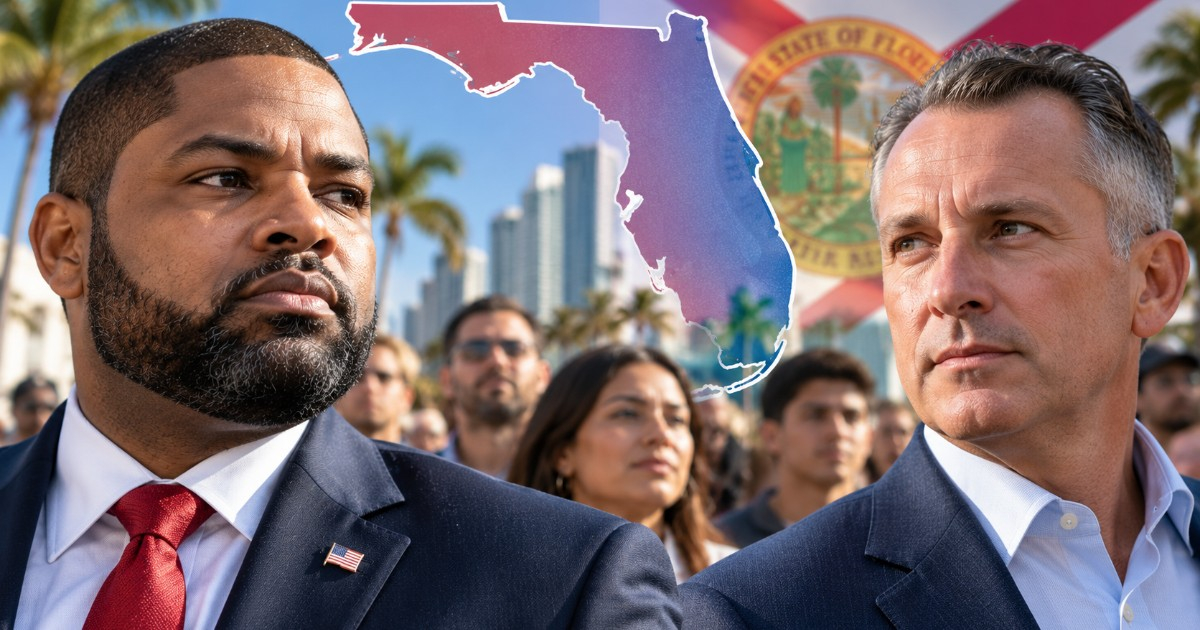
The Republican candidate for governor of Florida, Byron Donalds, receives 51% of the preferences among Cuban-American voters, compared to 42% for Democrat David Jolly, a difference of nine percentage points, according to a new survey by N+ Univision and YouGov that reveals a different electoral landscape among various Hispanic origin groups.
The results, published by N+ Univision, reveal that while Donalds maintains an advantage among Cubans and overall in the state, Latin voters in Florida are leaning towards Jolly, with 48% compared to 43% for the Republican candidate.
The survey was conducted between October 2 and October 15, 2026, with a sample of 825 registered voters in Florida and an oversample of 937 Hispanic voters, just over two weeks before the general elections on November 3.
In the overall state electorate, Donalds leads Jolly by 50% to 42%, an eight-point difference that contrasts with the five-point advantage of the Democrat among Latino voters.
However, the results show significant differences based on the national origin of the respondents.
While Cuban Americans favor Donalds, Puerto Ricans overwhelmingly support Jolly, with 51% to 35%, a 16 percentage point lead for the Democratic candidate.
Among voters of South American origin, the difference is much smaller: Jolly receives 47% compared to Donalds' 44%.
These figures reflect that the Latino electorate in Florida does not maintain a uniform party preference, even when facing similar economic and immigration concerns.
The survey has an approximate margin of error of four percentage points for the state sample and 3.9 points for the Hispanic sample.
The uncertainty is greater when analyzing subgroups such as Cuban Americans and Puerto Ricans, so the observed differences should be interpreted with caution.
The study also identifies differences in support for the parties in other contests. Among Cuban Americans, Republicans receive 52% compared to 41% for Democrats in the Senate election, and 51% compared to 43% in the generic ballot intention for the House of Representatives.
Puerto Ricans, on the other hand, favor the Democrats by 50% compared to 36% in the Senate and by 54% compared to 36% in the House of Representatives.
One of the factors influencing electoral preferences is the economic situation. 59% of Hispanic voters believe that employment and the cost of living are among the most important issues in Florida, while 57% mention housing prices and the difficulties in accessing them.
Concerns are also reflected in daily expenses: 61% identify food as one of the main pressures on the family budget, while 51% mention gasoline and transportation.
Moreover, four out of ten Latino voters believe that their household's financial situation has worsened over the past year.
The evaluation of President Donald Trump on these matters is largely negative among Hispanic respondents. 70% disapprove of his management of the cost of living, and the same percentage questions his handling of gas prices.
Regarding housing, disapproval stands at 63% among Latino voters, compared to 29% who approve of his performance in that area.
Migration policy is another area of concern. According to the survey, 55% of Hispanic voters believe that immigration control measures have gone too far.
That percentage includes 32% who believe it was necessary to strengthen border security but consider the measures taken to be excessive, and another 23% who argue that the situation at the border was exaggerated and that the subsequent actions were also disproportionate.
Among Cuban-American voters, 54% share the perception that immigration measures have gone too far, a percentage close to the 56% recorded among Puerto Rican and South American voters.
The fear of the personal consequences of these policies is also present. Forty-one percent of Latinos express concern about the possibility that they themselves, a family member, or someone close to them may be detained or affected by immigration measures, compared to 27% of the overall voter population in Florida.
Among Cuban Americans, that concern reaches 36%, while among Puerto Ricans it is 39%, and among South Americans it rises to 44%.
The survey shows, however, that dissatisfaction with some of the measures of the Trump administration does not necessarily translate into a abandonment of the Republican Party.
Among Latino voters who supported Trump in the 2024 presidential elections, 84% currently backs Donalds for governor and 85% favors the Republican Senate candidate.
At the same time, 28% of those who voted for Trump expressed some degree of doubt or regret regarding their decision for 2024.
That category includes different levels of uncertainty, including individuals who consider it likely that they would vote in the same way again, which means it does not equate to a loss of electoral support of that magnitude.
The contest for the Senate also reflects the contrast between the general electorate and the Hispanic one. The Republican Ashley Moody leads the Democrat Angie Nixon by 51% to 42% among all voters in the state, but among Latinos, the difference nearly disappears: Nixon receives 45% and Moody 44%.
Another significant contest is taking place in the 27th Congressional District of South Florida, where the Republican representative María Elvira Salazar seeks re-election against the Democrat Eliott Rodríguez, a journalist of Cuban descent.
According to the local coverage of N+ Univision, the survey recorded a favorable rating of 29% for Salazar and 22% for Rodríguez among Latino voters in Florida.
These figures correspond to the favorability of the candidates and not to voting intention. Therefore, the seven-point difference does not represent a directly measured electoral advantage nor can it be compared to the margin of victory obtained by Salazar in the 2024 elections.
The district encompasses areas of Miami, Coral Gables, and Little Havana, featuring a significant presence of Hispanic and Cuban-American populations.
Salazar has attempted to differentiate some of her immigration positions from the more restrictive measures of the Trump administration, while Rodríguez has focused part of her campaign on the cost of living and the economic concerns of residents.
The survey by N+ Univision was overseen by Sergio García-Ríos, the Surveys and Data Director of the network, with the collaboration of BluePoint Analytix. YouGov conducted the interviews and collected the data, which was later weighted using demographic and electoral variables.
The results describe the stated preferences of registered voters during the interview period, but they do not constitute a definitive forecast of electoral behavior on November 3rd.
Migration concerns among Cuban-Americans have taken on a particular dimension in South Florida in recent months.
In early October, the public broadcaster NPR examined the discontent among certain sectors of the Cuban community in Miami regarding deportations encouraged by the Trump administration, particularly among individuals who arrived during Joe Biden's term and remain in an uncertain immigration situation.
The report addressed the issues faced by those who received the I-220A form, the difficulties in obtaining permanent residency, and the cases of Cubans deported to third countries, including the Central African Republic.
Sociologist Guillermo Grenier from Florida International University (FIU) warned that the discontent among some Cuban-American voters could manifest as abstention, without necessarily translating into support for the Democratic Party.
On Friday, Byron Donalds visited the Bay of Pigs Museum in Little Havana, accompanied by his candidate for lieutenant governor, Cuban-American Senator Bryan Ávila.
During the meeting, Donalds reaffirmed his rejection of communism and socialism, and expressed his support for the Cuban exile community as candidates intensify their campaigning activities in South Florida.
We want Cuba to be free from communism, free from socialism, and I want to make something very clear: we will not tolerate communism here in Florida,” declared the Republican candidate during his visit.
The electoral campaign coincides with the beginning of in-person early voting in several counties in Florida, while mail-in voting was already underway.
According to the official statistics updated on October 20, registered voters identified as Democrats had returned 394,962 mail-in ballots, compared to 340,591 from Republicans, a difference of 54,371 ballots.
In Miami-Dade, authorities had recorded a total of 37,538 ballots from Democratic voters and 28,180 from Republicans by that cut-off, along with those from independent voters and other political organizations.
The figures exclusively reflect the party affiliation of those who returned their ballots, but they do not indicate which candidates were favored nor do they allow for predicting the final outcome.
The deadline to request a mail-in ballot in Florida is Thursday, October 22 at 5:00 p.m., while the general elections are scheduled for Tuesday, November 3, 2026.
Related videos:
Filed under: