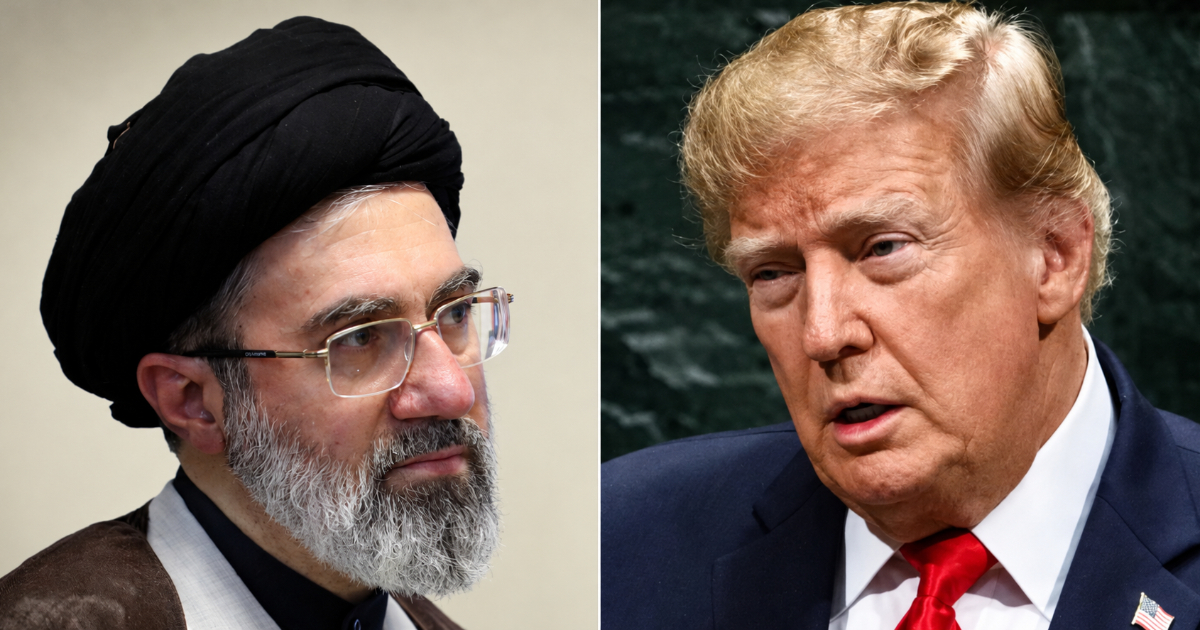
The Iranian Armed Forces issued a stern warning to Washington this Saturday: U.S. warships will not return to the Persian Gulf, according to a report by the EFE agency citing a statement reported by Tasnim.
“We will not allow, under any circumstances and at any time, for U.S. military ships to enter the Persian Gulf”, declared General Ali Abdolahi, chief of staff of the Iranian Armed Forces, in a defiant tone that reflects the sustained escalation since the onset of the conflict.
Abdolahi went further by directly referring to President Donald Trump: "He can only dream that his military and his army will return to the Persian Gulf." And he concluded: "They will have to take that wish to the grave forever."
The general also questioned Trump's repeated claims about having destroyed Iran's nuclear facilities. «If everything has been destroyed, what sense does it make to repeat such nonsense?», he asked, while describing Tehran's strategy as gradually dragging the United States and Israel deeper into the conflict as it continues.
The statements come at a time of heightened tension. The war between the U.S. and Israel on one side and Iran on the other began on February 28, 2026, and since then, the Strait of Hormuz—through which between 20% and 25% of the world’s oil transported by sea passes—has become the main theater of hostilities.
At the end of September, the Iranian Revolutionary Guard had already stated that U.S. vessels had withdrawn at least 500 kilometers from the entrance of the strait. In the last ten days, Iran reported at least 15 incidents involving vessels in Hormuz: four directly attacked and eleven that collided with naval mines.
The day before, the Revolutionary Guard reported that two supertankers suffered explosions and fires after colliding with mines while attempting to cross the strait via a route that Tehran labeled as "unauthorized." According to unverified data cited on social media, both vessels were jointly carrying around 4.5 million barrels of crude oil.
The tension is also reflected in energy markets: a barrel of Brent closed on Friday at $116.72, its highest level since late April, according to Reuters.
Meanwhile, Washington is bolstering its military presence in the region. The aircraft carrier USS Theodore Roosevelt is heading to the Arabian Sea to join the USS George H.W. Bush and USS George Washington, already deployed in the area, marking the largest American naval reinforcement in the Middle East since the invasion of Iraq in 2003.
The political context adds another layer of uncertainty. According to the New York Times, the U.S. and Israel are working on a “short and intense” attack that could target nuclear facilities, missile arsenals, drones, and Iranian energy infrastructure, possibly after the legislative elections on November 3.
The U.S. ambassador to Turkey, Tom Barrack, stated on Friday that an attack could occur “absolutely this weekend,” although Trump responded that he was not aware of it. General Abdolahi's warning this Saturday seems to be a direct response to that possibility.
Related videos:
Filed under: