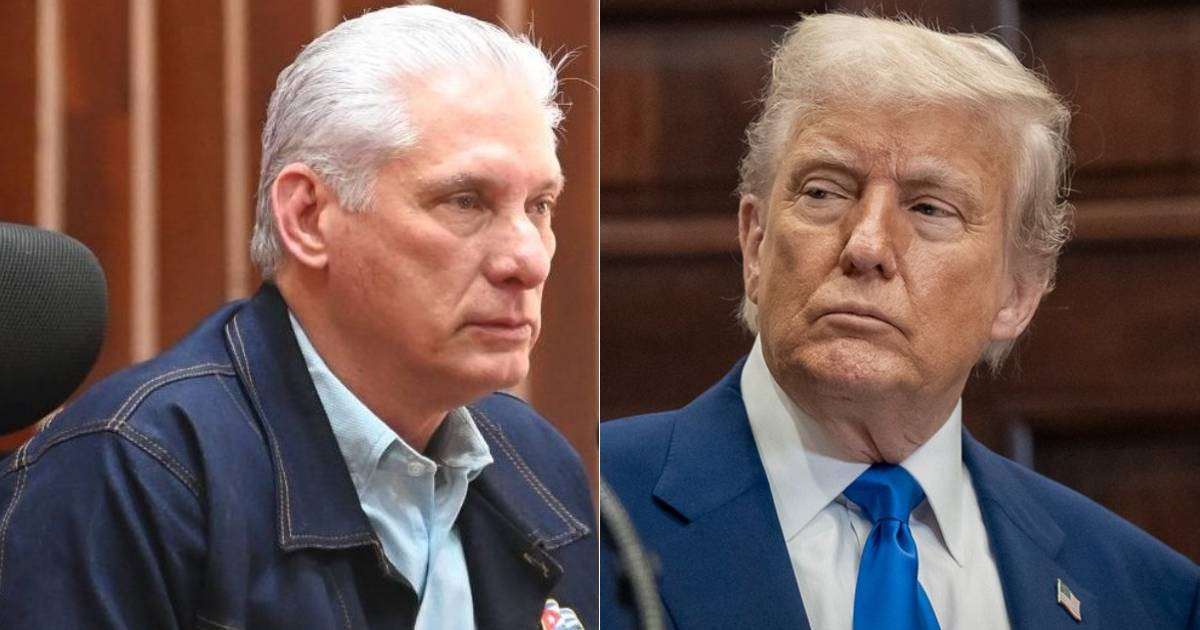
President Miguel Díaz-Canel responded this Friday to statements made by his American counterpart Donald Trump regarding Cuba with a message on Facebook, in which he accused the United States of harboring ambitions of domination and defended January 1, 1959, as the date of Cuba's independence.
"The U.S. government makes it clear that it does not give up its ambitions for domination over Cuba," wrote Díaz-Canel, who asserted that Cubans are determined to defend the independence that, according to his account, they achieved with the triumph of the revolution. The post included the hashtags #CubaIsNotAThreat and the phrase "the blockade is."
The message appeared hours after Trump jokingly remarked during a rally in Fort Myers, Florida, about stopping a U.S. warship about 50 yards off the Cuban coast when returning from operations in Iran. The White House occupant also claimed he would send Secretary of State Marco Rubio to "seal the deal."
The assertion of 1959 as the date of independence is not new in the discourse of the Cuban leader. In September, after Trump described Cuba as an "absolute failed state" before the UN General Assembly, Díaz-Canel maintained that the island's freedom began with the revolution and assured that the government would not allow it to be lost.
The chancellor Bruno Rodríguez Parrilla also reacted to the U.S. statements with a message on X. "We reject any threat regarding U.S. ambitions toward Cuba", he wrote, before warning that Cuba's shores, in addition to its beaches, have "a dog’s tooth, inhospitable to those who arrive with hostile intentions and desires for domination."
Rubio, for his part, published a call to Cubans on that same Friday to collaborate "discreetly with the CIA" (Central Intelligence Agency) and contribute to a change on the island. The Secretary of State described the moment as an opportunity and alluded to unfulfilled promises, corruption, and the privileges of a minority.
The exchange of statements occurs after indirect contacts between Washington and Havana became stalled. According to the U.S. media The Atlantic, the Trump administration demanded the resignation of Díaz-Canel as a condition for progress, while the Cuban chargé d'affaires in Washington dismissed weeks ago that there were any formal negotiations.
The tension also precedes the annual vote of the UN General Assembly on the resolution calling for an end to the U.S. embargo, scheduled for October 28.
Díaz-Canel anticipated that Cuba would receive less support than in previous years. In 2025, the resolution garnered 165 favorable votes, compared to the 187 recorded in 2024.
Related videos:
Filed under: