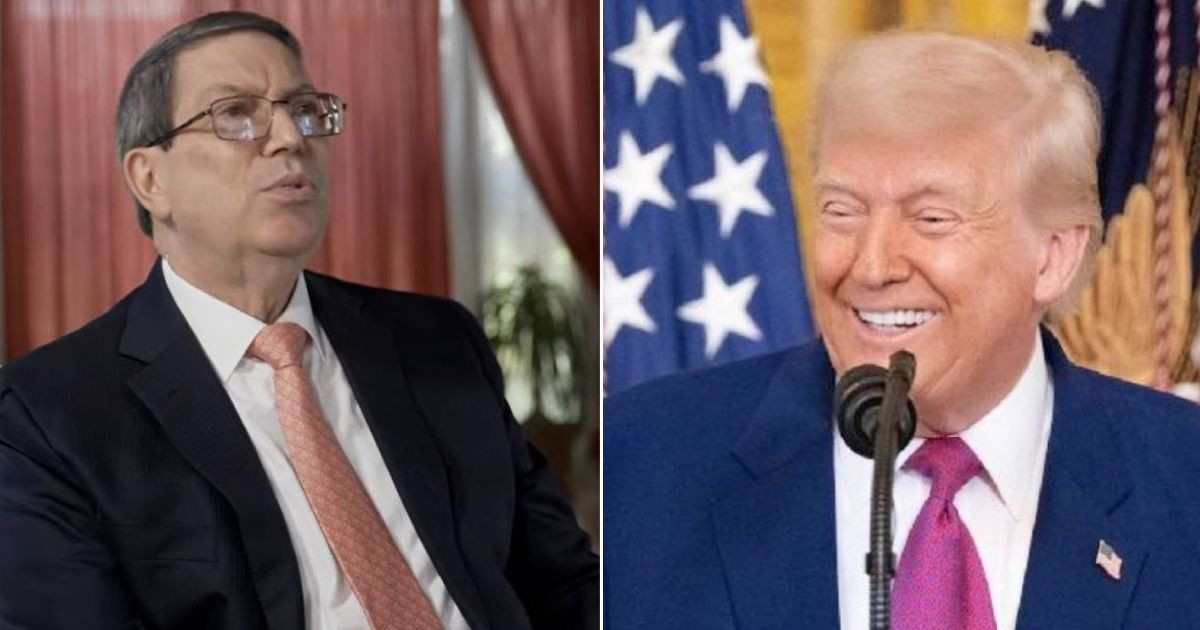
The Cuban Foreign Minister Bruno Rodríguez Parrilla once again brandished his rhetorical arsenal this Friday in response to the recent statements by U.S. President Donald Trump regarding a potential military ship deployment off the coast of Cuba.
He did it from his account on X, with a message that blends a tourist postcard with a geological warning: "We reject any threat regarding the ambitions of the US towards Cuba. Our shores have beautiful beaches, but they also hold danger for those who arrive with hostile intentions and desires for domination."
The tweet came hours after Trump, at a Republican rally at the Alico Arena in Fort Myers, Florida —in anticipation of the legislative elections on November 3— outlined a scenario in which U.S. ships returning from operations in Iran would make a strategic stop off the coast of Cuba.
“In fact, what we are going to do with Cuba is that we will return from Iran. Those beautiful ships will pass by Cuba. We will have one of them stop about 50 yards from the shore. They will raise their hands,” Trump declared to his supporters.
Trump added that he would send Secretary of State Marco Rubio to "close the deal" with Havana, and concluded with a terse "We don't have to stop," leaving the interpretation of what not stopping would mean open-ended.
On the same day, Rubio posted on X a direct call regarding potential future actions concerning the island: an invitation for those seeking change in Cuba to collaborate "discreetly with the CIA," citing "disappointment over broken promises, corruption, and the privileged lives of a few" as motivations. The message from the Secretary of State, unusually explicit for an official of his rank, adds to another message from October 5, in which he had already urged the Cuban armed apparatus to "open their eyes" to the reality of the regime.
The metaphor of the "dog's tooth" chosen by Rodríguez refers to the lapiaz or karst formations found on the Cuban coasts: irregular and sharp limestone rock formations present in areas like Guanahacabibes, Havana, Caguanes, and Cabo Cruz. This image aims to evoke an unassailable Cuba. What it does not evoke, however, is the reality faced by millions of Cubans who endure prolonged blackouts, shortages of food and medicine, and an economy in free fall after 67 years of dictatorship.
It is not the first time that Rodríguez has responded with "strong rejection" to provocations from Washington. In May, when Trump threatened to send the USS Abraham Lincoln aircraft carrier about 100 meters off the Cuban coast, the chancellor was already in the spotlight: he warned that a military aggression would lead to "a bloodbath," with thousands of Cuban and American victims. And on October 14, Rodríguez accused Rubio of "blackmailing" foreign leaders to reduce support for the annual UN resolution against the embargo, with the vote scheduled for October 27 and 28.
This international support has notably eroded: from 187 votes in favor in 2024, it dropped to 165 in 2025, and fell to 136 in an extraordinary session in July 2026. The latter was procedural in nature and does not equate to the annual resolutions on the matter, but it is symbolically illustrative. This week, Rodríguez accused a Latin American government of pressuring other countries to change their votes, in what seems to be another battle lost from the outset.
The tweet from the chancellor was accompanied by the hashtag #CubaIsNotAThreat. "The night is closing in on them and they're more alone than ever," replied one of the internet users who commented on Rodríguez's once again "forceful" statement.
Related videos:
Filed under: