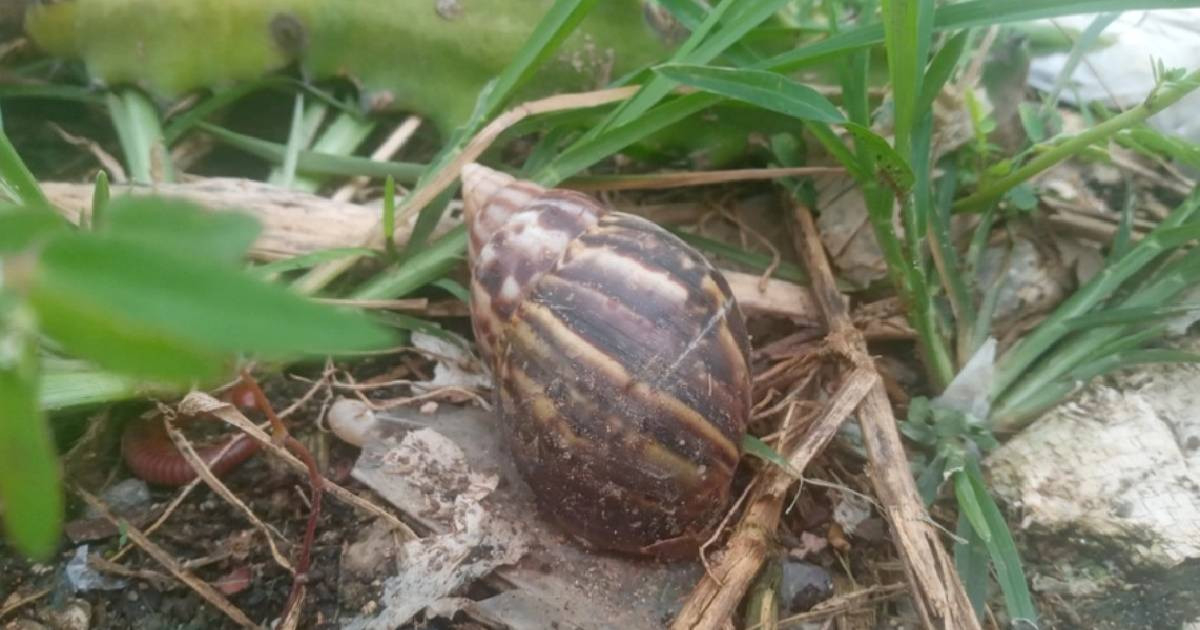
The potential emergence of the giant African snail in areas of the city of Holguín once again tests the response capacity of Cuban authorities to an invasive pest that has already spread across a large part of the country.
In this regard, the station Radio Ángulo warned this Saturday that social media users have shared photographs of snails with characteristics consistent with the African giant snail in urban areas.
So far, the plant health authorities have not officially confirmed that the specimens belong to that species.
The province faced a similar episode in 2019 when it launched a sanitation plan after detecting about 1,200 specimens. Although one colony was eliminated, another outbreak appeared in Certeneja in December 2020, highlighting the challenges of maintaining containment.
The current alert occurs in the context of an expanding infestation across Cuba. Since its first detection on the island in 2014, the Giant African Snail affected 14 of the 16 provinces in October 2020, with over 1,000 active hotspots in 59 municipalities.
Recent reports indicate that the problem persists in various territories. Last April, the authorities in Granma responded to an outbreak in Manzanillo, while in June, specialists from the Ministry of Science, Technology and Environment (Citma) confirmed the presence of the mollusk in the city of Matanzas, with a risk of spreading to Varadero.
In July, residents of Cárdenas reported a lack of institutional response regarding the presence of specimens in their homes. "There is no response from the authorities; no one comes here to provide guidance or to say what should be done with them," stated a resident of La Emilia.
In October 2025, the infestation spread across the entire city of Camagüey, where residents reported dozens of specimens daily. "The grass keeps growing more and more, and no leader is doing anything," a user wrote at the time on social media.
The African giant snail (Lissachatina fulica) poses a threat to agriculture and public health. It can damage more than 120 crops, including banana, cassava, citrus fruits, and rice, and carry the parasite Angiostrongylus cantonensis, which causes eosinophilic meningoencephalitis, a disease that affects the central nervous system and can be fatal.
Its reproductive capacity makes control difficult. It is hermaphroditic, can reproduce without mating, and can lay up to six batches of about 500 eggs annually, with a hatching rate exceeding 90%. Adult specimens can reach lengths of up to 30 centimeters.
Specialists recommend not handling animals directly, avoiding contact with their secretions, and using protection if it is absolutely necessary to collect them. They also warn that they should not be consumed, even if cooked.
Related videos:
Filed under: