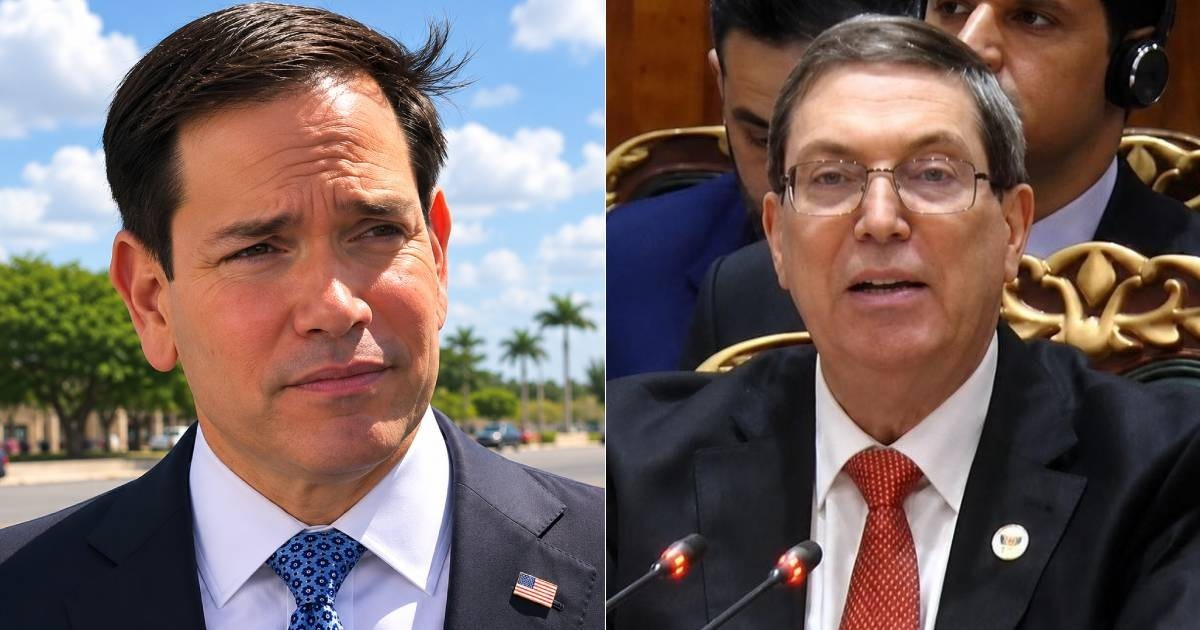
The chancellor of the Cuban regime, Bruno Rodríguez Parrilla, accused the U.S. Secretary of State, Marco Rubio, on Wednesday of pressuring heads of state and government to change their position in the annual vote of the UN General Assembly regarding the U.S. embargo on Cuba, scheduled for October 28.
The accusation came through the social network X, a day after the State Department confirmed that Rubio called Salvadoran President Nayib Bukele on Tuesday to urge him to align with Washington on "shared priorities" at the UN, including the Cuban issue.
"The U.S. Secretary of State, nervous and anxious about yet another defeat at the United Nations, is pressuring and blackmailing heads of state and government from various countries to change their votes against the blockade in the UN General Assembly," Rodríguez wrote.
The chancellor also accused Rubio of trying, with "repeated lies," to silence what he termed the "collective punishment" of the Trump administration against the Cuban people and to "make the rest of the international community complicit."
The U.S. Secretary of State, nervous and anxious about facing another defeat at the United Nations, is pressuring and blackmailing Heads of State and Government from various countries to change their votes against the blockade in the General Assembly of @ONU_es. Rubio, for his part, argued before Bukele that "the Cuban regime will not implement the reforms needed by the Cuban people as long as it believes it has the support of the international community."
The regime's reaction reflects nervousness in the face of a diplomatic offensive from Washington that is yielding results: Cuba's automatic support in the UN has notably eroded over the past two years.
In the annual vote of October 2025, the resolution received 165 votes in favor, compared to 187 in 2024, with 7 against and 12 abstentions. Argentina, historically supportive of Havana, voted against for the first time under the government of Javier Milei.
In July, a special session convened by Cuba to discuss the embargo gathered only 136 votes in favor, with 9 against and 30 abstentions.
The accusation of "blackmail" is striking coming from a government that exerts its own pressure on the countries accepting Cuban medical missions.
Washington asserts that the regime retains between 50% and 95% of the payments that these countries make for the services of Cuban professionals, a system that the U.S. describes as "forced labor." In 2026, several Caribbean countries suspended or modified their agreements with medical missions following U.S. pressure.
The regime estimates the cost of the embargo between March 2025 and February 2026 at 8,083.3 million dollars —the highest recorded figure, according to their claims, 7% more than the previous period— and the total historical accumulated amount at over 178.7 billion dollars at current prices. These are official Cuban figures without independent verification. Rodríguez added that these figures reflect the first month of the effects of the executive order signed by Trump on January 29, 2026, which restricted all fuel imports to the island.
At the same time, more than 554 opponents, activists, and Cuban organizations —including José Daniel Ferrer, Orlando Gutiérrez Boronat, and Jorge Luis García Pérez «Antúnez»— published a letter on Tuesday addressed to democratic governments in the European Union, the United Kingdom, Canada, Japan, and Latin America, urging them to vote against or abstain on October 28, arguing that supporting the resolution benefits the regime and not the Cuban people.
The annual resolution on the embargo has been debated in the General Assembly since 1992 and has never been binding. The embargo took effect on February 3, 1962, when President John F. Kennedy signed the executive order that established it.
Related videos:
Filed under: