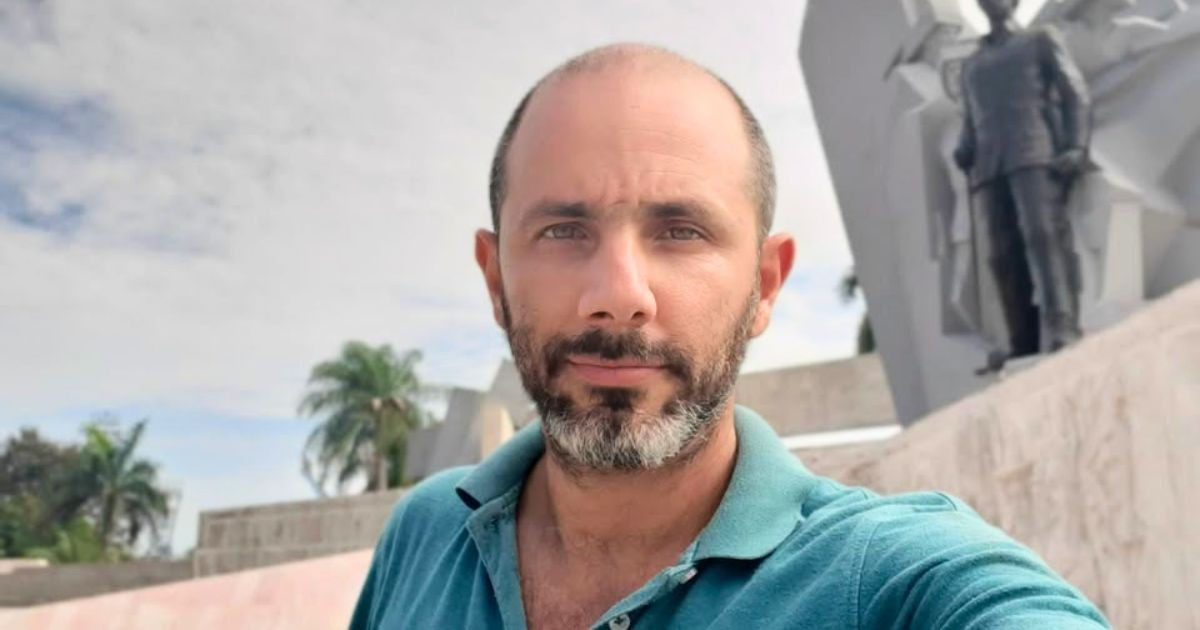
The Inter-American Press Association (IAPA) approved a resolution on Saturday demanding the immediate release of the independent Cuban journalist Henry Constantín Ferreiro, director of La Hora de Cuba, who remains imprisoned in the maximum-security Kilo 7 prison in Camagüey, accused of "disobedience."
The document, adopted during the 82nd General Assembly of the SIP held in Bogotá, Colombia, warned that "the preventive imprisonment of journalist Henry Constantín, director of La Hora de Cuba and regional vice president for Cuba of the SIP's Committee on Freedom of the Press and Information, who remains incarcerated in Kilo 7 prison, accused of disobedience, is of particular concern, after a court rejected a habeas corpus petition filed on his behalf."
The resolution also condemned that "the use of police and judicial mechanisms against independent journalists, content creators, and activists who report on matters of public interest has intensified, through arrests, summonses, surveillance, movement restrictions, and criminal proceedings."
Constantín was arrested on September 16 when he responded to a verbal summons at a police station in Camagüey. The authorities accuse him of failing to appear for a migration summons on September 9; he maintains that he did attend, but the officials had already left.
Days later, he was transferred without prior notice to his family to Kilo 7, where his situation worsened in mid-October when, during a search, prison officials claimed to have found a handmade knife among his belongings. The journalist suspects that the weapon was deliberately planted to incriminate him.
As a consequence, he was sent to a punishment cell for at least 15 days and lost family visits and daily phone calls.
The Cuban Observatory of Human Rights (OCDH) submitted a formal complaint to the Provincial Prosecutor's Office of Camagüey regarding irregularities in the process, demanding guarantees for the physical and psychological integrity of Constantín, the clarification of the alleged discovery, and the location of his file.
The SIP also noted in its resolution that the —in effect since early August— reinforces the regime's control over the media and information "by limiting the ability to formalize independent media and keeping under state control activities related to journalism, media publishing, news agencies, and broadcasting, in a context aggravated by blackouts and connectivity deficiencies."
The organization urged the Cuban authorities to ensure the legal recognition of independent media and to eliminate the regulations that restrict press freedom.
The case of Constantín has accumulated a series of international condemnations. Reporters Without Borders (RSF) documented that this is at least the nineteenth detention of the journalist related to his work. The Trump administration demanded his release on September 30 through Deputy Secretary of State Juan Pablo Segura, who referred to him as "unjustly detained" and stated that the Cuban regime had imprisoned him "simply for reporting the truth and exposing the regime's abuses."
Meanwhile, Cuban writers, journalists, and artists launched the campaign "Informing is not a crime" to demand their release.
Constantín is not the only journalist imprisoned in Cuba. According to data collected by journalist José Raúl Gallego, at least three others are also serving political prison sentences: Jorge Bello, Ángel Cuza, and José Gabriel Barrenechea. The latter was sentenced to six years in prison last January by the Provincial Court of Villa Clara, a decision that the Supreme People's Court upheld in July.
The repressive context is systemic: violations of press freedom in Cuba increased by 129.4% in September compared to August, rising from 17 to 39 reported incidents, according to the Cuban Observatory for Freedom of Expression (OCLE).
The SIP invoked in its resolution the Chapultepec Declaration, which states that "there are no free people or societies without freedom of expression and of the press," and that its exercise "is not a concession from the authorities; it is an inalienable right of the people."
Cuba ranks 160 out of 180 countries in the 2026 World Press Freedom Index by RSF, with a score of 29.22.
Related videos:
Filed under: