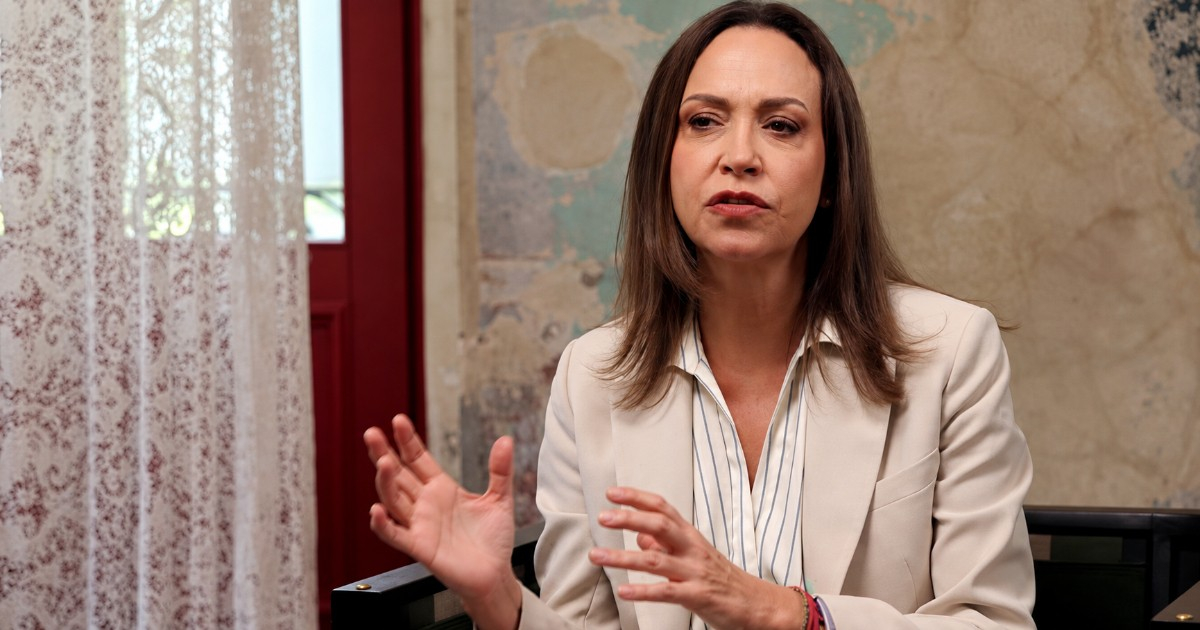
The return of María Corina Machado to Venezuela this Sunday, after nearly ten months away from the country, marks the beginning of a phase that prominent Venezuelan journalist and analyst Boris Muñoz describes in an opinion piece published in El País as the start of a much more demanding path: the opposition leader will need to "navigate more carefully" and "seek the least traumatic exit from chavismo without sacrificing the quest for justice of the majority."
Machado confirmed her arrival with a brief message on X: "I am here. With you." Her first public appearance was at the Santa Rosa church in Barquisimeto, Lara state, home to the sanctuary of the Virgin of the Divine Shepherdess, where overwhelmed supporters welcomed her with hugs and expressions of devotion. Among the crowd, a mother cried out in desperation: "Bring me my children!"—an image that captured the plight of more than 7.8 million Venezuelans who have had to emigrate in recent years.
Muñoz acknowledges that the end of Machado's "odyssey" is good news because it can rejuvenate a transition process that, in his view, suffers from three serious problems: it does not represent the popular sentiment, it is "micromanaged from Washington by Marco Rubio," and it has slowed down the regime change through an opaque and bureaucratic process.
The analyst recalls that since January 3, 2026, when U.S. forces captured Nicolás Maduro, "a trick by Trump left it out of the country's democratic transition that Machado was preparing to lead as a key player." Since then, the Venezuelan government has been headed by the acting president Delcy Rodríguez, and Washington supports negotiations between that government and a sector of the opposition represented by Dinorah Figuera.
Regarding the specific circumstances of the return, Muñoz cites individuals from Machado's circle, who succinctly stated that "the logistical and political obstacles were overcome." They noted that the opposition leader had not negotiated with either Dinorah Figuera's faction or the chavista government.
Marco Rubio, for his part, attributed the return to the reconciliation dialogue supported by the U.S., which would have allowed for the release of hundreds of political prisoners. Meanwhile, Trump reacted cautiously: "She's a very nice woman. She gave me her Nobel Prize, so how can I say otherwise? And I hope she's safe."
Muñoz emphasizes that Machado "is still walking on the razor's edge with Trump" and will likely challenge the Rodríguez government in a strategic manner to avoid alienating the United States, her "paradoxical supporter." The analyst Carlos Blanco summarized the short- and medium-term objectives of the leader in four points: mobilize the country to revive hope, create a popular organization that brings together parties and civil society, promote a broad opposition alliance, and forge a significant national agreement to overcome the crisis. With this agreement, Machado aims to hold presidential elections in the first half of 2027, the text states.
For that task, the article details considerable assets: 52% of voting intention and 61% of positive personal valuation, "a national structure that in the past facilitated the mobilization of millions of people" and a high international profile.
The parallel with Cuba quickly emerged: the founder of UNPACU, José Daniel Ferrer, took Machado's return as a model to urge the Cuban opposition to build an effective unified structure and select a leader, and expressed his willingness to return to the island alongside that leader: “I am going to Cuba with the leader of that effective and functional unity.”
The writer concludes his analysis in El País with a warning that encapsulates the complexity of the moment, referencing a phrase attributed to the 19th-century Venezuelan politician Antonio Guzmán Blanco: "Venezuela is like a dry hide: you step on one side, and it rises on the other." A fourth round of negotiations between the Venezuelan government and a segment of the opposition is scheduled for November 2026.
Boris Muñoz holds a PhD in Hispanic American Literature from Rutgers University and is the author of several books, including: The Law of the Street, testimonies from young protagonists of violence in Caracas (along with José Roberto Duque), Beyond the Literate City. Chronicles and Urban Spaces (co-edited with Silvia Spitta), and Dispatches from the Empire (2007).
He has been a contributor, editor, and columnist for various media outlets in America and Europe. He served as a visiting professor at the Rockefeller Center for Latin American Studies at Harvard University and received the María Moors Cabot Prize from Columbia University.
Related videos:
Filed under: