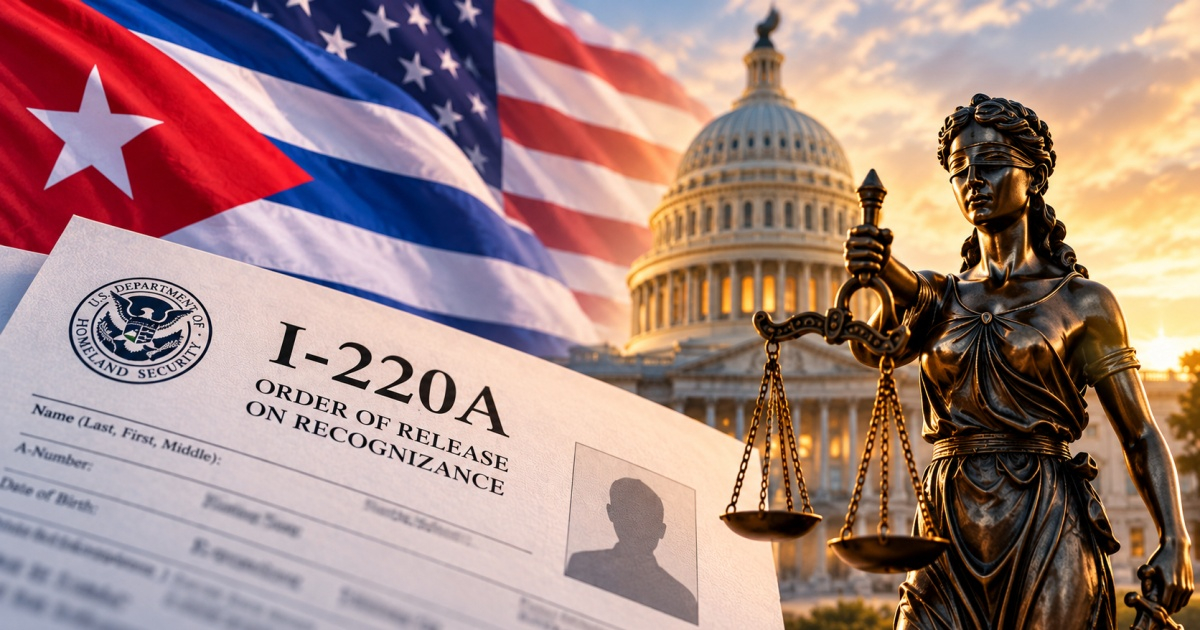
Cubans with an I-220A who are awaiting residency through the Cuban Adjustment Act are still pending several judicial decisions that could influence their cases.
Until Tuesday, October 27, 2026, no federal ruling of general applicability has established that the I-220A, on its own, constitutes a migration parole or automatically grants access to permanent residency.
The courts are examining different issues: whether specific releases of Cuban immigrants can be considered parole, what legal authority the Government had to detain them, and whether those who are once again in ICE custody have the right to request a bond hearing.
The decisions of the Board of Immigration Appeals (BIA), the Eleventh Circuit, and the Fifth Circuit, along with a case presented before the Supreme Court, help to understand the legal possibilities and limitations for Cubans with an I-220A.
What's at stake?: the difference between I-220A and parole
The Cuban Adjustment Act requires, among other criteria, that the person has been inspected and admitted or granted parole in the United States.
The immigration parole granted under section 212(d)(5) of the Immigration and Nationality Act (INA) can fulfill that requirement.
However, many Cubans who crossed the border between 2021 and 2023 received an I-220A, known as Order of Release on Recognizance, a document of release on recognizance that does not, by itself, constitute a grant of parole.
The United States Citizenship and Immigration Services (USCIS) explained this difference in a notice from February 2022, in which it identified release under section 236 of the INA as a distinct concept from parole.
That notice also addressed the possibility of reopening certain cases of Cubans released between January 12, 2017, and November 17, 2021, without generally recognizing the I-220A as parole.
The distinction between these documents and their immigration consequences is explained in our guide on the differences between the I-220A and parole for the Cuban Adjustment Act.
What has the BIA decided regarding Cubans with I-220A?
The Board of Immigration Appeals has issued several precedential decisions that influence the interpretation of the requirements for obtaining residency and the conditions of detention for immigrants:
Matter of Cabrera-Fernández (September 11, 2023): the BIA determined that release under section 236 of the INA is legally distinct from humanitarian parole. Therefore, such release does not alone satisfy the admission or parole requirement established in the Cuban Adjustment Act.
Matter of Q. Li (May 15, 2025): the Board examined the detention regime for individuals arriving in the United States who are subject to section 235(b). Its interpretation has become significant in litigation concerning whether certain individuals were detained and subsequently released under the appropriate legal authority.
Matter of Roque-Izada (June 20, 2025): the BIA reaffirmed the difference between conditional release under section 236 and the parole required for the Adjustment Act. It also rejected closing a deportation proceeding based solely on the possibility that USCIS would grant parole in the future.
These decisions remain relevant for immigration judges, although their application must take into account the binding rulings of federal courts in each jurisdiction.
For Cubans with I-220A, the key issue is not only the document they received upon release from custody but also the legal authority used to detain and release them, as well as the existence of any other documented admission or grant of parole.
The Eleventh Circuit returned two Cuban cases to the BIA
On February 23, 2026, the Eleventh Circuit Court of Appeals overturned two BIA decisions and remanded the cases for further proceedings in the cases of Labrada-Hechavarría and Castillo-Casanova.
The procedures involved two Cuban families who had entered the United States without documentation, were detained by the Department of Homeland Security (DHS), and were later released.
The immigration judges had determined that those releases did not constitute parole and, therefore, did not meet the corresponding requirement of the Cuban Adjustment Act. The BIA initially upheld that interpretation.
During the judicial review, an important change occurred: in July 2025, the federal government modified its position and acknowledged that the plaintiffs had been subject to the detention authority of section 235(a), instead of section 236(a) which it had previously defended.
Despite this change, the Government maintained that the requests should be denied because the applicants had benefited from a DHS error.
The Eleventh Circuit concluded that it had jurisdiction to examine the controversy and overturned the decisions of the BIA. It deemed relevant that the Government had changed its interpretation and that the Board itself had subsequently issued new decisions regarding the scope of section 235.
The court did not rule that those releases constituted parole nor ordered the granting of residency.
He returned the files for the BIA to reexamine them in light of the legal issues raised.
The ruling was issued as an unpublished opinion, so it does not establish a binding precedent for all cases in the Eleventh Circuit.
However, their reasoning may be relevant for other proceedings with similar legal circumstances.
Detention without bail: another controversy affecting immigrants
The discussion about the Cuban Adjustment Act should not be confused with litigation regarding immigration detention.
These latter determine, among other issues, when ICE can detain a person during their deportation proceedings and whether they have access to a bond hearing.
In Matter of Yajure Hurtado, dated September 5, 2025, the BIA interpreted that certain individuals present in the United States without having been admitted are subject to the mandatory detention provisions of section 235(b)(2)(A), which restricts the authority of immigration judges to grant them bail.
Federal courts have maintained differing interpretations regarding the scope of these provisions
Eleventh Circuit (Florida, Georgia, and Alabama): on May 6, 2026, in the case Hernández Álvarez, the court examined the application of sections 235 and 236 to individuals already within the country. Their decision supported the possibility of requesting a bond hearing under section 236(a) in the analyzed legal circumstances.
Fifth Circuit (Texas, Louisiana, and Mississippi): on October 23, 2026, in the case Sosnava Rodríguez, the en banc court overturned three decisions from lower courts and ruled that the affected immigrants, subject to the mandatory detention regime under section 235(b)(2)(A), did not have a constitutional right to individual bond hearings before being held in detention during their deportation proceedings.
Supreme Court: the case Rhoney v. Barbosa da Cunha, originating from the Second Circuit, raises a controversy regarding the legal framework for the detention of immigrants who are in the United States without having been admitted. Its proceedings are significant for determining the extent of federal powers in this matter.
These differences can have practical consequences for immigrants detained in different jurisdictions.
However, access to a bail audience does not solely depend on the state where the person is located.
Also influencing are their immigration history, the legal authority that grounds the detention, the existence of a final deportation order, and the applicable judicial decisions.
A bail hearing does not guarantee release: it means that the person can request an evaluation to determine whether it should be granted.
The consequences of the Fifth Circuit's procedures for Cuban immigrants are explained in our information about detention without bond and Cubans with I-220A.
The demand in Miami: what may happen after October 30
In the Southern District of Florida, the legal controversy initiated by Cubans with I-220A continues, as they seek to have certain immigration releases recognized as parole for the purposes of the Cuban Adjustment Act.
The plaintiffs responded to the government's new request to dismiss the lawsuit.
The indicated procedural calendar includes Friday, October 30, 2026, as the deadline for a new government response.
This deadline corresponds to a procedural action, not to a date set for the judge to issue a ruling.
Once the submission of the documents is complete, the court may resolve the pending issues in accordance with the progress of the case.
The filing of the petition does not, by itself, grant immigration protection to all individuals with an I-220A.
Any collective effect would depend on the decisions made by the court, the scope of the measures ordered, and the individuals legally covered by them.
What should Cubans do with I-220A while they wait?
- Meet the appointments with ICE and immigration hearings. The existence of lawsuits does not automatically suspend individual obligations. Failing to attend a hearing may result in an order of deportation in absentia, except for the exceptions provided by law.
- Check the status of the file. El sistema de información de casos de la Executive Office for Immigration Review (EOIR) permite consultar información sobre procedimientos judiciales mediante el número de extranjero o número A.
- Review the entry and release documentation with a lawyer. It is important to determine under what authority the person was detained, what documents were received, and if there is any record of admission or parole that may affect their eligibility for the Cuban Adjustment Act.
- Keep all immigration documents. Copies of the I-220A, the I-94 if available, court notifications, proof of appearance before ICE, and any application or resolution related to the case should be kept.
- Prepare a family plan in case of a possible detention. It is advisable for a trusted person to have access to essential documents, the number A, and the contact information of the legal representative.
- Beware of promises of automatic residency. No pending litigation guarantees that all Cubans with I-220A will obtain residency. There is also no general procedure that automatically converts that document into parole.
Frequently Asked Questions about the I-220A and the Cuban Adjustment Act
Can I file the I-485 if I have an I-220A?
The I-220A, by itself, does not demonstrate that the admission or parole requirement under the Cuban Adjustment Act has been met. The possibility of submitting a viable application depends on the complete immigration history and other legal requirements. Those with documented parole or other particular circumstances should consult their situation with an authorized professional before applying for adjustment.
Does the Eleventh Circuit ruling automatically benefit all Cubans with I-220A?
No. The decision of February 23, 2026, pertains to two specific proceedings and orders that the BIA reexamine them. Its arguments may be used in other litigations when circumstances are comparable, but they do not constitute a general grant of parole or residence.
Can I request bail if ICE detains me?
It depends on the legal authority used for the detention, the status of the immigration process, and the applicable case law. Some individuals may request a bail hearing before an immigration judge, while others are subject to different detention regimes. Eligibility must be assessed on an individual basis.
When will there be a definitive answer regarding the I-220A?
There is no single date. The procedures concerning the Cuban Adjustment Act and the litigation regarding immigration detention address different issues. A decision regarding the right to request bail would not necessarily resolve whether a release documented through an I-220A meets the requirements for parole to obtain residency.
The general requirements, deadlines, and necessary documents to apply for residency are explained in our .
Aviso legal: este artículo ofrece información general y no constituye asesoría jurídica individual. Las normas y decisiones migratorias pueden cambiar. Para evaluar un expediente concreto, se recomienda consultar con un autorizado o un representante acreditado por el Departamento de Justicia.
Related videos:
Filed under: