**Suggested title: Prime Minister of Trinidad and Tobago lashes out at former Caribbean leaders for defending Cuba: "Stop making fools of yourselves."**
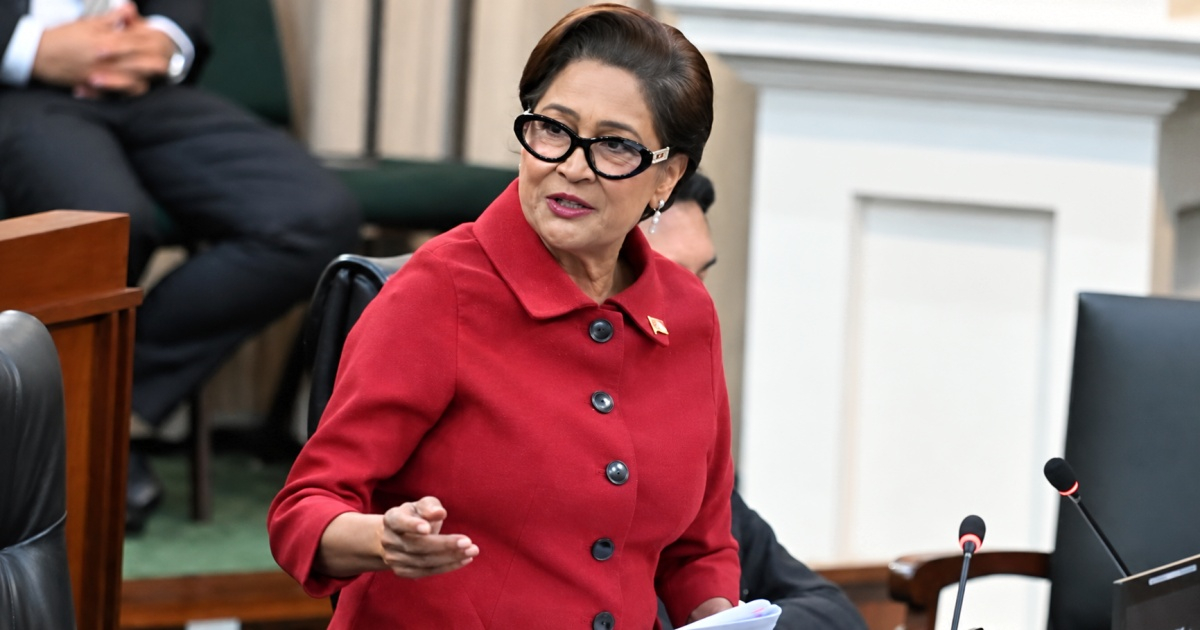
The Prime Minister of Trinidad and Tobago, Kamla Persad-Bissessar, issued a stern response on Monday to a group of former Caribbean heads of government who signed an open letter requesting international support for the annual UN resolution against the U.S. embargo on Cuba, the voting for which is scheduled for this Wednesday, October 28.
In statements to the newspaper Guardian Media, Persad-Bissessar accused the signatories of hypocrisy for advocating a political system for Cuba that, she argued, they would never accept in their own countries.
"I encourage these former leaders of Caricom to push for turning their own countries into dictatorships governed by the political parties to which they did not belong," he stated.
The representative was even more direct in her second message: “I believe you should stop making a fool of yourselves with this hypocrisy. My advice is that you do not support an oppressive political system imposed in another country that you do not want in your own; you only appear ignorant and confused.”
The statements deepen the differences between the government of Trinidad and Tobago and former leaders of the Caribbean Community (Caricom), who are calling for regional support to uphold the resolution against U.S. sanctions.
The letter that sparked the controversy
The trigger was an open letter published by the Jamaica Observer, dated Saturday, October 24, and addressed to all the nations of the world.
The newspaper identified ten former leaders of Caricom among the signatories: Freundel Stuart (Barbados), Dean Barrow and Said Musa (Belize), Keith Mitchell and Tillman Thomas (Grenada), Donald Ramotar (Guyana), Bruce Golding and P.J. Patterson (Jamaica), Kenny Anthony (Saint Lucia), and Ralph Gonsalves (Saint Vincent and the Grenadines).
However, Guardian Media also mentions among the signatories the former Trinidadian Prime Minister Keith Rowley, whose name does not appear in the list of ten leaders published by the Jamaican newspaper.
The letter describes Washington's measures against Cuba as "unilateral coercive actions" that are contrary to the UN Charter and international law, and calls on all nations to vote in favor of the resolution.
The signatories point out that since 1992, the General Assembly has overwhelmingly approved this resolution every year, but that the United States has ignored "the clear voice of the international community."
The letter also accuses Washington of trying to subjugate the Cuban population through economic hardships, particularly through restrictions and sanctions on third parties that supply or transport fuel to the Island.
The former leaders argue that the U.S. measures against the supply of gasoline, diesel, and other energy products aim to exacerbate the difficulties faced by the population in order to force a political surrender.
They also reject Washington's diplomatic pressures regarding the resolution and affirm that Cuba does not pose a threat to any nation.
The letter, however, does not address the situation of Cuban political prisoners, internal repression, or the responsibilities of the Havana government in the economic and social crisis facing the Island.
A dissonant voice in Caricom
Persad-Bissessar's stance is not new.
In February 2026, during the 50th Ordinary Meeting of the Conference of Heads of Government of Caricom, the Prime Minister already stated that she would not support a dictatorship in Cuba or anywhere else, advocating for free elections and political pluralism.
This political stance was also reflected in the abstention of Trinidad and Tobago during an extraordinary UN vote held in July 2026, related to an additional debate on the embargo, which recorded 136 votes in favor, nine against, and 30 abstentions.
Granada also abstained on that occasion.
The extraordinary vote was different from the annual resolution in October 2025, in which Trinidad and Tobago did vote in favor, along with the other members of Caricom.
The international affairs analyst Anthony Gonzales believes that the government of Port of Spain may choose to abstain this Wednesday.
"I believe the country has aligned itself with the United States and, as it did last year, it will probably do the same," Gonzales pointed out, according to statements gathered by Guardian Media.
The expert also pointed out that the Trinidadian government's public criticisms of the Cuban political system reflect a shift in their relations with Havana.
Internal and external pressures
Within Trinidad and Tobago, the pressure on the government is heading in the opposite direction.
The former Minister of Foreign Affairs Amery Browne publicly demanded on Monday, outside the Parliament, that the country votes in favor of the resolution.
“I believe in the solidarity of Caricom. I believe in the right of nations to express themselves politically and economically with freedom and without the burden of unjust sanctions, pressures, and, what is much worse, hunger, strangulation, a siege, or a blockade,” Browne stated.
The former minister defended Trinidad and Tobago's historical commitment to regional solidarity and international law. He also argued that previous U.S. administrations had respected the Caribbean nation's right to maintain an independent stance on Cuba.
That voice was joined by 23 social movements from Trinidad —representing workers, farmers, women, religious groups, and other sectors— who sent an open letter to Persad-Bissessar demanding a favorable vote.
The coalition argues that U.S. restrictions aim to create economic hardships among Cubans to facilitate political change. It also directed the Prime Minister to a report from the United Nations Human Rights Council's special rapporteur on the negative effects of unilateral coercive measures.
The regional context is also marked by intense U.S. diplomatic pressure before the vote: the Chargé d'Affaires of the U.S. in Barbados and the Eastern Caribbean, Karin Sullivan, published an opinion piece on October 23 addressed to the governments of the subregion, arguing that the blackouts in Cuba are the regime's responsibility, not the embargo.
The U.S. ambassador to the UN, Mike Waltz, also organized a forum on Cuba at the United Nations headquarters on October 19 and 20.
A resolution with declining support
The resolution, formally titled "Need to End the Economic, Commercial and Financial Blockade Imposed by the United States of America Against Cuba," has been voted on in the General Assembly every year since 1992.
Although it lacks binding character and cannot compel Washington to lift its sanctions, it carries considerable political and diplomatic weight.
However, its international support has considerably decreased in recent years.
In 2024, it received 187 votes in favor; in 2025, it fell to 165 favorable votes, with seven against and 12 abstentions, the worst result for the Cuban government in over a decade.
The United States maintains that its sanctions aim to pressure Havana over human rights violations and political repression, while governments opposing the embargo argue that the restrictions exacerbate the economic hardships faced by the population.
The vote this Wednesday will once again test international support for the resolution and will reveal whether Trinidad and Tobago maintains its historical backing for the measure or adopts a different stance amid the criticisms from its Prime Minister of the Cuban political system.
Related videos:
Filed under: