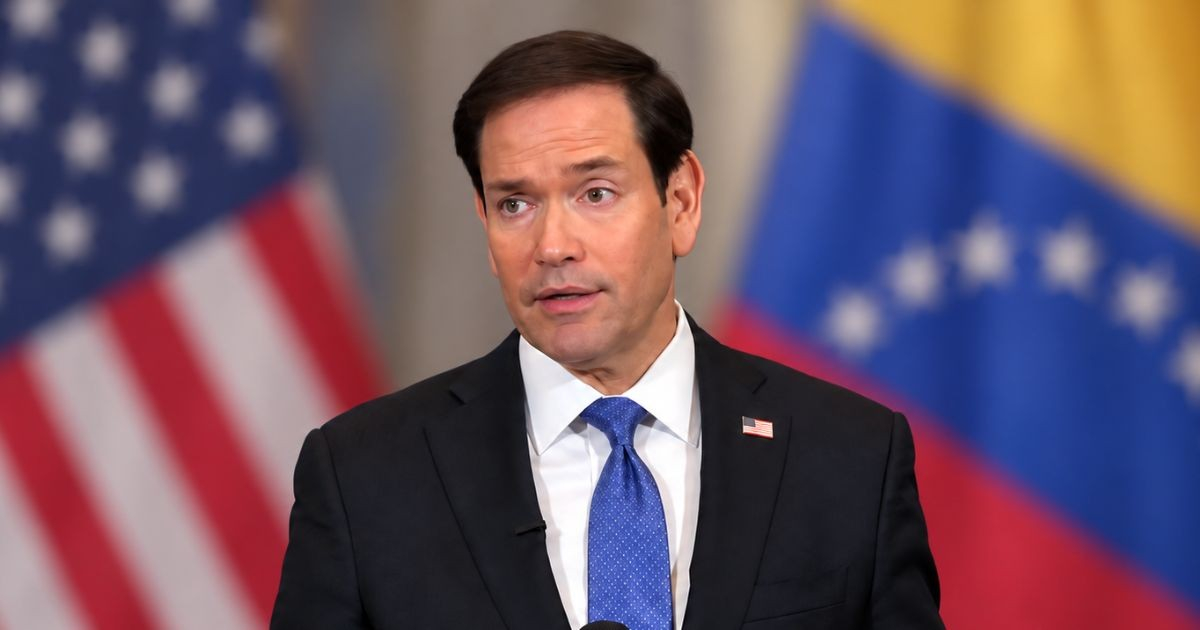
The U.S. Secretary of State, Marco Rubio, stated this Monday that Venezuela's electoral infrastructure was designed by Nicolás Maduro's government to rig elections and warned that it must be replaced before the country can hold a legitimate new vote.
Her statements come amid negotiations between the interim government of Delcy Rodríguez and opposition sectors to reform Venezuelan institutions.
Rubio made the statements during a phone conversation with journalists, according to the report by Reuters, one day after the return to Venezuela of opposition leader María Corina Machado.
The head of American diplomacy asserted that the electoral system inherited from chavismo does not provide the necessary guarantees for holding credible elections and that its transformation must occur swiftly.
Washington's position is not limited to changing the electoral authorities. It also includes the renewal of the Supreme Court of Justice (TSJ), which is considered one of the fundamental bodies to ensure that future results are not annulled or altered through judicial decisions.
According to Reuters, a senior official from the State Department explained that the United States hopes that the current discussions will lead to the establishment of a new Supreme Court before the end of 2026 and a renewed National Electoral Council shortly thereafter.
"I believe we are making real progress in that regard. But if anyone tries to derail the process, they will be causing great harm to Venezuela," stated the Secretary of State.
The official did not set a specific date for the presidential elections, despite insisting that the institutional renewal must take place swiftly.
The Trump administration is, however, managing a roadmap that includes the departure of Delcy Rodríguez from the acting presidency by 2027.
According to the agency EFE, the U.S. government believes that, once the Supreme Court and the National Electoral Council are renewed, Rodríguez should declare the absolute vacancy of the Presidency.
According to the U.S. official, that statement would open a six-month period to hold elections. However, Article 233 of the Venezuelan Constitution establishes a 30-day timeline to elect a president when a vacancy occurs during the first four years of the term.
"Once those two things are established, the new TSJ at the end of this year, and the new CNE (National Electoral Council) shortly thereafter, and that work has already begun, then Rodríguez should declare a permanent vacancy in the presidency," the official stated, according to the Spanish agency.
The proposal suggests that the elections would not be called immediately, but rather after modifying the institutions responsible for organizing, overseeing, and resolving conflicts related to the process.
Washington believes that this sequence would allow for elections whose results are accepted by both the winners and the losers.
The objective was explained by the U.S. official: "Our goal is to achieve elections in which, once held, the losing party acknowledges that the process was fair."
The roadmap represents an expectation from the Trump administration and does not yet equate to a formal decision by the Venezuelan authorities to declare the presidency vacant.
No definitive date has been set for the renewal of the National Electoral Council (CNE) or for the holding of the elections.
This Monday, the Secretary of State provided new details on the efforts made by Washington with the Venezuelan interim authorities.
According to statements gathered by EFE, Rubio confirmed that the United States had informed Rodríguez's government weeks ago that Machado should be able to return to his country without facing any obstacles.
Venezuelan authorities responded that the opposition leader could enter, even through an airport, and Washington relayed that information to its team.
"We told them, 'Look, our expectation is that she is Venezuelan. She belongs to her country. It is the country she comes from. She should be allowed to return,'" Rubio explained.
Rubio stated that the U.S. administration was not behind the obstacles that Machado faced in his previous attempts and attributed them to decisions made by third countries.
He also stated that, according to the information available to Washington, the leader had been able to return and move around Venezuela without incident.
His return, however, does not mean that he is formally participating in the ongoing political negotiations.
Reuters reported that the Vente Venezuela movement, led by Machado, is not part of the negotiation table supported by Washington, despite the role that the leader has played in the opposition to Maduro.
The situation has led to disagreements regarding who should participate in defining the electoral calendar and in the institutional reorganization of the country.
Machado has advocated for the need to move towards elections in 2027, while the Trump administration insists that there must first be institutional conditions that allow for a valid vote.
The process unfolds after U.S. forces captured Nicolás Maduro during a military operation on January 3, 2026, and transported him to the United States to face drug trafficking charges.
Following the capture, Delcy Rodríguez, who had held the Vice Presidency, took the helm of the Venezuelan government and initiated a phase of cooperation and negotiations with Washington.
The political conversations involve the interim Executive and representatives from opposing sectors, including the delegation associated with the National Assembly elected in 2015, led by Dinorah Figuera.
In that context, the U.S. government expects Delcy Rodríguez to step down from the presidency in 2027, once the institutional reforms deemed essential to call for new elections are completed.
The proposal comes at a time when opposition sectors have called for a faster transition and guarantees of participation for all political forces.
The situation took on a new dimension on Sunday with the return of María Corina Machado to Venezuela, after being away from her country for nearly ten months.
The opposition leader announced her return with a message on social media: "I am here. With you".
Machado had secretly left Venezuela in December 2025 to travel to Norway to receive the Nobel Peace Prize.
During the following months, he attempted to return several times, but faced difficulties related to flight routes and entry authorizations.
Upon his arrival, Rubio attributed Machado's return to the politically reconciliatory conversations supported by the United States and argued that the process represents an opportunity to move towards free elections.
The opposition figure has also expressed her willingness to engage in dialogue with the current authorities. This Monday, her party confirmed that she would be willing to meet with Delcy Rodríguez, as long as the discussions allow for progress towards concrete agreements for Venezuela's political future.
The acting president publicly responded to the leader's return with criticisms of her media presence.
Rodríguez described Machado's arrival as a "show" and criticized her previous support for international sanctions and U.S. intervention.
Related videos:
Filed under: