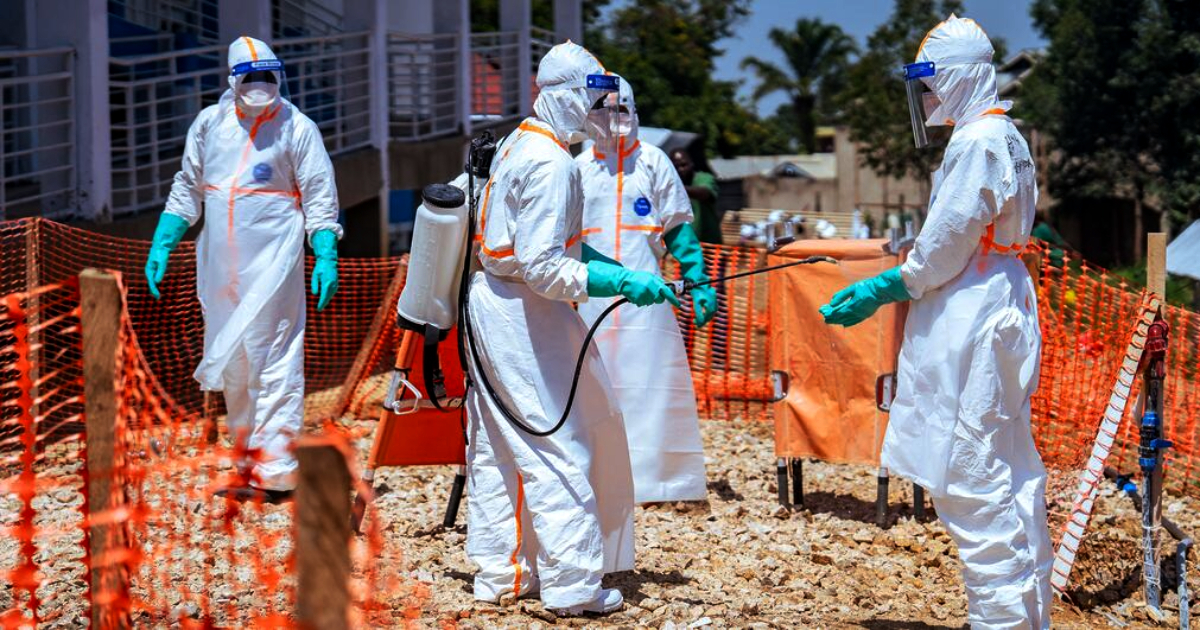
The Ebola epidemic affecting the Democratic Republic of the Congo (DRC) since mid-May has crossed a critical barrier this Tuesday: 10,060 confirmed cases and 4,887 deaths, according to the most recent report from the National Institute of Public Health (INSP) of the country, with data collected until October 25 and reported by EFE.
The fatality rate stands at 48.6%, which means that nearly half of those who contract the disease die. Only 2,684 people have managed to recover so far, and the contact tracing rate reaches 81.6%.
The outbreak, officially declared on May 15 and caused by the Bundibugyo strain of the virus, has become the second deadliest and most contagious in global history, already surpassing the one recorded in the same Congolese region between 2018 and 2020, which left 3,481 cases and 2,299 deaths.
The eastern provinces of Ituri and North Kivu account for the majority of active transmission, with 32 and 58 new cases respectively in the 24 hours prior to the report. According to the INSP, "transmission remains particularly pronounced in the health zones of Beni (35 cases), Mandima (11 cases), and Bunia (8 cases)."
In total, the epidemic spreads across 66 health zones distributed in eight of the 26 provinces of the country: Ituri, North Kivu, Tshopo, Bas-Uélé, Haut-Uélé, South Kivu, South Ubangi, and North Ubangi.
A concerning statistic for experts is that nearly six out of ten deceased individuals died outside of healthcare facilities, highlighting late detection and serious difficulties in accessing medical care.
The Bundibugyo strain lacks approved specific treatments. The World Health Organization (WHO) is working on two vaccines that have entered phase 1 trials in humans and have so far shown to be safe, although their development could take several months.
At the end of August, the DRC launched an immunization campaign with the Ervebo vaccine—the only one available on a large scale, designed for the Zaire variant—which has shown positive indications against Bundibugyo in animals but lacks confirmation in humans.
The outbreak has also spread beyond Congolese borders. Uganda declared the end of its own outbreak on August 26, after 20 infections and two deaths. Kenya and Nigeria have also reported cases linked to the outbreak in the DRC.
The WHO assesses the risk as "very high" for Congo, "high" for neighboring countries, and "low" on a global scale, not classifying it as a pandemic emergency, although it did declare it a Public Health Emergency of International Concern on May 16.
In response to the outbreak's expansion, the United States will require, starting November 3, a health declaration from all passengers on international flights —including those from Cuba— certifying that they have not been in the DRC in the 21 days prior to boarding. This measure will remain in effect until December 18, 2026.
The only outbreak that surpasses the current one in magnitude remains the West Africa epidemic between 2014 and 2016, which resulted in approximately 11,000 deaths and 28,000 infections in Guinea, Liberia, and Sierra Leone, and triggered an unprecedented international response.
The Congolese INSP warned that "the situation underscores the need to strengthen early detection, contact tracing, dignified and safe burials, and the safety of response teams."
Related videos:
Filed under: