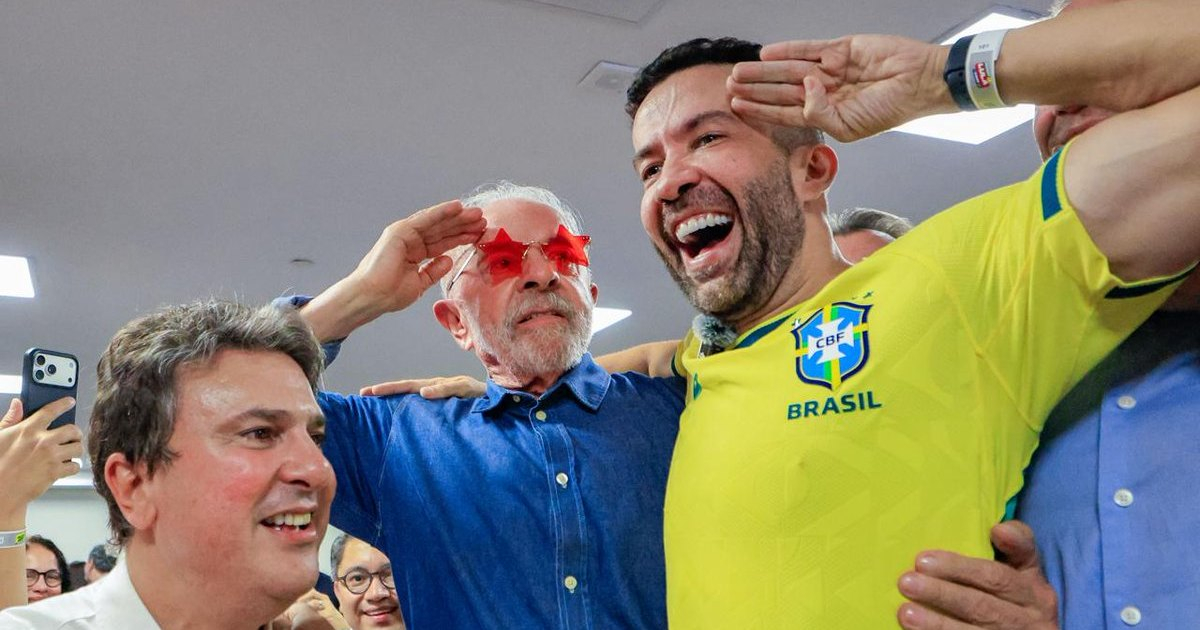
The outcome of the presidential runoff in Brazil, where Luiz Inácio Lula da Silva secured victory with 51.78% of valid votes against Flávio Bolsonaro's 48.22%, according to the report from the Superior Electoral Tribunal (TSE), could represent a breath of fresh air for the Cuban regime amid its economic-social collapse and growing international isolation. However, the actual impact of this victory will depend on how willing Brasilia is to bear the diplomatic and financial costs associated with a rapprochement with Havana.
During the election campaign, the elected Brazilian president only mentioned Cuba to distance himself and neutralize attacks, cautiously clarifying that no one in Brazil sought to replicate the model of the Island. In the televised debates, the topic was avoided, perhaps as a strategy to not polarize the centrist electorate or to avoid losing voters in a closely contested race, or as evidence that the closeness to the Island does not represent a political priority for the Workers' Party.
A possible rapprochement between Brasilia and Cuba would involve determining how to address the debt that Havana has accumulated, which is close to 676 million dollars for the loans granted for the construction of the Port of Mariel, according to records from the Brazilian National Bank for Economic and Social Development (BNDES). If both countries were to reactivate lines of credit or technical cooperation, the regime would need to provide real payment guarantees, which is challenging given the bankruptcy that the Island is experiencing and its usual practice of owing many while not paying anyone.
If there were a specific interest from Brasília in approaching Havana, it would be based on strictly pragmatic calculations. Economically, it would involve keeping trade channels open for Brazilian agribusiness exports and attempting to recover, through restructuring agreements or preferential supplies, at least a fraction of the unpaid debts that the regime has accumulated.
In political terms, the rapprochement would allow Lula to strengthen cohesion among the most loyal bases and sectors of his own party, while also reinforcing his ambition to position himself as a leader and interlocutor in multilateral forums in the region.
In the field of health, the question remains whether the recruitment of professionals under schemes similar to the Mais Médicos program, a crucial source of foreign currency that Havana lost in previous years, would be resumed. Although a reactivation of agreements in this sector would provide urgent revenue to the Cuban state coffers, any initiative in that direction would face severe legislative and ethical scrutiny in Brazil regarding the rights of professionals and salary retention, repeatedly denounced as human trafficking.
Finally, the biggest dilemma for Brasilia lies in the hemispheric scenario and its relationship with Washington. In a context where the United States maintains and intensifies its sanctions regime against Havana, it is worth asking what diplomatic maneuvering space Brazil would have. While Brazilian diplomacy might uphold its traditional rhetorical condemnation of the embargo in multilateral forums, it is unlikely that it would risk its commercial, energy, and strategic interests under pressure from the White House concerning the Island.
It will be necessary to observe how Lula's foreign pragmatism evolves in response to the Cuban crisis. As long as these conditions remain unresolved, the expectation of a Brazilian lifeline will continue to be a tentative hypothesis that Havana will attempt to leverage for propaganda and political maneuvering, even as reality suggests caution and restraint from Lula.
Beyond the strict bilateral sphere, Lula's presence in the Palácio do Planalto could strengthen regional populist propaganda and opposition to the United States. In a continent marked by democratic fatigue, the Cuban regime will attempt to capitalize on the figure of the PT leader to legitimize its narrative of resistance and rearticulate consensus platforms such as CELAC or the São Paulo Forum.
For the Castro regime, having the support of the largest South American power would serve as a useful political shield to deflect accusations of human rights violations and revive the narrative that its crisis is solely due to the American embargo, and of course, it would provide a source of income through donations or trade.
Lula's potential maneuvers to exercise regional leadership will not be easy given the heterogeneous Latin American landscape, where right and center-right leaderships exert significant influence, such as Javier Milei in Argentina, Santiago Peña in Paraguay, or Daniel Noboa in Ecuador. We will see whether the Brazilian leader opts for open ideological confrontation, which could affect integration blocs or harm intraregional trade, or takes a stance of pragmatic balance: maintaining a rhetoric of fraternity towards traditional leftists while not neglecting the essential commercial agreements within forums like Mercosur. In this power dynamic, the political oxygen that Cuba receives would serve more to sustain its external propaganda machinery than to alter a regional dynamic where economic interests tend to prevail over ideological affinities.
This scenario is further complicated by Brazil's macroeconomic situation. While the Brazilian Institute of Geography and Statistics (IBGE) has reported historically low unemployment and dynamism in agro-export production, the president takes office with a narrow margin for maneuver. According to reports from the Central Bank of Brazil (BCB), the general gross public debt hovers around 78% of the Gross Domestic Product (GDP) with a persistent fiscal deficit, while inflation forces the maintenance of the Selic rate at double-digit levels to control prices.
In the domestic sphere, reports from the National Confederation of Commerce (CNC) indicate that family debt exceeds 78%, which compels a prioritization of the internal social budget, such as the Bolsa Família programs, over any economic "adventure" abroad. With these budgetary constraints and under market scrutiny, Lula lacks the financial breathing room necessary to become the economic benefactor that the dictatorship in Havana longs for as a lifeline.
Related videos:
Filed under:
Opinion article: Las declaraciones y opiniones expresadas en este artículo son de exclusiva responsabilidad de su autor y no representan necesariamente el punto de vista de CiberCuba.