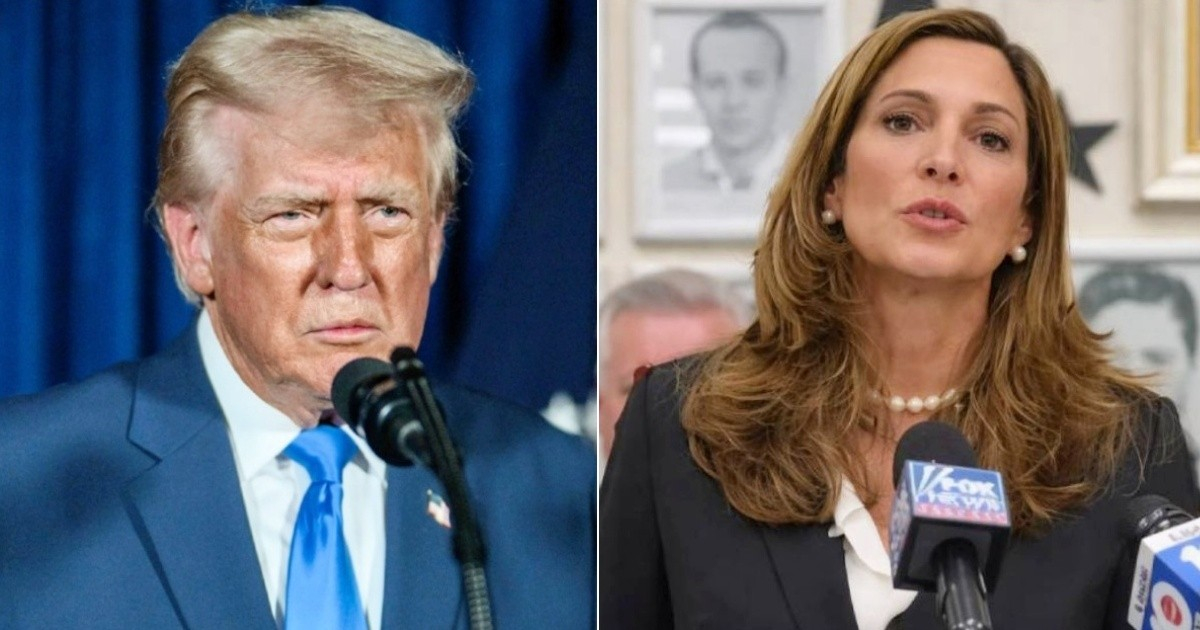
An automated call (robocall) funded by Battleground Alliance, a Democratic political action committee (super PAC), accuses Cuban-American congresswoman María Elvira Salazar of having voted in favor of everything Donald Trump wanted regarding immigration.
PolitiFact, an American media outlet specialized in fact-checking public claims, examined the call and concluded that it is “largely accurate” regarding Salazar's immigration history, although it omits important information about his stance on the use of body cameras by immigration agents.
The message, disseminated in English and aimed at voters in Florida's District 27, which includes areas of Miami, is part of the campaign leading up to the legislative elections on November 3, where Salazar is facing the Democratic journalist Eliott Rodríguez.
The statement claims that María Elvira Salazar supported the following: "Eighty-three billion dollars for ICE, for 10,000 new agents, for new detention centers, to arrest grandmothers, children, and people just trying to work. She visited Alligator Alcatraz and said that the cages were 'clean.' She voted against allowing ICE agents to take off their masks and wear body cameras."
The verification, conducted by journalist María Briceño, examined the budget figures, Salazar's statements about the Alligator Alcatraz detention center, and his voting record in Congress.
Where do the 83 billion dollars for ICE come from?
PolitiFact confirmed that Salazar supported two laws that allocated billions of additional dollars to the Immigration and Customs Enforcement (ICE).
The congresswoman voted in favor of H.R. 1, known as One Big Beautiful Bill, enacted by Trump in July 2025. This legislation allocated around 75 billion dollars to ICE, including 45 billion for immigrant detention centers and nearly 30 billion to hire new agents.
The Department of Homeland Security (DHS) explained that these resources would allow for the hiring of 10,000 new ICE agents and the expansion of detention capacity.
In June 2026, Salazar also supported the Secure America Act, which allocated an additional $38.5 billion to the agency.
Battleground Alliance explained to PolitiFact that it calculated the 83 billion mentioned in the call by adding the 45 billion allocated for detention centers in the first law and the 38.5 billion from the second.
Therefore, the figure of 83 billion is correct as the sum of those two specific items, but it does not represent the total funds approved for ICE through both laws.
Do the funds support the arrest of the elderly, children, and workers?
The call links the funding approved by Salazar to the arrests and deportations under the Trump administration, including the arrests of elderly individuals, minors, and people at their workplaces.
PolitiFact reminds us that the Trump administration has maintained that anyone who stays illegally in the United States may be subject to deportation. It also notes that various media outlets have documented the detention of elderly individuals, children, and workers during immigration operations.
Salazar's vote helped provide resources to expand ICE's operational and detention capacity, although it did not constitute an individual authorization for the arrests mentioned in the electoral message.
Alligator Alcatraz: Did Salazar say the cages were clean?
Yes. PolitiFact confirmed that Salazar described the facilities of Alligator Alcatraz as clean after visiting the immigrant detention center in South Florida in July 2025.
In an interview with CBS News, the congresswoman stated: "It's a jail, people are in cages, I sat on the beds, they are clean, they are soft... It was clean and very well presented. I'm talking about the areas I visited."
Salazar also stated that the facilities met the highest applicable standards for federal detention centers of that kind.
In another interview, with Fox & Friends, he explicitly stated that "the cages were clean," a statement that Battleground Alliance used to support its accusation.
However, the conditions of the center were questioned by journalistic investigations and monitoring organizations.
Additionally, a report from the Office of Inspector General of the Department of Homeland Security, published in September 2026, found that the facilities did not meet federal standards related to health and environmental safety, medical care, nutrition, and personal hygiene.
The document also described the confinement of some detainees in small metal enclosures. These findings contrast with the positive assessment that Salazar had expressed following his visit, although they correspond to a subsequent evaluation.
In September, a woman from South Florida, whose father had been detained in Alligator Alcatraz, publicly confronted the congresswoman for her support of the facilities.
Salazar responded to NBC that the woman had previously rejected the assistance offered for her father's case, and described the confrontation as a "coordinated political effort with a clear agenda."
Body cameras and masks: what did Salazar really vote for?
This is the point at which PolitiFact identifies the main omission of context in the message from Battleground Alliance.
The call claims that Salazar "voted against having ICE agents remove their masks and wear body cameras."
However, the congresswoman did not vote directly against a separate bill aimed at banning masks or requiring body cameras.
What he rejected was a motion presented by the Democrats to return a legislative project to committee.
The proposal included demands for ICE agents to wear body cameras, remove their masks, display their identification, and have a warrant to arrest immigrants.
A motion to postpone allows a bill to be sent back to committee, sometimes with instructions to make amendments before its final approval.
Therefore, Salazar voted against a motion that included those demands, but that vote does not exactly equate to rejecting an independent law on the use of masks or body cameras.
In addition, in April 2026, Salazar voted in favor of the final version of legislation that became law and allocated 20 million dollars for body cameras for immigration agents.
That rule, however, did not prohibit the use of masks during the operations.
The statement is based, therefore, on a real vote, but it omits that Salazar also supported funding for body cameras. His legislative record does not allow for the assertion that he generally opposed that mechanism of oversight.
Salazar's votes and his public statements on immigration
The controversy arises as the campaign comes to a close, pitting Salazar against Democratic journalist Eliott Rodríguez in Florida's District 27.
The message from Battleground Alliance contrasts Salazar's legislative support for measures that enhance ICE's detention and deportation capabilities with his public statements in favor of immigration reform.
In July 2025, the congresswoman presented the Dignity Act, an initiative that includes mechanisms for the regularization of immigrants without criminal records who meet certain requirements.
In September 2026, she recorded a video in front of the White House in which she accused Trump of having gone "too far" with deportations.
Related videos:
Filed under: