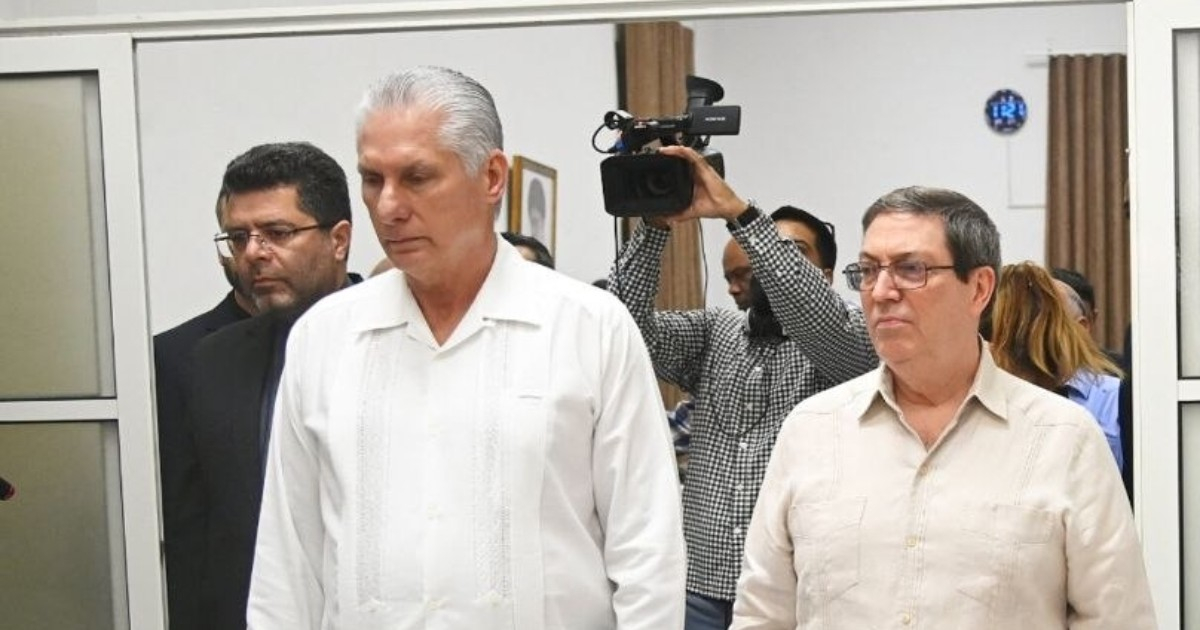
Miguel Díaz-Canel celebrated this Tuesday on Facebook what he described as a majority support from the international community for Cuba during the debate at the UN General Assembly regarding the American embargo, overlooking the embarrassing episode involving Foreign Minister Bruno Rodríguez Parrilla in the same setting.
"Today at the UN, the majority support of the international community for Cuba was evident in condemning the blockade and the US government's policy of maximum strangulation," said Díaz-Canel. The leader asserted that the US representative was left "in obvious isolation."
What Díaz-Canel omitted in his message was the incident involving his own chancellor during the debate: Rodríguez interrupted the speech of the U.S. ambassador Mike Waltz, approached the podium along with other members of the Cuban delegation, presented at least three points of order that were rejected, and provoked a suspension of the session ordered by the President of the General Assembly, Khalilur Rahman.
Rodríguez labeled Waltz's intervention as a "media circus" and shared a video of the altercation on X, presenting it as a response to American "lies", although international outlets such as EFE, Bloomberg Línea, and La Nación described the episode as a chaotic and unusually confrontational exchange.
Waltz, for his part, denied that there is a blockade in the strict sense, arguing that it would imply "a ring of military ships around an island," and urged member states to reject the Cuban resolution, warning that voting in favor would amount to contributing to the "mistreatment of the Cuban people."
Díaz-Canel, without mentioning the incident, concluded his post with the phrase "Cuba is not a threat, the blockade is," accusing Washington of maintaining a "criminal energy blockade" against the island and pressuring sovereign nations to change their stance.
The reaction of Cubans in the comments on that same post was largely sarcastic and critical. "So the problem is over, tomorrow we have a new Cuba," wrote a user with irony.
Others were more direct: "Stop killing your people [...] you eat meat while your people eat tortillas with oil," one commentator claimed, while a third demanded "free elections for Cuba."
This is the 34th time that Cuba has presented the resolution calling for an end to the embargo before the UN, since it began doing so in 1992, and international support has shown a declining trend: from 187 votes in favor in 2024, it fell to 165 in 2025, the lowest level since 1999, with seven votes against and 12 abstentions.
Related videos:
Filed under: