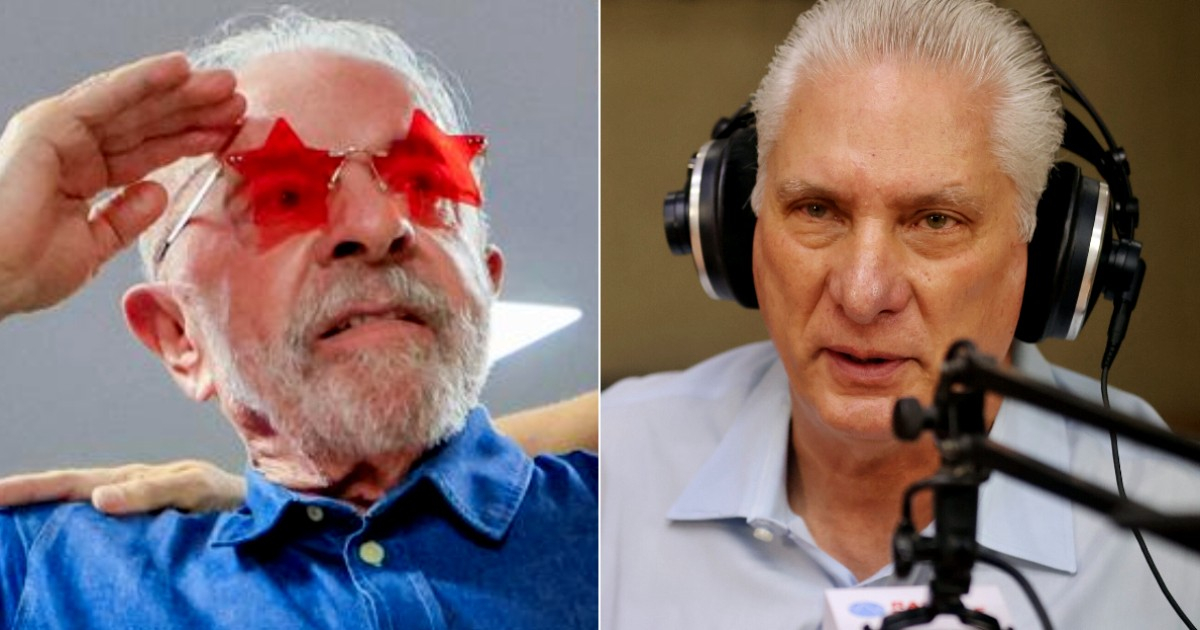
Miguel Díaz-Canel congratulated Luiz Inácio Lula da Silva this Monday for his victory in the second round of the presidential elections in Brazil, held on Sunday, in a message that reflects both the relief of the Cuban regime and the fragility of its regional alliances.
Lula won the runoff with 51.79% of the votes compared to 48.21% for Flávio Bolsonaro, according to the Superior Electoral Tribunal with 100% of the ballots counted, marking an unprecedented comeback after finishing second in the first round on October 4.
Díaz-Canel published two messages on the social network X, addressing the elected president as "dear brother" and asserting that the victory "ensures the continuation of the path of peace, sovereignty, and social justice undertaken by the Brazilian people under your leadership."
In a second message, he added: "Can #Brazil count on #Cuba in the construction of the unity and integration of our Greater Homeland, Latin American and Caribbean?"
The warmth of the greeting contrasts with the reality of a bilateral relationship laden with tensions and unresolved debts.
Cuba owes 676 million dollars to Brazil related to loans from the National Bank for Economic and Social Development (BNDES) for the construction of the Port of Mariel, carried out by the construction company Odebrecht —investigated in the Lava Jato scandal— with payments suspended since May 2018 and which the Brazilian government itself acknowledged in May 2026 that it does not expect to recover.
The Lula who will assume his fourth term on January 5, 2027 is not the unconditional ally of the times of Fidel and Raúl Castro.
In 2024, ahead of the Venezuelan elections, Lula refused to acknowledge Maduro's victory due to a lack of verifiable evidence and described the Venezuelan regime as "very unpleasant" and with an "authoritarian bias," statements that implicitly question the legitimacy of regimes like the Cuban one.
The regional isolation of Havana has intensified rapidly. Argentina voted against Cuba at the UN regarding the resolution on the US embargo, Ecuador abstained, and Bolivia exited ALBA following the electoral defeat of socialism, all within the past year.
This diplomatic erosion is compounded by an unprecedented energy crisis.
Venezuela interrupted its oil deliveries to Cuba in November 2025, Russia in October of that same year, and Mexico in January 2026. Cuba produces only about 40,000 barrels daily of the 90,000 to 110,000 needed, and in April 2026, only one fuel tanker arrived out of the eight needed each month, with blackouts exceeding 30 consecutive hours.
In this context, Brazil has become one of the few regional governments that still maintains ties with Havana: in 2026 it sent around 20,800 tons of food, donated medications for approximately 1,000 patients, and transported 48 tons of powdered milk to Santiago de Cuba.
However, the new BNDES law enacted in March 2026 restricts loans to countries that are in default, which closes the door to new loans for Cuba and makes humanitarian assistance the only real channel of the bilateral relationship.
Flávio Bolsonaro rejected the outcome of the runoff election and announced that he would seek to challenge the results, adding uncertainty to the Brazilian political landscape ahead of Lula's inauguration in January 2027.
Related videos:
Filed under: