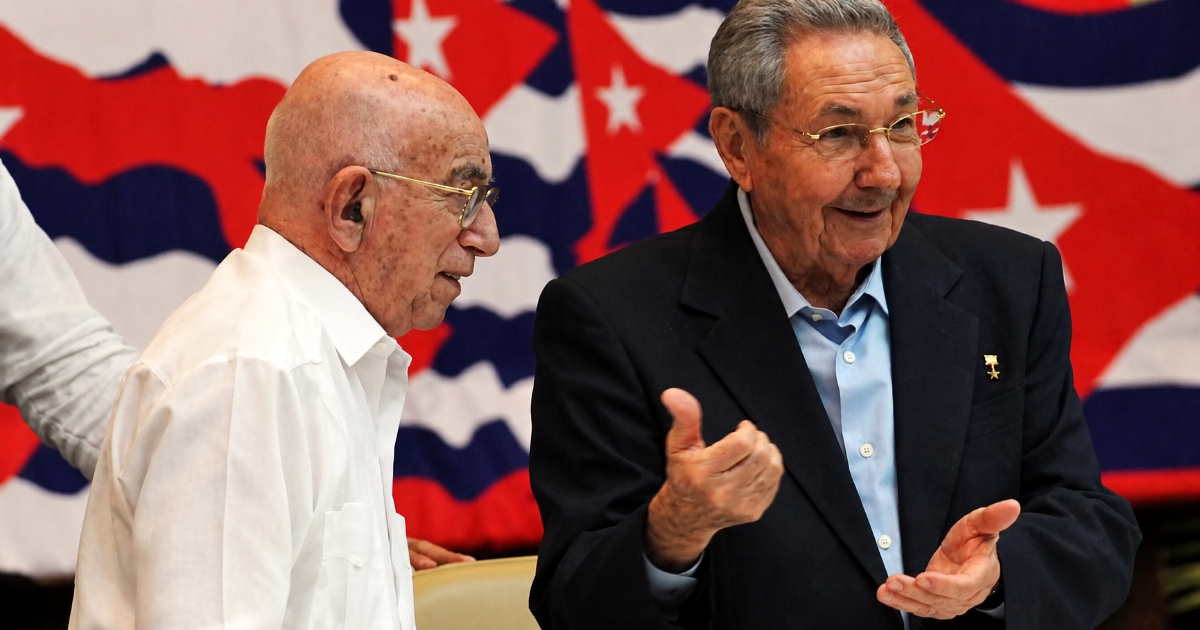
The Cuban leader Miguel Díaz-Canel congratulated José Ramón Machado Ventura on his 96th birthday this Monday, stating that the veteran leader remains "active in the forefront," a phrase that highlights the government's effort to portray the last survivors of the historic generation as key figures in the country's political life.
"To the heroic Commander of the Revolution, to the medical minister of founding times, to the tireless and exemplary trainer of party cadres, to the beloved comrade José Ramón Machado Ventura, congratulations on your 96th birthday, which once again finds you active at the forefront," wrote Díaz-Canel on Facebook.
The congratulation transcends personal homage. It is part of an official narrative that insists on presenting the so-called "continuity" as the legitimate heir of the founders of the regime, whose historical authority continues to be invoked to support a leadership that did not participate in the guerrilla struggle and governs a Cuba that is profoundly different from the one those founders promised to build.
The paradox becomes increasingly evident: as the protagonists of the so-called “Cuban Revolution” disappear, their successors need to symbolically keep them in the forefront, as if their definitive withdrawal threatens to weaken the political foundations of the system.
The formula used with Machado Ventura inevitably recalls that of the "foot in the stirrup", with which Raúl Castro himself and official propaganda insist on portraying the former leader, now 95 years old, as a fighter still willing to take action.
In both cases, the message is similar: the historical figures age, abandon responsibilities, and physically disappear, but the governmental rhetoric refuses to acknowledge that their political time is also coming to an end.
Machado Ventura: the man who built continuity
Machado Ventura's trajectory helps to understand why his figure continues to be upheld by the regime.
Born on October 26, 1930, in San Antonio de las Vueltas, now in Villa Clara province, he studied Medicine, became involved with the July 26 Movement, and participated in the Second Eastern Front Frank País, under the command of Raúl Castro.
After the revolutionary triumph, he took on health responsibilities and served as Minister of Public Health from 1960 to 1968. However, his true political influence was solidified later within the Communist Party of Cuba (PCC).
Member of the Central Committee since its creation in 1965 and of the Political Bureau since 1975, he developed for decades responsibilities related to party organization, internal discipline, and personnel policy.
Its role was largely to help shape and select those who would assume the main responsibilities of the State and the Government, according to the political criteria of the PCC.
Machado Ventura was, in this sense, one of the architects of the reproduction of Castroite power: a leader less visible than Fidel or Raúl Castro, but crucial in building the apparatus responsible for preserving the ideological loyalty of successive generations of officials.
His loyalty to Raúl was evident in February 2008, when he was appointed first vice president of the Councils of State and Ministers, becoming his immediate institutional successor.
The appointment shifted the promotion expectations of younger leaders, such as Carlos Lage, and demonstrated that the historical leadership continued to prioritize personal and political trust during the succession process.
In 2011, Machado Ventura assumed the second secretariat of the PCC, a position he held until April 2021. He participated in preparing a generational transition meant not to replace the foundations of the system, but to ensure its continuity.
The very idea of continuity is one of the most important political legacies of his career.
A successor that still needs the blessing of its founders
Raúl Castro stepped down from the presidency in 2018 and from the first secretary position of the PCC in 2021, formally handing over leadership to Díaz-Canel. Machado Ventura also relinquished his primary party responsibilities at that time.
However, five years later, both continue to be used as leading references of authority in official communication.
The case of Raúl is particularly illustrative.
Upon stepping down from the leadership of the Party in April 2021, he assured that, for as long as he lived, he would be ready, “with one foot in the stirrup,” to defend the revolution and socialism.
That metaphor ultimately became a recurring slogan of the propaganda apparatus.
In May 2026, during a mobilization in support of Castro, Díaz-Canel was even more explicit: «Continue with your foot in the stirrup. Command!».
The phrase contains a political contradiction that is hard to overlook: the man who formally holds the highest responsibility of the Party and the State continues to address his predecessor as a higher authority, publicly inviting him to give orders.
In September, following new false rumors about his death, the regime once again utilized the image of the "foot in the stirrup," presenting Raúl Castro's reappearance as a demonstration of political strength.
The campaigns «Raúl is Raúl» and «And he's still here» reinforced the same idea: the mere physical presence of the former leader became a propagandistic event.
It's not just about honoring those who founded the system. The reiteration of these messages reveals to what extent the current leadership continues to use them as a source of political legitimacy.
Díaz-Canel holds the main institutional positions, but his authority is constantly presented as a continuation of the will of Fidel and Raúl Castro, rather than as the result of his own political project.
The celebration of Machado Ventura's 96th birthday exemplifies this mechanism: a leader retired from primary responsibilities continues to be described as someone "active at the forefront," even though his public participation is increasingly limited.
The old guard against protests and the crisis
The presence of the historical figures has not been solely ceremonial.
During the protests on July 11, 2021, when thousands of Cubans took to the streets to demand freedoms and political change, the regime once again relied on its veteran leaders.
Raúl Castro participated in meetings of the Political Bureau, Ramiro Valdés traveled to Palma Soriano and Machado Ventura traveled to Villa Clara, where he called to "strengthen revolutionary vigilance in workplaces and demonstrate the firmness of the Revolution".
The mobilization demonstrated that, in the face of a significant political crisis, Díaz-Canel's leadership continued to rely on figures associated with traditional mechanisms of power control.
Machado Ventura also led tours for years through cooperatives, sugar mills, and agricultural operations, advocating for increased productivity and greater labor discipline.
In 2019, due to fuel shortages, he recommended turning to oxen teams, even in areas where tractors were available. In 2021, he called for expanding the cultivation of medicinal plants to alleviate the shortage of medications.
Those exhortations contrasted with the structural problems of a centralized economy that the leader himself had defended for decades.
In January 2025, Machado Ventura stated that he had never been concerned about how much he earned and that he personally had no material problems.
His statements contrasted with the economic hardships faced by millions of Cubans and with the image of sacrifice that official media typically attribute to the historical leaders.
A generation that is fading away and a power that refuses to let it go
The death of Ramiro Valdés Menéndez on June 21, 2026, at the age of 94, marked another stage in the disappearance of the generation that participated in the power takeover and the establishment of the Cuban communist state.
Founder of the intelligence and security services of the regime, former Minister of the Interior and Deputy Prime Minister until his death, Valdés had been connected to government responsibilities for over six decades.
In May, CiberCuba identified four nonagenarian survivors of the historical generation: Raúl Castro, Machado Ventura, Ramiro Valdés, and Guillermo García Frías.
After Valdés's death, three of those figures remain: Raúl Castro, 95 years old; Machado Ventura, 96; and Guillermo García Frías, 98.
Raúl continues to be officially presented as the "leader at the forefront of the Revolution," despite having stepped back from his main institutional responsibilities. García Frías maintains his connection with the Flora and Fauna Business Group, while Machado Ventura continues to receive honors for his party career.
The contrast between her advanced age and the official discourse of a constant readiness for combat is particularly significant in a country where generational succession has been presented as a guarantee of political stability.
The new leadership has its own personnel, institutions, and control mechanisms, but continues to insist on a legitimacy inherited from the fighters of the Sierra Maestra.
That symbolic dependency presents a contradiction: “continuity” aims to demonstrate that the regime can survive its founders, but it still needs to showcase them as if they were still essential.
Political power, concentrated for decades in Fidel and Raúl Castro and their historical inner circle, has been formally transferred to a subsequent generation. However, the government's rhetoric continues to subordinate the authority of the new leaders to the legacy of their predecessors.
The persistence of that narrative also reflects a difficulty in justifying the continuation of the system based on its current results, in a country marked by economic crisis, power outages, the deterioration of public services, and massive emigration.
While the historical leaders are remembered as key figures in the revolutionary conquests, the responsibilities for the deterioration that accumulated during their long periods in power rarely feature in official tributes.
Machado Ventura, one of the men who helped select and train the generations destined to succeed the Castros, precisely represents that continuity between the power of the founders and that of their heirs.
At 96 years old, Díaz-Canel congratulates him for remaining "active in the forefront," just as he insists on presenting Raúl Castro, 95, eternally ready for a new challenge, "with one foot in the stirrup."
But time imposes a limit that no slogan can alter. The men who built the regime are fading away, while their successors continue to seek in them the authority they need to justify their own permanence in power.
Related videos:
Filed under: